
PUBLISHER: Global Market Insights Inc. | PRODUCT CODE: 1982293

PUBLISHER: Global Market Insights Inc. | PRODUCT CODE: 1982293
Vehicle Roadside Assistance Market Opportunity, Growth Drivers, Industry Trend Analysis, and Forecast 2026 - 2035
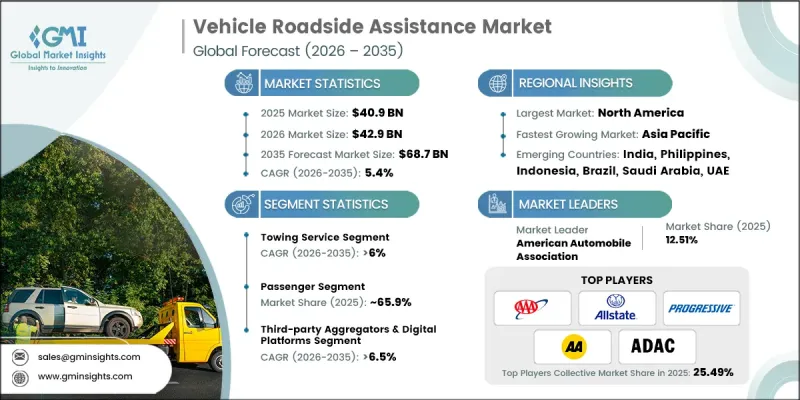
The Global Vehicle Roadside Assistance Market was valued at USD 40.9 billion in 2025 and is estimated to grow at a CAGR of 5.4% to reach USD 68.7 billion by 2035.
The vehicle roadside assistance (VRA) industry is undergoing significant evolution as global vehicle ownership rises, traffic congestion intensifies, and modern vehicles become more technologically advanced. Roadside assistance is no longer limited to basic breakdown towing; it now operates as a comprehensive mobility support network designed to ensure driver safety, minimize vehicle downtime, and maintain service continuity. Growing expectations for reliability and convenience are positioning roadside assistance as an essential component of insurance packages, OEM warranty programs, fleet management solutions, and subscription-based mobility services. Increasing integration of connected vehicle technologies and digital platforms is reshaping how assistance is delivered. As vehicle systems become more complex, professional roadside support services are becoming indispensable to both individual drivers and commercial fleet operators, supporting long-term market expansion across developed and emerging economies.
| Market Scope | |
|---|---|
| Start Year | 2025 |
| Forecast Year | 2026-2035 |
| Start Value | $40.9 Billion |
| Forecast Value | $68.7 Billion |
| CAGR | 5.4% |
Modern vehicle roadside assistance platforms are technology-driven and multi-functional. Services such as towing, battery support, tire replacement, fuel delivery, lockout assistance, and minor mechanical repairs are now supported by GPS-enabled dispatch tools, telematics connectivity, predictive diagnostics, and mobile applications. Providers are improving response times, streamlining digital claims processing, and enabling real-time vehicle tracking to enhance operational efficiency and customer satisfaction. Collaboration among insurers, automotive manufacturers, telematics firms, independent service providers, and digital mobility platforms is intensifying. Subscription-based coverage models, insurance add-ons, usage-based services, and app-enabled on-demand solutions are redefining revenue models and service accessibility within the vehicle roadside assistance market.
The towing services segment accounted for 33% share in 2025 and is projected to grow at a CAGR of 6% through 2035. Towing remains the most frequently requested roadside service among vehicle owners and fleet managers. Demand spans across personal and commercial vehicles, addressing breakdown recovery, accident response, and long-distance transport needs across urban and highway networks. The essential nature of towing services continues to anchor its dominant position within the industry.
The passenger vehicle segment held 65.9% share in 2025 and is anticipated to grow at a CAGR of 4.2% between 2026 and 2035. High levels of private vehicle ownership, expanding urban populations, and increased dependence on fast and reliable emergency assistance services are driving this segment's growth. Passenger vehicles generate substantial demand for a wide range of roadside support services. The adoption of digital platforms and connected vehicle systems enables quicker dispatch, improved communication, and enhanced user experience for individual motorists.
North America Vehicle Roadside Assistance Market accounted for 33.5% share in 2025 and is expected to grow at a CAGR of 5.7% through 2035. Strong vehicle ownership rates, widespread insurance penetration, and rapid adoption of connected and electric vehicles are key contributors to regional growth. The presence of established automotive clubs, OEM-supported programs, and digital on-demand assistance platforms ensures extensive service coverage. Additionally, logistics providers and commercial fleets increasingly rely on integrated roadside assistance solutions to reduce downtime and maintain operational efficiency, further strengthening regional market performance.
Major companies operating in the Global Vehicle Roadside Assistance Market include American Automobile Association, Allianz, Allstate, GEICO, Progressive, ADAC, Automobile Association, Japan Automobile Federation (JAF), Better World Club, and RACE. Companies in the Vehicle Roadside Assistance Market are reinforcing their competitive position through digital transformation and strategic partnerships. Leading providers are investing in telematics integration, AI-powered dispatch systems, and mobile application platforms to enhance response speed and service transparency. Collaboration with insurance companies, automotive OEMs, and fleet operators is expanding bundled service offerings and subscription-based coverage models. Firms are also focusing on data analytics to predict service demand and optimize resource allocation. Expansion into electric vehicle support services and specialized fleet solutions is creating new revenue streams.
Table of Contents
Chapter 1 Methodology
- 1.1 Research approach
- 1.2 Quality commitments
- 1.2.1 GMI AI policy & data integrity commitment
- 1.3 Research trail & confidence scoring
- 1.3.1 Research trail components
- 1.3.2 Scoring components
- 1.4 Data collection
- 1.4.1 Partial list of primary sources
- 1.5 Data mining sources
- 1.5.1 Paid sources
- 1.6 Base estimates and calculations
- 1.6.1 Base year calculation
- 1.7 Forecast model
- 1.8 Research transparency addendum
Chapter 2 Executive Summary
- 2.1 Industry 360° synopsis, 2022 - 2035
- 2.2 Key market trends
- 2.2.1 Regional
- 2.2.2 Vehicle
- 2.2.3 Service
- 2.2.4 Service Channel
- 2.2.5 End Use
- 2.3 TAM Analysis, 2026-2035
- 2.4 CXO perspectives: Strategic imperatives
Chapter 3 Industry Insights
- 3.1 Industry ecosystem analysis
- 3.1.1 Supplier landscape
- 3.1.2 Profit margin analysis
- 3.1.3 Cost structure
- 3.1.4 Value addition at each stage
- 3.1.5 Factor affecting the value chain
- 3.1.6 Disruptions
- 3.2 Industry impact forces
- 3.2.1 Growth drivers
- 3.2.1.1 Rise in global vehicle ownership
- 3.2.1.2 Increase in insurance-bundled roadside assistance
- 3.2.1.3 Surge in connected cars and OEM programs
- 3.2.1.4 Growth in urbanization and road safety awareness
- 3.2.2 Industry pitfalls and challenges
- 3.2.2.1 Low penetration in emerging markets
- 3.2.2.2 Overlap in coverage reducing incremental revenue
- 3.2.3 Market opportunities
- 3.2.3.1 Rise in electric vehicle (EV) specific services
- 3.2.3.2 Growth in commercial fleets and shared mobility
- 3.2.3.3 Expansion of digital and aggregator platforms
- 3.2.3.4 Increase in vehicle ownership in emerging markets
- 3.2.1 Growth drivers
- 3.3 Growth potential analysis
- 3.4 Regulatory landscape
- 3.4.1 North America
- 3.4.1.1 Federal Motor Carrier Safety Administration (FMCSA) Roadside Assistance & Emergency Service Guidelines
- 3.4.1.2 National Highway Traffic Safety Administration (NHTSA) Vehicle Safety Recall & Assistance Programs.
- 3.4.2 Europe
- 3.4.2.1 EU Roadside Assistance Directive (2006/126/EC)
- 3.4.2.2 Germany: Straßenverkehrs-Zulassungs-Ordnung (StVZO) Emergency Assistance Compliance
- 3.4.2.3 UK: Roadside Recovery & Vehicle Assistance Regulations
- 3.4.2.4 France: Code de la Route - Vehicle Breakdown Assistance
- 3.4.3 Asia Pacific
- 3.4.3.1 China: Road Traffic Safety Law - Roadside Assistance Guidelines
- 3.4.3.2 Japan: Road Transport Vehicle Act - Roadside Service Regulations
- 3.4.3.3 South Korea: Motor Vehicle Management Act - Emergency Assistance Provisions
- 3.4.3.4 Singapore: Road Traffic Act - Vehicle Breakdown & Roadside Support
- 3.4.4 Latin America
- 3.4.4.1 Brazil: ANTT Roadside Assistance Regulations
- 3.4.4.2 Mexico: Federal Road Safety & Vehicle Assistance Norms
- 3.4.4.3 Chile: Road Transport Safety & Assistance Guidelines
- 3.4.5 MEA
- 3.4.5.1 UAE: Federal Transport Authority Roadside Assistance & Emergency Services Policy
- 3.4.5.2 Saudi Arabia: Vision 2030 - Vehicle Roadside Support Framework
- 3.4.5.3 South Africa: National Road Traffic Act - Roadside Assistance Regulations
- 3.4.1 North America
- 3.5 Porter’s analysis
- 3.6 PESTEL analysis
- 3.7 Technology and Innovation landscape
- 3.7.1 Current technological trends
- 3.7.2 Emerging technologies
- 3.8 Patent analysis
- 3.9 Pricing analysis & cost structure
- 3.9.1 Average service pricing by type
- 3.9.2 Subscription vs. pay-per-use models
- 3.9.3 Cost structure breakdown: labor, fuel, insurance
- 3.9.4 Regional price variations
- 3.9.5 Cost inflation trends & impact
- 3.10 Sustainability and environmental impact analysis
- 3.10.1 Sustainable practices
- 3.10.2 Waste reduction strategies
- 3.10.3 Energy efficiency in production
- 3.10.4 Eco-friendly initiatives
- 3.10.5 Carbon footprint considerations
- 3.11 Future outlook & opportunities
- 3.12 Sustainability and environmental impact analysis
- 3.12.1 Sustainable practices
- 3.12.2 Waste reduction strategies
- 3.12.3 Energy efficiency in production
- 3.12.4 Eco-friendly initiatives
- 3.12.5 Carbon footprint considerations
- 3.13 Future outlook & opportunities
- 3.14 Service level agreement (SLA) & performance metrics
- 3.14.1 Industry-standard SLA benchmarks
- 3.14.2 Average response time by service type
- 3.14.3 First-call resolution rates
- 3.14.4 Customer Satisfaction Score (CSAT) metrics
- 3.14.5 Net Promoter Score (NPS) benchmarking
- 3.15 Unit Economics & Profitability Benchmarking
- 3.15.1 Average revenue per service call
- 3.15.2 Cost per service event
- 3.15.3 Contribution margin by service type
- 3.15.4 Customer acquisition cost (CAC)
- 3.15.5 Customer lifetime value (LTV)
Chapter 4 Competitive Landscape, 2025
- 4.1 Introduction
- 4.2 Company market share analysis
- 4.2.1 North America
- 4.2.2 Europe
- 4.2.3 Asia Pacific
- 4.2.4 Latin America
- 4.2.5 MEA
- 4.3 Competitive analysis of major market players
- 4.4 Competitive positioning matrix
- 4.5 Key developments
- 4.5.1 Mergers & acquisitions
- 4.5.2 Partnerships & collaborations
- 4.5.3 New Product Launches
- 4.5.4 Expansion Plans and funding
Chapter 5 Market Estimates & Forecast, By Service, 2022 - 2035 ($Bn)
- 5.1 Key trends
- 5.2 Towing Services
- 5.3 Tire Replacement Services
- 5.4 Battery Assistance Services
- 5.5 Fuel Delivery Services
- 5.6 Lockout & Replacement Key Services
- 5.7 Winching & Extraction Services
- 5.8 Others
Chapter 6 Market Estimates & Forecast, By Vehicle, 2022 - 2035 ($Bn)
- 6.1 Key trends
- 6.2 Passenger Cars
- 6.2.1 Sedans
- 6.2.2 SUVs & Crossovers
- 6.2.3 Hatchbacks
- 6.3 Commercial Vehicles
- 6.3.1 Light Commercial Vehicles (LCVs)
- 6.3.2 Medium Commercial Vehicles (MCVs)
- 6.3.3 Heavy Commercial Vehicles (HCVs)
Chapter 7 Market Estimates & Forecast, By Service Channel, 2022 - 2035 ($Bn)
- 7.1 Key trends
- 7.2 OEM Networks
- 7.3 Insurance Company Networks
- 7.4 Independent Service Providers
- 7.5 Third-Party Aggregators & Digital Platforms
Chapter 8 Market Estimates & Forecast, By End Use, 2022 - 2035 ($Bn)
- 8.1 Key trends
- 8.2 Individual/Retail Customers
- 8.3 Commercial Fleet Operators
- 8.4 Automotive Dealerships
- 8.5 Rental & Leasing Companies
- 8.6 Others
Chapter 9 Market Estimates & Forecast, By Region, 2022 - 2035 ($Bn)
- 9.1 Key trends
- 9.2 North America
- 9.2.1 US
- 9.2.2 Canada
- 9.3 Europe
- 9.3.1 Germany
- 9.3.2 UK
- 9.3.3 France
- 9.3.4 Italy
- 9.3.5 Spain
- 9.3.6 Russia
- 9.3.7 Belgium
- 9.3.8 Netherlands
- 9.3.9 Sweden
- 9.4 Asia Pacific
- 9.4.1 China
- 9.4.2 India
- 9.4.3 Japan
- 9.4.4 Australia
- 9.4.5 South Korea
- 9.4.6 Philippines
- 9.4.7 Indonesia
- 9.4.8 Singapore
- 9.5 Latin America
- 9.5.1 Brazil
- 9.5.2 Mexico
- 9.5.3 Argentina
- 9.6 MEA
- 9.6.1 South Africa
- 9.6.2 Saudi Arabia
- 9.6.3 UAE
Chapter 10 Company Profiles
- 10.1 Global Players
- 10.1.1 Automobile Association (AA)
- 10.1.2 Agero
- 10.1.3 Allianz Global Assistance
- 10.1.4 Allstate Insurance
- 10.1.5 American Automobile Association (AAA)
- 10.1.6 AXA Assistance USA
- 10.1.7 Europ Assistance
- 10.1.8 GEICO
- 10.1.9 Liberty Mutual Insurance
- 10.1.10 Nationwide
- 10.1.11 Progressive Insurance
- 10.1.12 RAC Limited
- 10.1.13 Travelers Insurance
- 10.2 Regional Players
- 10.2.1 ADAC
- 10.2.2 Better World Club
- 10.2.3 Japan Automobile Federation (JAF)
- 10.2.4 RACE
- 10.3 Emerging Players
- 10.3.1 ARC
- 10.3.2 Five Star Roadside
- 10.3.3 HONK Technologies

