
PUBLISHER: Global Market Insights Inc. | PRODUCT CODE: 1982301

PUBLISHER: Global Market Insights Inc. | PRODUCT CODE: 1982301
Safety Valves Market Opportunity, Growth Drivers, Industry Trend Analysis, and Forecast 2026 - 2035
The Global Safety Valves Market was valued at USD 4.6 billion in 2025 and is estimated to grow at a CAGR of 5.2% to reach USD 7.5 billion by 2035.
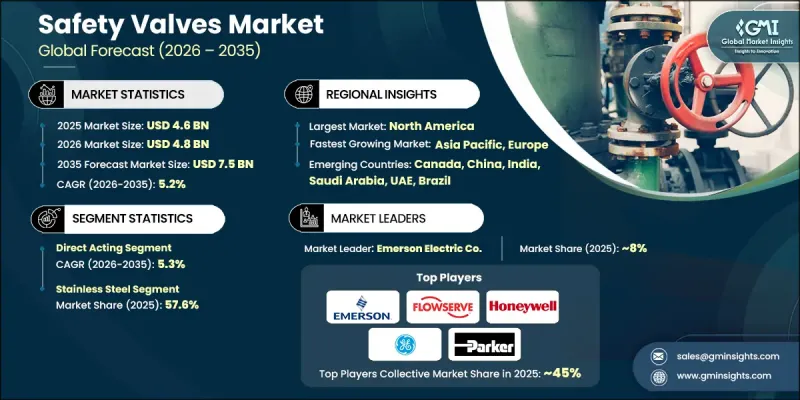
Market growth has remained steady in recent years, supported by stricter safety mandates, modernization of industrial infrastructure, and rising deployment of high-pressure processing systems across critical industries. As industrial operations become more complex and regulatory frameworks tighten, companies are placing stronger emphasis on reliable overpressure protection systems. Safety valves continue to serve as essential components that safeguard equipment, personnel, and production continuity by preventing pressure-related failures. Growing investment in plant upgrades, expansion of aging industrial assets, and heightened focus on operational reliability are reinforcing global demand. Advanced configurations, including pilot-operated systems, high-pressure direct-acting models, and bellows-sealed designs, are gaining wider adoption to meet evolving process requirements. However, integrating technologically advanced valve systems remains a challenge due to capital intensity and large-scale facility requirements. Despite these constraints, sustained industrialization and compliance-driven procurement strategies continue to drive long-term growth in the safety valves market.
| Market Scope | |
|---|---|
| Start Year | 2025 |
| Forecast Year | 2026-2035 |
| Start Value | $4.6 Billion |
| Forecast Value | $7.5 Billion |
| CAGR | 5.2% |
The direct-acting valves segment generated USD 2.1 billion in 2025 and is anticipated to grow at a CAGR of 5.3% from 2026 to 2035. This category leads the market due to its straightforward engineering, dependable performance, and adaptability across low- to mid-pressure systems. Its broad suitability for general industrial processes supports consistent demand in maintenance and replacement cycles. As operators increasingly align with standardized pressure protection frameworks and regulatory compliance requirements, direct-acting valves remain the preferred solution for cost-efficient and reliable safety management.
The stainless steel segment held 57.6% share, generating USD 2.6 billion in 2025. Stainless steel safety valves are widely selected for their corrosion resistance, structural strength, and ability to perform under high-temperature and high-pressure conditions. Their durability in harsh operating environments makes them indispensable in industries requiring stringent compliance and operational resilience. Expanding installation of demanding processing systems continues to accelerate the adoption of stainless steel valves worldwide.
U.S. Safety Valves Market reached USD 942.4 million in 2025 and is projected to grow at a CAGR of 5.4% between 2026 and 2035. Regional demand is supported by ongoing asset replacement programs, facility upgrades, and routine maintenance cycles. Increasing emphasis on traceability, certification, and adherence to strict safety standards is encouraging buyers to prioritize corrosion-resistant materials and trusted original equipment manufacturers. The focus on regulatory compliance and operational efficiency continues to sustain steady procurement volumes across industrial sectors.
Key participants in the Global Safety Valves Market include Emerson Electric Co., Flowserve Corporation, Crane Co., Parker Hannifin Corporation, Honeywell International Inc., Schneider Electric SE, Pentair plc, Rotork Plc, Spirax Sarco Limited, Watts Water Technologies, Inc., Moog Inc., ValvTechnologies, Inc., Burkert Fluid Control Systems, Cameron, and GE Measurement & Control Solutions. Companies in the Global Safety Valves Market are reinforcing their competitive position through product innovation, certification expansion, and strategic partnerships. Manufacturers are investing in advanced materials, digital monitoring integration, and enhanced pressure-control technologies to improve reliability and lifecycle performance. Expanding global distribution networks and strengthening aftermarket services help companies secure recurring revenue through maintenance and replacement contracts. Strategic collaborations with engineering firms and industrial operators enable customized valve solutions for complex applications. Firms are also prioritizing compliance with international safety standards and obtaining third-party certifications to build trust and credibility.
Table of Contents
Chapter 1 Methodology & Scope
- 1.1 Market scope and definition
- 1.2 Research design
- 1.2.1 Research approach
- 1.2.2 Data collection methods
- 1.3 Data mining sources
- 1.3.1 Global
- 1.3.2 Regional/Country
- 1.4 Base estimates and calculations
- 1.4.1 Base year calculation
- 1.4.2 Key trends for market estimation
- 1.5 Primary research and validation
- 1.5.1 Primary sources
- 1.6 Forecast model
- 1.7 Research assumptions and limitations
Chapter 2 Executive Summary
- 2.1 Industry 360° synopsis
- 2.2 Key market trends
- 2.2.1 Regional
- 2.2.2 Type
- 2.2.3 Material
- 2.2.4 Size
- 2.2.5 Pressure Range
- 2.2.6 End User
- 2.2.7 Distribution Channel
Chapter 3 Industry Insights
- 3.1 Industry ecosystem analysis
- 3.1.1 Supplier landscape
- 3.1.2 Profit margin
- 3.1.3 Value addition at each stage
- 3.1.4 Factor affecting the value chain
- 3.2 Industry impact forces
- 3.2.1 Growth drivers
- 3.2.1.1 Rising cost of advanced safety valve systems
- 3.2.1.2 Growing availability of diverse safety valve technologies and application specific systems
- 3.2.1.3 Increasing need to reduce financial burden on industrial operators
- 3.2.2 Industry pitfalls & challenges
- 3.2.2.1 Government subsidies for industrial modernization and equipment upgrades
- 3.2.2.2 Lack of standardized regulations and process-safety frameworks.
- 3.2.3 Industry Opportunities
- 3.2.3.1 Increasing adoption of digital and precision based safety technologies
- 3.2.3.2 Expansion of digital platforms and on demand industrial safety services
- 3.2.1 Growth drivers
- 3.3 Growth potential analysis
- 3.4 Future market trends
- 3.5 Technology and innovation landscape
- 3.5.1 Current technological trends
- 3.5.2 Emerging technologies
- 3.6 Price trends
- 3.6.1 By region
- 3.6.2 By Product type
- 3.7 Regulatory landscape
- 3.7.1 Standards and compliance requirements
- 3.7.2 Regional regulatory frameworks
- 3.7.3 Certification standards
- 3.8 Porter’s analysis
- 3.9 PESTEL analysis
Chapter 4 Competitive Landscape, 2025
- 4.1 Introduction
- 4.2 Company market share analysis
- 4.2.1 By Region
- 4.2.1.1 North America
- 4.2.1.2 Europe
- 4.2.1.3 Asia Pacific
- 4.2.1.4 Latin America
- 4.2.1.5 Middle East & Africa
- 4.2.1 By Region
- 4.3 Company matrix analysis
- 4.4 Competitive analysis of major market players
- 4.5 Competitive positioning matrix
- 4.6 Key developments
- 4.6.1 Mergers & acquisitions
- 4.6.2 Partnerships & collaborations
- 4.6.3 New product launches
- 4.6.4 Expansion plans
Chapter 5 Safety Valves Market Estimates & Forecast, By Type, 2022 - 2035, (USD Billion) (Thousand Units)
- 5.1 Key trends
- 5.2 Direct acting
- 5.3 Bellows
- 5.4 Pilot-operated
Chapter 6 Safety Valves Market Estimates & Forecast, By Material, 2022 - 2035, (USD Billion) (Thousand Units)
- 6.1 Key trends
- 6.2 Stainless Steel
- 6.3 Carbon Steel
- 6.4 Brass
- 6.5 Plastic
- 6.6 Others (Inconel, etc.)
Chapter 7 Safety Valves Market Estimates & Forecast, By Size, 2022 - 2035, (USD Billion) (Thousand Units)
- 7.1 Key trends
- 7.2 Up to 1"
- 7.3 1" to 6"
- 7.4 6" to 25"
- 7.5 25" to 50"
- 7.6 50" and Larger
Chapter 8 Safety Valves Market Estimates & Forecast, By Pressure Range, 2022 - 2035, (USD Billion) (Thousand Units)
- 8.1 Key trends
- 8.2 < 35MPa
- 8.3 35 - 70 MPa
- 8.4 70 - 110 MPa
- 8.5 400 MPa
- 8.6 700 MPa
- 8.7 20 kpsi
- 8.8 60 kpsi
Chapter 9 Safety Valves Market Estimates & Forecast, By End Users, 2022 - 2035, (USD Billion) (Thousand Units)
- 9.1 Key trends
- 9.2 Oil & Gas
- 9.3 Water & Wastewater Treatment
- 9.4 Power Industry
- 9.5 Chemical Industry
- 9.6 Others
Chapter 10 Safety Valves Market Estimates & Forecast, By Distribution Channel, 2022 - 2035, (USD Billion) (Thousand Units)
- 10.1 Key trends
- 10.2 Direct Sales
- 10.3 Indirect Sales
Chapter 11 Safety Valves Market Estimates & Forecast, By Region, 2022 - 2035, (USD Billion) (Thousand Units)
- 11.1 Key trends
- 11.2 North America
- 11.2.1 U.S.
- 11.2.2 Canada
- 11.3 Europe
- 11.3.1 Germany
- 11.3.2 UK
- 11.3.3 France
- 11.3.4 Italy
- 11.3.5 Spain
- 11.4 Asia Pacific
- 11.4.1 China
- 11.4.2 India
- 11.4.3 Japan
- 11.4.4 South Korea
- 11.4.5 Australia
- 11.5 Latin America
- 11.5.1 Brazil
- 11.5.2 Mexico
- 11.6 MEA
- 11.6.1 Saudi Arabia
- 11.6.2 UAE
Chapter 12 Company Profiles
- 12.1 Burkert Fluid Control Systems
- 12.2 Cameron
- 12.3 Crane Co.
- 12.4 Emerson Electric Co.
- 12.5 Flowserve Corporation
- 12.6 GE Measurement & Control Solutions
- 12.7 Honeywell International Inc.
- 12.8 Moog Inc.
- 12.9 Parker Hannifin Corporation
- 12.10 Pentair plc
- 12.11 Rotork Plc
- 12.12 Schneider Electric SE
- 12.13 Spirax Sarco Limited
- 12.14 ValvTechnologies, Inc.
- 12.15 Watts Water Technologies, Inc.

