PUBLISHER: Global Market Insights Inc. | PRODUCT CODE: 1982302

PUBLISHER: Global Market Insights Inc. | PRODUCT CODE: 1982302
Laundry Care Products Market Opportunity, Growth Drivers, Industry Trend Analysis, and Forecast 2026 - 2035
The Global Laundry Care Products Market was valued at USD 112.6 billion in 2025 and is estimated to grow at a CAGR of 4.9% to reach USD 182.2 billion by 2035.
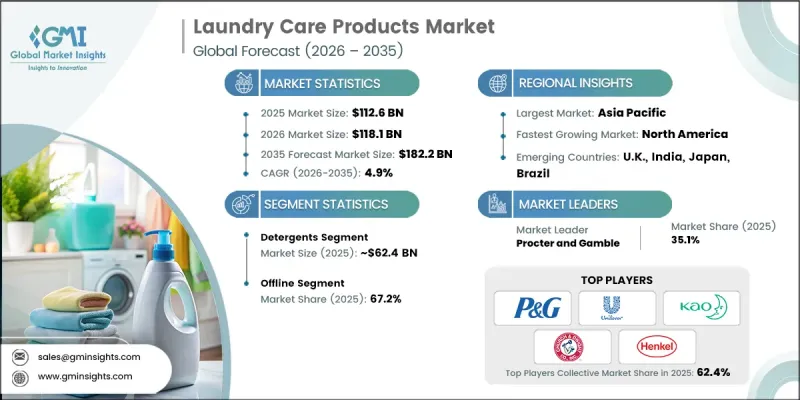
Growth across both domestic and commercial segments remains steady, supported by evolving consumer preferences and supportive regulatory frameworks. Government guidelines and sustainability initiatives encourage the development and adoption of safer, environmentally responsible formulations. Consumers are increasingly favoring products that align with regulatory standards and environmental commitments, reinforcing long-term demand. Continuous innovation, technological advancements, and formulation improvements are reshaping the competitive landscape. The market is steadily transitioning toward sustainable and eco-conscious solutions as shoppers seek high-performance products that also minimize environmental impact. Brands are responding with biodegradable ingredients, concentrated formats, and resource-efficient packaging. This shift toward sustainability, combined with product diversification and premium positioning, is strengthening the overall outlook for the global laundry care products market throughout the forecast period.
| Market Scope | |
|---|---|
| Start Year | 2025 |
| Forecast Year | 2026-2035 |
| Start Value | $112.6 Billion |
| Forecast Value | $182.2 Billion |
| CAGR | 4.9% |
The detergents segment generated USD 62.4 billion in 2025 and is expected to reach USD 101.9 billion by 2035. Detergents remain the cornerstone of the laundry care products market due to their essential role in fabric cleaning and maintenance. These products address core consumer priorities such as effective stain removal, fabric care, and fragrance enhancement. Ongoing innovation in concentrated formulas, cold-water compatibility, and environmentally responsible compositions is further driving segment expansion. Their adaptability across various washing conditions and fabric types continues to support their dominant market position.
The offline distribution channels segment accounted for 67.2% share in 2025. Physical retail outlets, including supermarkets, hypermarkets, convenience stores, and specialty shops, continue to play a leading role in product sales. Many consumers prefer in-store shopping experiences that allow them to compare brands, assess packaging, and make immediate purchase decisions. Traditional retail infrastructure remains particularly strong in regions where brick-and-mortar shopping habits are deeply established, reinforcing the importance of offline sales channels.
United States Laundry Care Products Market held 75% share in 2025, driving overall growth. Heightened consumer awareness of hygiene and cleanliness has strengthened product demand, with households maintaining frequent laundry routines. Increasing interest in environmentally friendly formulations is supporting the expansion of premium and sustainable product categories. The region benefits from a strong presence of established global brands and continued product premiumization, including multifunctional and fabric-specific solutions. Growing environmental consciousness among consumers is accelerating demand for biodegradable and naturally derived formulations, further reinforcing market expansion.
Key companies operating in the Global Laundry Care Products Market include Procter and Gamble, Unilever, Henkel, Reckitt, Kao, Church and Dwight, Clorox, Colgate-Palmolive, Amway, S.C. Johnson and Son, Godrej Consumer Products, LG Household and Health Care, Lion, Nirma, and Blue Moon Group. Companies in the Global Laundry Care Products Market are strengthening their competitive position through innovation, sustainability initiatives, and brand differentiation strategies. Leading players are investing in research and development to create high-efficiency formulations that perform well at lower temperatures while reducing environmental impact. Many brands are expanding premium product lines, introducing plant-based ingredients, and adopting recyclable or reduced-plastic packaging solutions. Strategic partnerships with retailers and expanded distribution networks help improve market penetration. Digital marketing, targeted advertising, and consumer education campaigns further enhance brand loyalty.
Table of Contents
Chapter 1 Methodology & Scope
- 1.1 Market scope and definition
- 1.2 Research design
- 1.2.1 Research approach
- 1.2.2 Data collection methods
- 1.3 Data mining sources
- 1.3.1 Global
- 1.3.2 Regional/Country
- 1.4 Base estimates and calculations
- 1.4.1 Base year calculation
- 1.4.2 Key trends for market estimation
- 1.5 Primary research and validation
- 1.5.1 Primary sources
- 1.6 Forecast model
- 1.7 Research assumptions and limitations
Chapter 2 Executive Summary
- 2.1 Industry 360° synopsis
- 2.2 Key market trends
- 2.2.1 Regional
- 2.2.2 Product Type
- 2.2.3 Price
- 2.2.4 Application
- 2.2.5 Distribution Channel
- 2.3 CXO perspectives: Strategic imperatives
- 2.3.1 Key decision points for industry executives
- 2.3.2 Critical success factors for market players
- 2.4 Future outlook and strategic recommendations
Chapter 3 Industry Insights
- 3.1 Industry ecosystem analysis
- 3.1.1 Supplier landscape
- 3.1.2 Profit margin
- 3.1.3 Value addition at each stage
- 3.1.4 Factor affecting the value chain
- 3.2 Industry impact forces
- 3.2.1 Growth drivers
- 3.2.1.1 Rising consumer awareness of hygiene and cleanliness
- 3.2.1.2 Innovation and product development
- 3.2.1.3 Increasing urbanization and busy lifestyles
- 3.2.2 Industry pitfalls & challenges
- 3.2.2.1 Intense market competition and price wars
- 3.2.2.2 Environmental concerns and regulatory challenges
- 3.2.3 Opportunities
- 3.2.3.1 Sustainability-driven premium laundry solutions
- 3.2.3.2 Expansion in emerging markets with rising appliance penetration
- 3.2.1 Growth drivers
- 3.3 Growth potential analysis
- 3.4 Future market trends
- 3.5 Technology and innovation landscape
- 3.5.1 Current technological trends
- 3.5.2 Emerging technologies
- 3.6 Price trends
- 3.6.1 By product type
- 3.6.2 By region
- 3.7 Regulatory landscape
- 3.7.1 Standards and compliance requirements
- 3.7.2 Regional regulatory frameworks
- 3.7.3 Certification standards
- 3.8 Trade statistics
- 3.8.1 Major importing countries
- 3.8.2 Major exporting countries
- 3.9 Gap analysis
- 3.10 Risk assessment and mitigation
- 3.11 Porter’s analysis
- 3.12 PESTEL analysis
- 3.13 Consumer behaviour analysis
- 3.13.1 Purchasing patterns
- 3.13.2 Preference analysis
- 3.13.3 Regional variations in consumer behaviour
- 3.13.4 Impact of e-commerce on buying decisions
Chapter 4 Competitive Landscape, 2025
- 4.1 Introduction
- 4.2 Company market share analysis
- 4.2.1 By region
- 4.2.1.1 North America
- 4.2.1.2 Europe
- 4.2.1.3 Asia Pacific
- 4.2.1.4 Latin America
- 4.2.1.5 Middle East and Africa
- 4.2.1 By region
- 4.3 Company matrix analysis
- 4.4 Competitive analysis of major market players
- 4.5 Competitive positioning matrix
- 4.6 Key developments
- 4.6.1 Mergers & acquisitions
- 4.6.2 Partnerships & collaborations
- 4.6.3 New product launches
- 4.6.4 Expansion plans
Chapter 5 Market Estimates & Forecast, By Product Type, 2022-2035 (USD Billion) (Million Units)
- 5.1 Key trends
- 5.2 Detergents
- 5.2.1 Powder detergents
- 5.2.2 Liquid detergents
- 5.2.3 Pods/capsules
- 5.3 Fabric softeners and conditioners
- 5.4 Stain removers and pre-treatment products
- 5.5 Bleaches
- 5.6 Laundry additives
- 5.7 Others
Chapter 6 Market Estimates & Forecast, By Price, 2022-2035 (USD Billion) (Million Units)
- 6.1 Key trends
- 6.2 Low
- 6.3 Medium
- 6.4 High
Chapter 7 Market Estimates & Forecast, By Application, 2022-2035 (USD Billion) (Million Units)
- 7.1 Key trends
- 7.2 Household
- 7.3 Commercial
Chapter 8 Market Estimates & Forecast, By Distribution Channel, 2022-2035 (USD Billion) (Million Units)
- 8.1 Key trends
- 8.2 Online
- 8.2.1 E-Commerce
- 8.2.2 Company website
- 8.3 Offline
- 8.3.1 Supermarkets/Hypermarkets
- 8.3.2 Specialty Stores
- 8.3.3 Others (Individual stores, Departmental stores, etc.)
Chapter 9 Market Estimates & Forecast, By Region, 2022-2035 (USD Billion) (Million Units)
- 9.1 Key trends
- 9.2 North America
- 9.2.1 U.S.
- 9.2.2 Canada
- 9.3 Europe
- 9.3.1 Germany
- 9.3.2 France
- 9.3.3 UK
- 9.3.4 Italy
- 9.3.5 Spain
- 9.4 Asia Pacific
- 9.4.1 China
- 9.4.2 India
- 9.4.3 Japan
- 9.4.4 South Korea
- 9.4.5 Australia
- 9.5 Latin America
- 9.5.1 Brazil
- 9.5.2 Mexico
- 9.5.3 Argentina
- 9.6 MEA
- 9.6.1 South Africa
- 9.6.2 Saudi Arabia
- 9.6.3 UAE
Chapter 10 Company Profiles
- 10.1 Amway
- 10.2 Blue Moon Group
- 10.3 Church and Dwight
- 10.4 Clorox
- 10.5 Colgate-Palmolive
- 10.6 Godrej Consumer Products
- 10.7 Henkel
- 10.8 Kao
- 10.9 LG Household and Health Care
- 10.10 Lion
- 10.11 Nirma
- 10.12 Procter and Gamble
- 10.13 Reckitt
- 10.14 S.C. Johnson and Son
- 10.15 Unilever

