
PUBLISHER: Global Market Insights Inc. | PRODUCT CODE: 1982305

PUBLISHER: Global Market Insights Inc. | PRODUCT CODE: 1982305
Food Fibers Market Opportunity, Growth Drivers, Industry Trend Analysis, and Forecast 2026 - 2035
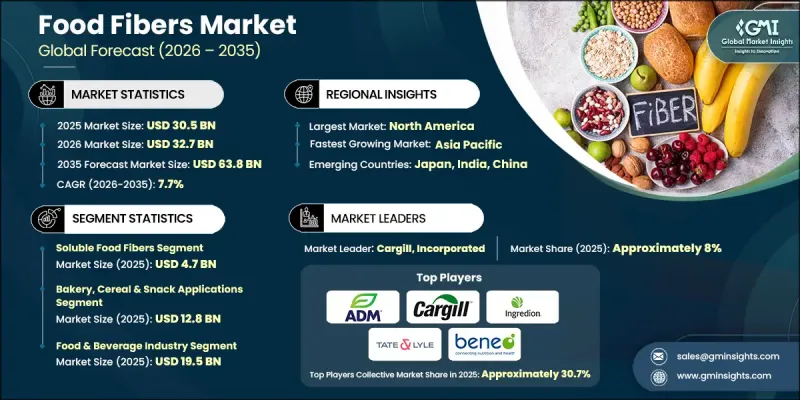
The Global Food Fibers Market was valued at USD 30.5 billion in 2025 and is estimated to grow at a CAGR of 7.7% to reach USD 63.8 billion by 2035.
The food fibers industry is witnessing strong expansion as consumers place greater emphasis on health, wellness, and preventive nutrition. Increasing awareness about digestive health and overall well-being is encouraging individuals to incorporate fiber-rich products into their daily diets. As a result, demand for fiber-fortified foods and beverages continues to rise across global markets. Growing concerns related to lifestyle-associated health conditions, including metabolic and cardiovascular disorders, are further influencing purchasing behavior. Consumers are actively seeking dietary solutions that support weight management, balanced blood sugar levels, and long-term health outcomes. This shift toward proactive nutrition is motivating food manufacturers to develop innovative functional products enriched with dietary fibers. The functional food and beverage segment has emerged as a key growth engine within the broader nutrition industry, reinforcing the strategic importance of fiber-based ingredients. Continuous product development and increasing retail availability are further strengthening the growth trajectory of the global food fibers market.
| Market Scope | |
|---|---|
| Start Year | 2025 |
| Forecast Year | 2026-2035 |
| Start Value | $30.5 Billion |
| Forecast Value | $63.8 Billion |
| CAGR | 7.7% |
The soluble food fibers segment generated USD 4.7 billion in 2025 and is expected to grow at a CAGR of 8.2% between 2026 and 2035. Growth in this segment is driven by rising recognition of soluble fibers for supporting digestive balance, cholesterol management, and glycemic control. Manufacturers are incorporating soluble fibers into functional foods, beverages, and dietary supplements to meet consumer demand for health-oriented solutions. At the same time, indigestible food fibers are gaining attention for their role in promoting regular bowel function and maintaining overall gut wellness.
The bakery, cereal, and snack applications segment accounted for USD 12.8 billion in 2025 and is projected to grow at a CAGR of 7.3% through 2035. This segment maintains market leadership as producers integrate dietary fibers to enhance texture, improve stability, and increase nutritional value in everyday food products. Food fibers also support innovation in dairy alternatives and plant-based formulations by contributing to desirable consistency and structural properties. In the dietary supplements category, fibers are utilized to deliver digestive health benefits and to formulate targeted wellness blends aligned with consumer preferences.
North America Food Fibers Market reached USD 10.7 billion in 2025 and is anticipated to experience steady growth over the forecast period. Regional expansion is supported by heightened consumer awareness regarding digestive health, weight management, and preventive dietary practices. Strong demand for fiber-enriched functional foods, beverages, and supplements is reinforced by well-established retail distribution networks and growing education about the long-term health benefits of dietary fiber consumption.
Major companies operating in the Global Food Fibers Market include Cargill, Incorporated; Archer Daniels Midland Company (ADM); Ingredion Incorporated; Tate & Lyle PLC; Roquette Freres; Kerry Group; BENEO GmbH; J Rettenmaier & Sohne GmbH + Co KG; Nexira Inc.; and International Flavors and Aromas. Companies in the Food Fibers Market are strengthening their competitive position through product innovation, strategic partnerships, and expansion into high-growth regions. Leading players are investing in research and development to create customized fiber solutions tailored to specific functional and nutritional needs. Collaboration with food and beverage manufacturers is accelerating the integration of advanced fiber ingredients into new product launches. Firms are also focusing on clean-label formulations and sustainable sourcing practices to align with evolving consumer expectations.
Table of Contents
Chapter 1 Methodology
- 1.1 Market scope and definition
- 1.2 Research design
- 1.2.1 Research approach
- 1.2.2 Data collection methods
- 1.3 Data mining sources
- 1.3.1 Global
- 1.3.2 Regional/Country
- 1.4 Base estimates and calculations
- 1.4.1 Base year calculation
- 1.4.2 Key trends for market estimation
- 1.5 Primary research and validation
- 1.5.1 Primary sources
- 1.6 Forecast model
- 1.7 Research assumptions and limitations
Chapter 2 Executive Summary
- 2.1 Industry 360° synopsis
- 2.2 Key market trends
- 2.2.1 Regional
- 2.2.2 Fiber Type
- 2.2.3 Application
- 2.2.4 End use
- 2.3 TAM Analysis, 2026-2035
- 2.4 CXO perspectives: Strategic imperatives
- 2.4.1 Executive decision points
- 2.4.2 Critical success factors
- 2.5 Future Outlook and Strategic Recommendations
Chapter 3 Industry Insights
- 3.1 Industry ecosystem analysis
- 3.1.1 Supplier Landscape
- 3.1.2 Profit Margin
- 3.1.3 Value addition at each stage
- 3.1.4 Factor affecting the value chain
- 3.1.5 Disruptions
- 3.2 Industry impact forces
- 3.2.1 Growth drivers
- 3.2.2 Industry pitfalls and challenges
- 3.2.3 Market opportunities
- 3.3 Growth potential analysis
- 3.4 Regulatory landscape
- 3.4.1 North America
- 3.4.2 Europe
- 3.4.3 Asia Pacific
- 3.4.4 Latin America
- 3.4.5 Middle East & Africa
- 3.5 Porter’s analysis
- 3.6 PESTEL analysis
- 3.7 Price trends
- 3.7.1 By region
- 3.7.2 By fiber type
- 3.8 Future market trends
- 3.9 Technology and Innovation landscape
- 3.9.1 Current technological trends
- 3.9.2 Emerging technologies
- 3.10 Patent Landscape
- 3.11 Trade statistics (Note: the trade statistics will be provided for key countries only)
- 3.11.1 Major importing countries
- 3.11.2 Major exporting countries
- 3.12 Sustainability and Environmental Aspects
- 3.12.1 Sustainable Practices
- 3.12.2 Waste Reduction Strategies
- 3.12.3 Energy Efficiency in Production
- 3.12.4 Eco-friendly Initiatives
Chapter 4 Competitive Landscape, 2025
- 4.1 Introduction
- 4.2 Company market share analysis
- 4.2.1 By region
- 4.2.1.1 North America
- 4.2.1.2 Europe
- 4.2.1.3 Asia Pacific
- 4.2.1.4 LATAM
- 4.2.1.5 MEA
- 4.2.1 By region
- 4.3 Company matrix analysis
- 4.4 Competitive analysis of major market players
- 4.5 Competitive positioning matrix
- 4.6 Key developments
- 4.6.1 Mergers & acquisitions
- 4.6.2 Partnerships & collaborations
- 4.6.3 New Product Launches
- 4.6.4 Expansion Plans
Chapter 5 Market Estimates and Forecast, By Fiber Type, 2022- 2035 (USD Billion, Kilo Tons)
- 5.1 Key trends
- 5.2 Soluble fibers
- 5.2.1 Pectins and gums
- 5.2.2 Beta-glucan and specialized fibers
- 5.2.3 Other soluble fibers
- 5.3 Insoluble fibers
- 5.3.1 Cellulose and modified cellulose
- 5.3.2 Wheat bran and cereal fibers
- 5.3.3 Fruit and vegetable fibers
- 5.4 Prebiotic fibers
- 5.4.1 Inulin
- 5.4.2 Resistant starch
- 5.4.3 FOS
- 5.4.4 GOS
- 5.4.5 Other prebiotic fibers
- 5.5 Functional fibers/engineered fibers
- 5.5.1 Polydextrose
- 5.5.2 Resistant maltodextrin
- 5.5.3 Novel engineered fibers
Chapter 6 Market Estimates and Forecast, By Application, 2022 - 2035 (USD Billion, Kilo Tons)
- 6.1 Key trends
- 6.2 Bakery, Cereal & Snack Applications
- 6.2.1 Bread and Bakery Products
- 6.2.2 Breakfast Cereals and Snacks
- 6.2.3 Confectionary and Sweet Products
- 6.2.4 Others
- 6.3 Dairy & Plant-Based Applications
- 6.3.1 Dairy Products
- 6.3.1.1 Yogurt & Fermented Dairy
- 6.3.1.2 Cheese & Processed Dairy Products
- 6.3.1.3 Other Dairy Products
- 6.3.2 Plant-Based Dairy Alternatives
- 6.3.2.1 Plant-Based Milks
- 6.3.2.2 Plant-Based Yogurts
- 6.3.2.3 Plant-Based Cheese & Other Dairy Replacements
- 6.3.1 Dairy Products
- 6.4 Beverages
- 6.4.1 Functional & Sports Drinks
- 6.4.2 Juices & Enhanced Waters
- 6.4.3 Other Fiber-Fortified Beverages
- 6.5 Dietary Supplements
- 6.5.1 Powders & Capsules
- 6.5.2 Prebiotic / Gut and Health Supplements
- 6.5.3 Weight Management & Metabolic Health Supplements
Chapter 7 Market Estimates and Forecast, By End Use, 2022 - 2035 (USD Billion, Kilo Tons)
- 7.1 Key trends
- 7.2 Food & Beverage Industry
- 7.3 Dietary Supplements & Nutraceuticals
- 7.4 Medical & Clinical Nutrition
- 7.5 Sports & Performance Nutrition
- 7.6 Animal & Pet Nutrition
- 7.7 Others
Chapter 8 Market Estimates and Forecast, By Region, 2022 - 2035 (USD Billion, Kilo Tons)
- 8.1 Key trends
- 8.2 North America
- 8.2.1 U.S.
- 8.2.2 Canada
- 8.3 Europe
- 8.3.1 Germany
- 8.3.2 UK
- 8.3.3 France
- 8.3.4 Italy
- 8.3.5 Spain
- 8.3.6 Rest of Europe
- 8.4 Asia Pacific
- 8.4.1 China
- 8.4.2 India
- 8.4.3 Japan
- 8.4.4 Australia
- 8.4.5 South Korea
- 8.4.6 Rest of Asia Pacific
- 8.5 Latin America
- 8.5.1 Brazil
- 8.5.2 Mexico
- 8.5.3 Argentina
- 8.5.4 Rest of Latin America
- 8.6 Middle East & Africa
- 8.6.1 Saudi Arabia
- 8.6.2 South Africa
- 8.6.3 UAE
- 8.6.4 Rest of Middle East & Africa
Chapter 9 Company Profiles
- 9.1 Archer Daniels Midland Company (ADM)
- 9.2 Cargill, Incorporated
- 9.3 Ingredion Incorporated
- 9.4 Tate & Lyle PLC
- 9.5 BENEO GmbH
- 9.6 Roquette Freres
- 9.7 Kerry Group
- 9.8 International Flavors and Aromas Other
- 9.9 J Rettenmaier & Sohne GmbH + Co KG
- 9.10 Nexira Inc.

