
PUBLISHER: Global Market Insights Inc. | PRODUCT CODE: 1982306

PUBLISHER: Global Market Insights Inc. | PRODUCT CODE: 1982306
Flow Chemistry Market Opportunity, Growth Drivers, Industry Trend Analysis, and Forecast 2026 - 2035
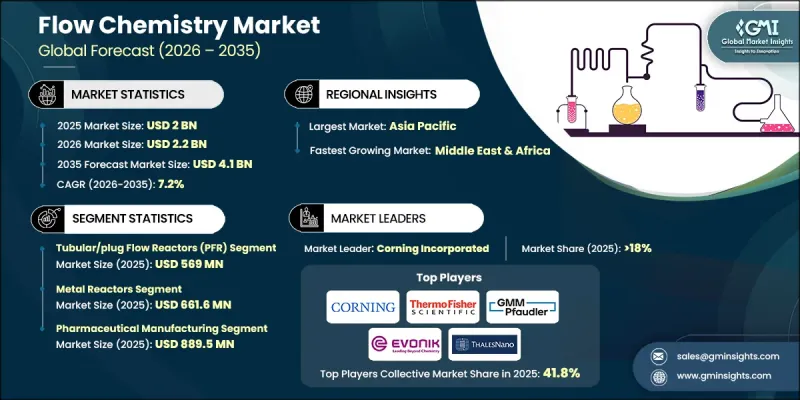
The Global Flow Chemistry Market was valued at USD 2 billion in 2025 and is estimated to grow at a CAGR of 7.2% to reach USD 4.1 billion by 2035.
The rising shift toward continuous manufacturing in the pharmaceutical sector is significantly contributing to market expansion. Regulatory bodies such as the U.S. FDA actively encourage continuous processing due to its ability to improve product quality, enhance process control, and shorten production timelines. Flow chemistry enables the safe handling of highly reactive intermediates while supporting real-time monitoring, aligning with Quality by Design principles and advanced process optimization. As pharmaceutical manufacturers modernize production facilities, demand for flow-based systems continues to grow. Growing emphasis on sustainable and green chemistry practices is further accelerating adoption. Continuous flow processes consume less solvent, generate lower waste volumes, and typically require reduced energy compared to conventional batch operations. Increasing environmental regulations and global sustainability initiatives are encouraging manufacturers to transition toward cleaner production technologies. Flow chemistry supports these objectives by enabling more controlled reactions with minimized environmental impact. Advancements in microreactor engineering and modular flow platforms are also strengthening the market by improving scalability, flexibility, and operational responsiveness.
| Market Scope | |
|---|---|
| Start Year | 2025 |
| Forecast Year | 2026-2035 |
| Start Value | $2 Billion |
| Forecast Value | $4.1 Billion |
| CAGR | 7.2% |
The tubular or plug flow reactors (PFR) segment reached USD 569 million in 2025. Segmentation by reactor type reflects a clear shift in chemical processing strategies, as manufacturers aim to balance adaptability, scalability, and operational performance. Batch reactors continue to maintain strong adoption due to their versatility in handling multiple product lines and enabling precise control in small- to mid-scale production. However, advancements in chemical engineering technologies, along with more rigorous safety and environmental regulations, are prompting companies to reassess traditional batch configurations. This transition is particularly evident in processes involving high heat transfer demands or hazardous intermediates, where continuous systems often provide enhanced control and safety advantages.
The metal reactors segment captured USD 661.6 million in 2025. Increasing specialization in reactor selection is evident as industries adopt systems tailored to specific chemical applications and continuous processing requirements. Tubular or plug flow reactors (PFR) and continuous stirred-tank reactors (CSTR) remain widely preferred due to their operational reliability and scalability. In catalytic applications, packed-bed and fixed-bed reactors are gaining stronger industry acceptance because they improve catalyst interaction and overall reaction efficiency. At the same time, microstructured reactors are drawing growing research attention, as their compact configurations enable superior heat and mass transfer performance, supporting highly controlled and precise synthesis processes.
North America Flow Chemistry Market generated USD 299.5 million in 2025. The region's expansion is driven by the growing implementation of continuous manufacturing across pharmaceuticals, specialty chemicals, and biotechnology sectors. The United States holds the dominant regional share, supported by significant investments in process innovation, widespread adoption of advanced synthesis technologies, and a strong network of research institutions and contract development and manufacturing organizations. Manufacturers are increasingly leveraging flow chemistry to improve reaction efficiency, enhance operational safety, and ensure regulatory compliance, particularly in complex and high-risk chemical processes.
Key participants in the Global Flow Chemistry Market include Evonik, Corning Incorporated, GMM Pfaudler, Thermo Fisher Scientific, Sulzer Ltd., Vapourtec Ltd., Zibo Taiji Industrial Enamel Co. Ltd, Syrris Ltd., SPX Technologies Inc., Chemtrix BV, Xylem Inc., and Alfa Laval AB. Companies operating in the Global Flow Chemistry Market are implementing strategic initiatives to strengthen their competitive positioning and expand their global footprint. Major players are investing in advanced reactor technologies, modular system design, and digital process integration to enhance efficiency and scalability. Strategic collaborations with pharmaceutical manufacturers and specialty chemical producers enable customized solutions and long-term supply agreements. Firms are also focusing on expanding production capabilities and regional distribution networks to improve market accessibility. Continuous investment in research and development supports innovation in microreactor platforms and automation technologies.
Table of Contents
Chapter 1 Methodology & Scope
- 1.1 Market scope and definition
- 1.2 Research design
- 1.2.1 Research approach
- 1.2.2 Data collection methods
- 1.3 Data mining sources
- 1.3.1 Global
- 1.3.2 Regional/Country
- 1.4 Base estimates and calculations
- 1.4.1 Base year calculation
- 1.4.2 Key trends for market estimation
- 1.5 Primary research and validation
- 1.5.1 Primary sources
- 1.6 Forecast model
- 1.7 Research assumptions and limitations
Chapter 2 Executive Summary
- 2.1 Industry 360° synopsis
- 2.2 Key market trends
- 2.2.1 Regional
- 2.2.2 Reactor Type
- 2.2.3 Material Type
- 2.2.4 Application
- 2.3 TAM Analysis, 2026-2035
- 2.4 CXO perspectives: Strategic imperatives
- 2.4.1 Executive decision points
- 2.4.2 Critical success factors
- 2.5 Future Outlook and Strategic Recommendations
Chapter 3 Industry Insights
- 3.1 Industry ecosystem analysis
- 3.1.1 Supplier Landscape
- 3.1.2 Profit Margin
- 3.1.3 Value addition at each stage
- 3.1.4 Factor affecting the value chain
- 3.1.5 Disruptions
- 3.2 Industry impact forces
- 3.2.1 Growth drivers
- 3.2.1.1 Increasing adoption of continuous manufacturing in pharmaceuticals
- 3.2.1.2 Strong push for green and sustainable chemistry
- 3.2.1.3 Technological advancements in microreactors and modular systems
- 3.2.2 Industry pitfalls and challenges
- 3.2.2.1 High Initial Capital Investment
- 3.2.2.2 Integration Issues with Legacy Infrastructure
- 3.2.3 Market opportunities
- 3.2.3.1 Expansion in Emerging Applications like Photochemistry & Electrochemistry
- 3.2.3.2 Growing Demand for Custom, Modular, and Skid Mounted Systems
- 3.2.1 Growth drivers
- 3.3 Growth potential analysis
- 3.4 Regulatory landscape
- 3.4.1 North America
- 3.4.2 Europe
- 3.4.3 Asia Pacific
- 3.4.4 Latin America
- 3.4.5 Middle East & Africa
- 3.5 Porter's analysis
- 3.6 PESTEL analysis
- 3.7 Price trends
- 3.7.1 By region
- 3.7.2 Product type
- 3.8 Future market trends
- 3.9 Technology and Innovation Landscape
- 3.9.1 Current technological trends
- 3.9.2 Emerging technologies
- 3.10 Patent Landscape
- 3.11 Trade statistics (HS code) (Note: the trade statistics will be provided for key countries only)
- 3.11.1 Major importing countries
- 3.11.2 Major exporting countries
- 3.12 Sustainability and environmental aspects
- 3.12.1 Sustainable practices
- 3.12.2 Waste reduction strategies
- 3.12.3 Energy efficiency in production
- 3.12.4 Eco-friendly initiatives
- 3.13 Carbon footprint considerations
Chapter 4 Competitive Landscape, 2024
- 4.1 Introduction
- 4.2 Company market share analysis
- 4.2.1 By region
- 4.2.1.1 North America
- 4.2.1.2 Europe
- 4.2.1.3 Asia Pacific
- 4.2.1.4 LATAM
- 4.2.1.5 MEA
- 4.2.1 By region
- 4.3 Company matrix analysis
- 4.4 Competitive analysis of major market players
- 4.5 Competitive positioning matrix
- 4.6 Key developments
- 4.6.1 Mergers & acquisitions
- 4.6.2 Partnerships & collaborations
- 4.6.3 New product launches
- 4.6.4 Expansion plans
Chapter 5 Market Estimates and Forecast, By Reactor Type, 2022 - 2035 (USD million) (Tons)
- 5.1 Key trends
- 5.2 Tubular/Plug Flow Reactors (PFR)
- 5.3 Microstructured Reactors
- 5.4 Packed-Bed/Fixed-Bed Reactors
- 5.5 Continuous Stirred-Tank Reactors (CSTR)
- 5.6 Photochemical Flow Reactors
- 5.7 Electrochemical Flow Reactors
- 5.8 Oscillatory Flow Reactors (OFR)
- 5.9 Hybrid & Integrated Systems
- 5.10 Others
Chapter 6 Market Estimates and Forecast, By Material Type, 2022 - 2035 (USD million) (Tons)
- 6.1 Key trends
- 6.2 Polymer-Based Reactors
- 6.3 Metal Reactors
- 6.4 Glass/Quartz Reactors
- 6.5 Ceramic/Silicon Reactors
- 6.6 Other materials
Chapter 7 Market Estimates and Forecast, By Application, 2022 - 2035 (USD million) (Tons)
- 7.1 Key trends
- 7.2 Pharmaceutical manufacturing
- 7.3 Fine chemicals production
- 7.4 Petrochemical processing
- 7.5 Agrochemical manufacturing
- 7.6 Others
Chapter 8 Market Estimates and Forecast, By Region, 2022 - 2035 (USD million) (Tons)
- 8.1 Key trends
- 8.2 North America
- 8.2.1 U.S.
- 8.2.2 Canada
- 8.3 Europe
- 8.3.1 Germany
- 8.3.2 UK
- 8.3.3 France
- 8.3.4 Spain
- 8.3.5 Italy
- 8.3.6 Rest of Europe
- 8.4 Asia Pacific
- 8.4.1 China
- 8.4.2 India
- 8.4.3 Japan
- 8.4.4 Australia
- 8.4.5 South Korea
- 8.4.6 Rest of Asia Pacific
- 8.5 Latin America
- 8.5.1 Brazil
- 8.5.2 Mexico
- 8.5.3 Rest of Latin America
- 8.6 Middle East and Africa
- 8.6.1 Saudi Arabia
- 8.6.2 South Africa
- 8.6.3 UAE
- 8.6.4 Rest of Middle East and Africa
Chapter 9 Company Profiles
- 9.1 Thermo Fisher Scientific
- 9.2 Xylem Inc.
- 9.3 Alfa Laval AB
- 9.4 SPX Technologies Inc.
- 9.5 Sulzer Ltd.
- 9.6 Corning Incorporated
- 9.7 Syrris Ltd.
- 9.8 Vapourtec Ltd.
- 9.9 Chemtrix BV
- 9.10 Evonik
- 9.11 Zibo Taiji Industrial Enamel Co.,Ltd
- 9.12 GMM Pfaudler

