PUBLISHER: Global Market Insights Inc. | PRODUCT CODE: 1982308

PUBLISHER: Global Market Insights Inc. | PRODUCT CODE: 1982308
Boiler Market Opportunity, Growth Drivers, Industry Trend Analysis, and Forecast 2026 - 2035
The Global Boiler Market was valued at USD 112.2 billion in 2025 and is estimated to grow at a CAGR of 6.8% to reach USD 220.9 billion by 2035.
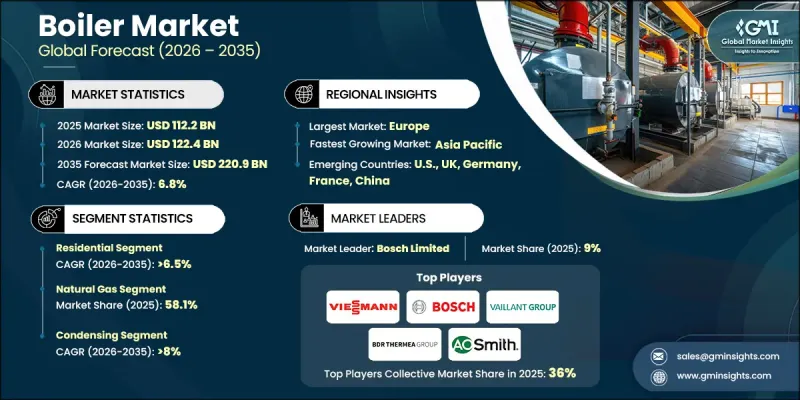
Boilers remain a fundamental part of the global thermal equipment sector, driven by energy consumption trends, regulatory frameworks, and capital investment cycles. Market growth is supported by ongoing infrastructure development, modernization of existing systems, and the sustained need for reliable heat generation solutions worldwide. Boilers are pressurized vessels designed to heat water or other fluids using fuel, electricity, or alternative heat sources, often converting fluids into steam under controlled pressure. Core components include a combustion or heating chamber, heat transfer surfaces, pressure regulation systems, and safety controls to ensure stable operation and durability. Replacement demand from aging installations, rising maintenance costs, and stricter efficiency and emissions regulations underpins market resilience. While developing regions primarily contribute to volume growth, mature markets focus on efficiency upgrades, emissions compliance, and lifecycle optimization, shaping regional demand patterns, pricing, and technology adoption strategies globally.
| Market Scope | |
|---|---|
| Start Year | 2025 |
| Forecast Year | 2026-2035 |
| Start Value | $112.2 Billion |
| Forecast Value | $220.9 Billion |
| CAGR | 6.8% |
The commercial boiler segment is projected to reach USD 30 billion by 2035, fueled by demand for reliable, energy-efficient heating in non-residential buildings. Growth is driven by infrastructure expansion, system replacements, and stricter efficiency regulations, while technological advancements and sustainability goals continue to influence purchasing decisions.
The oil-fired boiler industry was valued at USD 20.9 billion in 2025. Market dynamics are shaped by fuel price fluctuations, regional fuel availability, and emission standards. Demand is particularly strong in areas with limited natural gas infrastructure, where replacement and efficiency improvements drive adoption. Emission control requirements and fuel transition policies are also influencing long-term growth trends.
North America Boiler Market is projected to reach USD 14 billion by 2035. The market reflects a mature yet evolving landscape guided by energy transition initiatives, regulatory compliance, and operational efficiency. Investment priorities increasingly emphasize system optimization, electrification readiness, and emissions accountability rather than capacity expansion.
Key players operating in the Global Boiler Market include Babcock Wanson, Miura America, Viessmann, Lennox International, Thermax, Bosch Limited, Parker Boiler, U.S. Boiler Company, Baxi, IHI Corporation, Fulton, Ariston Holding, BURNHAM Commercial Boilers, Vaillant Group, A.O. Smith, John Cockerill, DAIKIN Industries, P.M. Lattner Manufacturing, BDR Thermea Group, Hurst Boiler & Welding, Ferroli, Bradford White Corporation, Cleaver-Brooks, Carrier, and Vattenfall. Companies in the Boiler Market are pursuing multiple strategies to strengthen their market presence. Manufacturers are focusing on research and development to enhance efficiency, emissions compliance, and electrification compatibility. They are investing in advanced materials, modular designs, and smart monitoring systems to improve reliability and operational performance. Strategic partnerships with industrial, commercial, and energy sector clients are expanding deployment opportunities, while geographic expansion and localization allow firms to capture emerging market growth. Companies are also emphasizing lifecycle services, predictive maintenance, and retrofit solutions to extend customer value and foster long-term relationships.
Table of Contents
Chapter 1 Methodology & Scope
- 1.1 Research approach
- 1.2 Quality commitments
- 1.2.1 GMI AI policy & data integrity commitment
- 1.2.1.1 Source consistency protocol
- 1.2.1 GMI AI policy & data integrity commitment
- 1.3 Research trail & confidence scoring
- 1.3.1 Research trail components
- 1.3.2 Scoring components
- 1.4 Data collection
- 1.4.1 Partial list of primary sources
- 1.5 Data mining sources
- 1.5.1 Paid sources
- 1.5.1.1 Sources, by region
- 1.5.1 Paid sources
- 1.6 Base estimates and calculations
- 1.6.1 Base year calculation for any one approach
- 1.7 Market estimates & forecasts parameters
- 1.8 Forecast model
- 1.8.1 Quantified market impact analysis
- 1.8.1.1 Mathematical impact of growth parameters on forecast
- 1.8.1 Quantified market impact analysis
- 1.9 Research transparency addendum
- 1.9.1 Source attribution framework
- 1.9.2 Quality assurance metrics
- 1.9.3 Our commitment to trust
- 1.10 Market definitions
Chapter 2 Executive Summary
- 2.1 Industry synopsis, 2022 - 2035
- 2.1.1 Business trends
- 2.1.2 Fuel trends
- 2.1.3 Capacity trends
- 2.1.4 Application trends
- 2.1.5 Technology trends
- 2.1.6 Sales channel trends
- 2.1.7 Regional trends
Chapter 3 Industry Insights
- 3.1 Industry ecosystem analysis
- 3.1.1 Raw material availability & sourcing analysis
- 3.1.2 Manufacturing capacity assessment
- 3.1.3 Supply chain resilience & risk factors
- 3.1.4 Distribution network analysis
- 3.2 Regulatory landscape
- 3.3 Industry impact forces
- 3.3.1 Growth drivers
- 3.3.2 Industry pitfalls & challenges
- 3.4 Growth potential analysis
- 3.5 Porter's analysis
- 3.5.1 Bargaining power of suppliers
- 3.5.2 Bargaining power of buyers
- 3.5.3 Threat of new entrants
- 3.5.4 Threat of substitutes
- 3.6 PESTEL analysis
- 3.6.1 Political factors
- 3.6.2 Economic factors
- 3.6.3 Social factors
- 3.6.4 Technological factors
- 3.6.5 Legal factors
- 3.6.6 Environmental factors
- 3.7 Cost structure analysis of boiler
- 3.8 Price trend analysis (USD/Unit)
- 3.8.1 By region
- 3.8.2 By capacity
- 3.9 Emerging opportunities & trends
- 3.10 Investment analysis & future prospects
- 3.11 Digital transformation & industry 4.0 integration
- 3.12 Sustainability initiatives & compliances
Chapter 4 Competitive Landscape, 2026
- 4.1 Introduction
- 4.2 Company market share analysis, by region, 2025
- 4.2.1 North America
- 4.2.2 Europe
- 4.2.3 Asia Pacific
- 4.2.4 Middle East & Africa
- 4.2.5 Latin America
- 4.3 Competitive positioning matrix
- 4.4 Key developments
- 4.4.1 Mergers & acquisitions
- 4.4.2 Partnerships & collaborations
- 4.4.3 New product launches
- 4.4.4 Expansion plans & funding
Chapter 5 Market Size and Forecast, By Fuel, 2022 - 2035 (USD Million & Units)
- 5.1 Key trends
- 5.2 Natural gas
- 5.3 Oil
- 5.4 Coal
- 5.5 Electric
- 5.6 Others
Chapter 6 Market Size and Forecast, By Capacity, 2022 - 2035 (USD Million & Units)
- 6.1 Key trends
- 6.2 ≤ 10 MMBTU/hr
- 6.3 > 10 - 50 MMBTU/hr
- 6.4 > 50 - 100 MMBTU/hr
- 6.5 > 100 - 250 MMBTU/hr
- 6.6 > 250 MMBTU/hr
Chapter 7 Market Size and Forecast, By Application, 2022 - 2035 (USD Million & Units)
- 7.1 Key trends
- 7.2 Residential
- 7.2.1 Single family
- 7.2.2 Multi family
- 7.3 Commercial
- 7.3.1 Offices
- 7.3.2 Healthcare facilities
- 7.3.3 Educational institutions
- 7.3.4 Lodgings
- 7.3.5 Retail stores
- 7.3.6 Others
- 7.4 Industrial
- 7.4.1 Food processing
- 7.4.2 Pulp & paper
- 7.4.3 Chemical
- 7.4.4 Refinery
- 7.4.5 Primary metal
- 7.4.6 Others
Chapter 8 Market Size and Forecast, By Technology, 2022 - 2035 (USD Million & Units)
- 8.1 Key trends
- 8.2 Condensing
- 8.3 Non-condensing
Chapter 9 Market Size and Forecast, By Sales Channel, 2022 - 2035 (USD Million & Units)
- 9.1 Key trends
- 9.2 Online
- 9.3 Dealer
- 9.4 Retail
Chapter 10 Market Size and Forecast, By Region, 2022 - 2035 (USD Million & Units)
- 10.1 Key trends
- 10.2 North America
- 10.2.1 U.S.
- 10.2.2 Canada
- 10.2.3 Mexico
- 10.3 Europe
- 10.3.1 France
- 10.3.2 UK
- 10.3.3 Poland
- 10.3.4 Italy
- 10.3.5 Spain
- 10.3.6 Austria
- 10.3.7 Germany
- 10.3.8 Sweden
- 10.3.9 Russia
- 10.4 Asia Pacific
- 10.4.1 China
- 10.4.2 India
- 10.4.3 Philippines
- 10.4.4 Japan
- 10.4.5 South Korea
- 10.4.6 Australia
- 10.4.7 Indonesia
- 10.5 Middle East & Africa
- 10.5.1 Saudi Arabia
- 10.5.2 Iran
- 10.5.3 UAE
- 10.5.4 Nigeria
- 10.5.5 South Africa
- 10.6 Latin America
- 10.6.1 Argentina
- 10.6.2 Chile
- 10.6.3 Brazil
Chapter 11 Company Profiles
- 11.1 A.O. Smith
- 11.2 Ariston Holding
- 11.3 Babcock & Wilcox
- 11.4 Babcock Wanson
- 11.5 Baxi
- 11.6 BDR Thermea Group
- 11.7 Bosch Limited
- 11.8 Bradford White Corporation
- 11.9 BURNHAM COMMERCIAL BOILERS
- 11.10 Carrier
- 11.11 Clayton Industries
- 11.12 Cleaver-Brooks
- 11.13 DAIKIN INDUSTRIES
- 11.14 FERROLI
- 11.15 Fulton
- 11.16 Hurst Boiler & Welding
- 11.17 IHI Corporation
- 11.18 John Cockerill
- 11.19 Lennox International
- 11.20 MITSUBISHI HEAVY INDUSTRIES
- 11.21 Miura America
- 11.22 Navien
- 11.23 P.M. Lattner Manufacturing
- 11.24 PARKER BOILER
- 11.25 Thermax
- 11.26 U.S. Boiler Company
- 11.27 Vaillant Group
- 11.28 Vattenfall
- 11.29 VIESSMANN
- 11.30 WM Technologies

