
PUBLISHER: Global Market Insights Inc. | PRODUCT CODE: 1982309

PUBLISHER: Global Market Insights Inc. | PRODUCT CODE: 1982309
Sky-based Communication Market Opportunity, Growth Drivers, Industry Trend Analysis, and Forecast 2026 - 2035
The Global Sky-based Communication Market was valued at USD 172.3 million in 2025 and is estimated to grow at a CAGR of 25.6% to reach USD 1.67 billion by 2035.
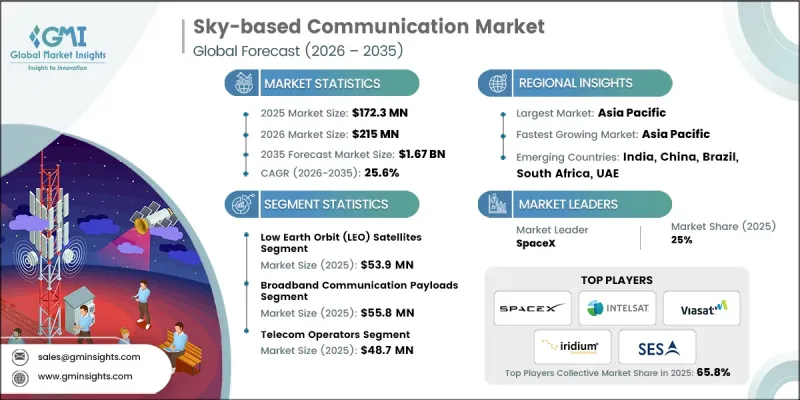
Market growth is fueled by rising demand for satellite-enabled broadband connectivity, rapid deployment of low earth orbit constellations, growing defense and secure communication needs, and expanding adoption across aviation and maritime sectors. The integration of 5G frameworks with non-terrestrial networks is further strengthening the role of satellite infrastructure in next-generation connectivity. As global efforts intensify to bridge the digital divide, satellite-based systems are emerging as a practical solution for delivering broadband access to remote and geographically challenging areas where terrestrial networks remain limited. Sky-based communication platforms offer wide-area coverage, rapid deployment, and network resilience, making them increasingly attractive for both commercial and strategic applications. The push toward universal digital inclusion, combined with rising data consumption and mobility requirements, is accelerating long-term investment across the global sky-based communication ecosystem.
| Market Scope | |
|---|---|
| Start Year | 2025 |
| Forecast Year | 2026-2035 |
| Start Value | $172.3 Million |
| Forecast Value | $1.67 Billion |
| CAGR | 25.6% |
Expanding digital public services, remote education platforms, telehealth solutions, and modernization of secure communication frameworks are increasing reliance on dependable satellite broadband infrastructure. Public sector investment, spectrum allocation support, and national connectivity initiatives are strengthening the commercial and strategic case for satellite communication networks. The rapid rollout of low-earth-orbit satellite constellations is reshaping the competitive landscape by delivering lower latency and higher bandwidth compared to traditional satellite architectures. Governments are supporting LEO integration to enhance communication resilience, improve data security, and reinforce national network redundancy, driving further expansion of the sky-based communication market.
The low earth orbit satellites segment generated USD 53.9 million in 2025. LEO satellites provide low-latency and high-throughput connectivity, making them well-suited for real-time broadband services, IoT connectivity, and direct-to-device communication solutions. Accelerated deployment of large-scale constellations by public and private operators is expanding global coverage and improving service continuity. To remain competitive, manufacturers are focusing on modular and scalable satellite platforms, advanced constellation management systems, and high-performance communication payloads designed to support evolving broadband and secure communication requirements.
The broadband communication payloads segment reached USD 55.8 million in 2025. These payloads enable high-capacity, low-latency internet services that support enterprise networks, industrial IoT, aviation connectivity, maritime communication, and government applications. Rising demand for high-speed data transfer, cloud-based services, and advanced digital applications is encouraging operators to deploy enhanced payload technologies across multiple orbital configurations, strengthening the overall satellite broadband ecosystem.
North America Sky-based Communication Market accounted for 28.6% share in 2025. The region maintains a leadership position due to significant investments in satellite broadband infrastructure, secure communication systems, and advanced ground network capabilities. Ongoing expansion of launch capacity and integration of diverse satellite constellations are increasing connectivity coverage across underserved areas. Regulatory evolution, public-private collaboration, and government-backed funding initiatives continue to accelerate commercialization while reinforcing secure communication capabilities for both civilian and defense sectors.
Key companies operating in the Global Sky-based Communication Market include SpaceX, Viasat, SES S.A., Eutelsat, OneWeb, Intelsat, Inmarsat, Iridium Communications, Telesat, AST Space Mobile, Airbus, Thales Group, L3Harris Technologies, Honeywell International, Maxar Technologies, and EchoStar. Companies in the Global Sky-based Communication Market are strengthening their market position through constellation expansion, strategic partnerships, and vertical integration. Leading players are investing in next-generation satellite platforms, reusable launch technologies, and advanced payload innovation to improve bandwidth efficiency and reduce latency. Collaboration with telecom operators and government agencies enables integration with 5G and non-terrestrial networks, expanding service reach. Firms are also focusing on software-defined satellites, network management solutions, and secure encryption technologies to enhance service reliability and defense-grade communication.
Table of Contents
Chapter 1 Methodology and Scope
- 1.1 Market scope and definition
- 1.2 Research design
- 1.2.1 Research approach
- 1.2.2 Data collection methods
- 1.3 Data mining sources
- 1.3.1 Global
- 1.3.2 Regional/Country
- 1.4 Base estimates and calculations
- 1.4.1 Base year calculation
- 1.4.2 Key trends for market estimation
- 1.5 Primary research and validation
- 1.5.1 Primary sources
- 1.6 Forecast model
- 1.7 Research assumptions and limitations
Chapter 2 Executive Summary
- 2.1 Industry 360° synopsis
- 2.2 Key market trends
- 2.2.1 Platform layer trends
- 2.2.2 Payload type trends
- 2.2.3 End-user industry trends
- 2.2.4 Regional trends
- 2.3 TAM Analysis, 2026 - 2035 (USD Million)
- 2.4 CXO perspectives: Strategic imperatives
- 2.4.1 Executive decision points
- 2.4.2 Critical success factors
- 2.5 Future outlook and strategic recommendations
Chapter 3 Industry Insights
- 3.1 Industry ecosystem analysis
- 3.1.1 Supplier landscape
- 3.1.2 Profit margin
- 3.1.3 Cost structure
- 3.1.4 Value addition at each stage
- 3.1.5 Factor affecting the value chain
- 3.1.6 Disruptions
- 3.2 Industry impact forces
- 3.2.1 Growth drivers
- 3.2.1.1 Rising demand for satellite-based broadband connectivity
- 3.2.1.2 Expansion of low earth orbit (LEO) satellite constellations
- 3.2.1.3 Growing defense and secure communication requirements
- 3.2.1.4 Increasing adoption in aviation and maritime connectivity
- 3.2.1.5 Integration of 5G and non-terrestrial networks (NTN)
- 3.2.2 Pitfalls and challenges
- 3.2.2.1 High deployment and infrastructure costs
- 3.2.2.2 Signal latency and space debris risks
- 3.2.1 Growth drivers
- 3.3 Growth potential analysis
- 3.4 Regulatory landscape
- 3.4.1 North America
- 3.4.2 Europe
- 3.4.3 Asia Pacific
- 3.4.4 Latin America
- 3.4.5 Middle East & Africa
- 3.5 Porter’s analysis
- 3.6 PESTEL analysis
- 3.7 Technology and Innovation landscape
- 3.7.1 Current technological trends
- 3.7.2 Emerging technologies
- 3.8 Emerging Business Models
- 3.9 Compliance Requirements
- 3.10 Supply Chain Resilience
- 3.11 Defense Budget Analysis
- 3.12 Global Defense Spending Trends
- 3.13 Regional Defense Budget Allocation
- 3.13.1 North America
- 3.13.2 Europe
- 3.13.3 Asia Pacific
- 3.13.4 Middle East and Africa
- 3.13.5 Latin America
- 3.14 Key Defense Modernization Programs
- 3.15 Budget Forecast (2025-2034)
- 3.15.1 Impact on Industry Growth
- 3.15.2 Defense Budgets by Country
- 3.15.3 Defense Budget Allocation by Segment
- 3.15.3.1 Personnel
- 3.15.3.2 Operations and Maintenance
- 3.15.3.3 Procurement
- 3.15.3.4 Research, Development, Test and Evaluation
- 3.15.3.5 Infrastructure and Construction
- 3.15.3.6 Technology and Innovation
- 3.16 Sustainability Initiatives
- 3.17 Supply Chain Resilience
- 3.18 Geopolitical Analysis
- 3.19 Workforce Analysis
- 3.20 Digital Transformation
- 3.21 Mergers, Acquisitions, and Strategic Partnerships Landscape
- 3.22 Risk Assessment and Management
- 3.23 Major Contract Awards (2022-2025)
Chapter 4 Competitive Landscape, 2025
- 4.1 Introduction
- 4.2 Company market share analysis
- 4.2.1 By region
- 4.2.1.1 North America
- 4.2.1.2 Europe
- 4.2.1.3 Asia Pacific
- 4.2.1.4 Latin America
- 4.2.1.5 Middle East & Africa
- 4.2.2 Market concentration analysis
- 4.2.1 By region
- 4.3 Competitive benchmarking of key players
- 4.3.1 Product portfolio comparison
- 4.3.1.1 Product range breadth
- 4.3.1.2 Technology
- 4.3.1.3 Innovation
- 4.3.2 Geographic presence comparison
- 4.3.2.1 Global footprint analysis
- 4.3.2.2 Service network coverage
- 4.3.2.3 Market penetration by region
- 4.3.3 Competitive positioning matrix
- 4.3.3.1 Leaders
- 4.3.3.2 Challengers
- 4.3.3.3 Followers
- 4.3.3.4 Niche players
- 4.3.4 Strategic outlook matrix
- 4.3.1 Product portfolio comparison
- 4.4 Key developments, 2022-2025
- 4.4.1 Mergers and acquisitions
- 4.4.2 Partnerships and collaborations
- 4.4.3 Technological advancements
- 4.4.4 Expansion and investment strategies
- 4.4.5 Sustainability initiatives
- 4.4.6 Digital transformation initiatives
- 4.5 Emerging/ startup competitors landscape
Chapter 5 Market Estimates and Forecast, By Platform Layer, 2022 - 2035 (USD Million)
- 5.1 Key trends
- 5.2 High Altitude Platform Systems (HAPS)
- 5.3 Near-Space Platforms (NSP)
- 5.4 Low Earth Orbit (LEO) Satellites
- 5.5 Medium Earth Orbit (MEO) Satellites
- 5.6 Geostationary Orbit (GEO) Satellites
Chapter 6 Market Estimates and Forecast, By Payload Type, 2022 - 2035 (USD Million)
- 6.1 Key trends
- 6.2 Broadband Communication Payloads
- 6.3 Narrowband / IoT Payloads
- 6.4 Mobile Backhaul Payloads
- 6.5 Direct-to-Device (D2D) Payloads
- 6.6 Broadcast Payloads (TV/Radio)
- 6.7 Military Secure Communication Payloads
Chapter 7 Market Estimates and Forecast, By End-User Industry, 2022 - 2035 (USD Million)
- 7.1 Key trends
- 7.2 Telecom Operators
- 7.3 Aviation Industry
- 7.4 Maritime Industry
- 7.5 Defense & Homeland Security
- 7.6 Government Agencies
- 7.7 Others
Chapter 8 Market Estimates and Forecast, By Region, 2022 - 2035 (USD Million)
- 8.1 Key trends
- 8.2 North America
- 8.2.1 U.S.
- 8.2.2 Canada
- 8.3 Europe
- 8.3.1 Germany
- 8.3.2 UK
- 8.3.3 France
- 8.3.4 Spain
- 8.3.5 Italy
- 8.3.6 Netherlands
- 8.4 Asia Pacific
- 8.4.1 China
- 8.4.2 India
- 8.4.3 Japan
- 8.4.4 Australia
- 8.4.5 South Korea
- 8.5 Latin America
- 8.5.1 Brazil
- 8.5.2 Mexico
- 8.5.3 Argentina
- 8.6 Middle East and Africa
- 8.6.1 Saudi Arabia
- 8.6.2 South Africa
- 8.6.3 UAE
Chapter 9 Company Profiles
- 9.1 Global Key Players
- 9.1.1 SpaceX
- 9.1.2 Intelsat
- 9.1.3 SES S.A.
- 9.1.4 Inmarsat
- 9.1.5 Viasat
- 9.2 Regional Key Players
- 9.2.1 North America
- 9.2.1.1 L3Harris Technologies
- 9.2.1.2 Honeywell International
- 9.2.1.3 EchoStar
- 9.2.1.4 AST SpaceMobile
- 9.2.1.5 Maxar Technologies
- 9.2.2 Europe
- 9.2.2.1 Eutelsat OneWeb
- 9.2.2.2 Thales Group
- 9.2.2.3 Airbus
- 9.2.3 Asia Pacific
- 9.2.3.1 Telesat
- 9.2.1 North America
- 9.3 Niche / Disruptors
- 9.3.1 Iridium Communications

