PUBLISHER: Global Market Insights Inc. | PRODUCT CODE: 1982310

PUBLISHER: Global Market Insights Inc. | PRODUCT CODE: 1982310
U.S. Residential Heat Pump Market Opportunity, Growth Drivers, Industry Trend Analysis, and Forecast 2026 - 2035
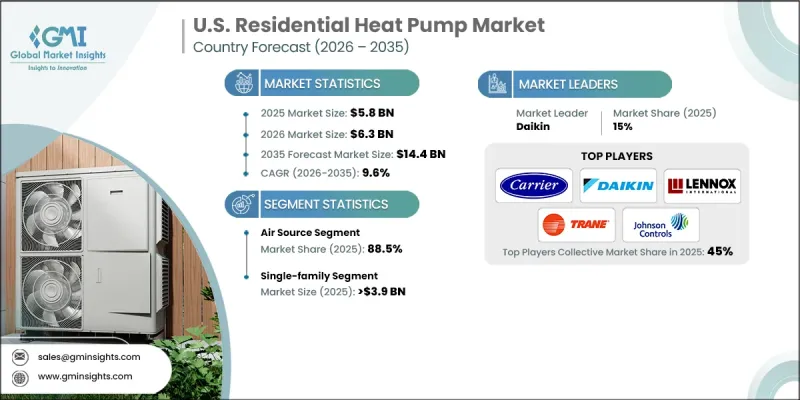
U.S. Residential Heat Pump Market was valued at USD 5.8 billion in 2025 and is estimated to grow at a CAGR of 9.6% to reach USD 14.4 billion by 2035.
Strong momentum toward renewable energy integration within HVAC systems and the steady transition away from traditional heating technologies are driving sustained market expansion. Heightened focus on lowering carbon emissions and improving household energy efficiency continues to reshape consumer purchasing behavior. Growth in new residential construction alongside large-scale home renovation projects is accelerating demand for advanced heating and cooling solutions. Homeowners are increasingly prioritizing dependable systems that deliver efficient space heating, cooling, and water heating while reducing long-term energy expenses. Supportive regulatory mandates aimed at limiting high-emission equipment are further encouraging widespread residential heat pump adoption. Manufacturers are broadening product portfolios to address evolving efficiency standards and performance expectations. Rising replacement of legacy systems, combined with growing environmental awareness, is reinforcing long-term market growth. Continuous product innovation designed to enhance affordability, operational reliability, and performance across varying temperature conditions is strengthening deployment across diverse U.S. climate zones. Financial incentives promoting energy-efficient home upgrades are also contributing to accelerated industry penetration.
| Market Scope | |
|---|---|
| Start Year | 2025 |
| Forecast Year | 2026-2035 |
| Start Value | $5.8 Billion |
| Forecast Value | $14.4 Billion |
| CAGR | 9.6% |
The air source segment held 88.5% share in 2025 and is anticipated to grow at a CAGR of 10.1% through 2035. Strong residential demand for year-round heating and cooling, combined with the high efficiency and reduced energy consumption of air source systems, is supporting segment dominance. Advancements in environmentally conscious system designs are aligning with evolving sustainability goals and reinforcing regulatory compliance requirements. These improvements are enhancing system appeal among homeowners seeking energy-efficient and lower-emission alternatives.
The single-family application segment generated USD 3.9 billion in 2025. Expansion within this category is supported by continued housing development, urban population growth, and government-backed rebate programs encouraging heat pump installation. Enhanced engineering advancements have improved system durability, temperature precision, and operational quietness, increasing adoption across single-family residences. Improved adaptability to diverse weather conditions is further strengthening product uptake within this segment.
Key companies operating in the U.S. Residential Heat Pump Market include American Standard Heating and Air Conditioning, Bard HVAC, Baxi, Blue Star, Bosch Thermotechnology, Bryant Heating and Cooling, Carrier, Daikin, EarthLinked Technologies, Fujitsu General, Goodman, Johnson Controls, Lennox International, LG Electronics, Miami Heat Pump, Midea, Mitsubishi Electric Trane HVAC US, Panasonic North America, Rheem Manufacturing, SpacePak, and Trane Technologies. Companies in the U.S. residential heat pump market are enhancing their market position through continuous investment in research and development focused on high-efficiency, low-emission technologies. Strategic collaborations with distributors, contractors, and homebuilders are expanding sales networks and strengthening customer outreach. Many manufacturers are diversifying product lines to address varying climate conditions and residential needs while integrating smart connectivity features for improved user control. Competitive pricing strategies, financing options, and participation in incentive programs are increasing product accessibility.
Table of Contents
Chapter 1 Methodology & Scope
- 1.1 Research design
- 1.2 Quality commitment
- 1.2.1 GMI AI policy & data integrity commitment
- 1.2.1.1 Source consistency protocol
- 1.2.1 GMI AI policy & data integrity commitment
- 1.3 Research Trail & Confidence Scoring
- 1.3.1 Research Trail Components
- 1.3.2 Scoring components
- 1.4 Data Collection
- 1.4.1 Partial list of primary sources
- 1.5 Data mining sources
- 1.5.1 Paid Sources
- 1.5.1.1 Sources, by country
- 1.5.1 Paid Sources
- 1.6 Base estimates and calculations
- 1.6.1 Base year calculation for any one approach
- 1.7 Forecast model
- 1.8 Research transparency addendum
- 1.8.1 Source attribution framework
- 1.8.2 Quality assurance metrics
- 1.8.3 Our commitment to trust
- 1.9 Market definitions
Chapter 2 Executive Summary
- 2.1 Industry synopsis, 2022 - 2035
- 2.2 Business trends
- 2.3 Product trends
- 2.4 Application trends
Chapter 3 Industry Insights
- 3.1 Industry ecosystem analysis
- 3.1.1 Raw material availability & sourcing analysis
- 3.1.2 Key factors affecting the value chain
- 3.1.3 Disruptions
- 3.2 Industry impact forces
- 3.2.1 Growth drivers
- 3.2.2 Industry pitfalls & challenges
- 3.3 Growth potential analysis
- 3.4 Regulatory landscape
- 3.5 Porter's analysis
- 3.5.1 Bargaining power of suppliers
- 3.5.2 Bargaining power of buyers
- 3.5.3 Threat of new entrants
- 3.5.4 Threat of substitutes
- 3.6 PESTEL analysis
- 3.6.1 Political factors
- 3.6.2 Economic factors
- 3.6.3 Social factors
- 3.6.4 Technological factors
- 3.6.5 Legal factors
- 3.6.6 Environmental factors
- 3.7 Price trend analysis (USD/Unit)
- 3.7.1 By product
- 3.7.2 By application
- 3.8 Cost structure analysis of heat pumps
- 3.9 Emerging opportunities & trends
- 3.9.1 Digital transformation with IoT technologies
- 3.9.2 Emerging market penetration
- 3.10 Investment analysis & future outlook
Chapter 4 Competitive Landscape, 2026
- 4.1 Introduction
- 4.2 Company market share analysis, 2025
- 4.3 Competitive positioning matrix
- 4.4 Key developments
- 4.4.1 Mergers & acquisitions
- 4.4.2 Partnerships & collaborations
- 4.4.3 New product launches
- 4.4.4 Expansion plans and funding
Chapter 5 Market Size and Forecast, By Product, 2022 - 2035, (USD Million and '000 Units)
- 5.1 Key trends
- 5.2 Air Source
- 5.3 Ground Source
- 5.4 Water Source
Chapter 6 Market Size and Forecast, By Application, 2022 - 2035, (USD Million and '000 Units)
- 6.1 Key trends
- 6.2 Single Family
- 6.3 Multi Family
Chapter 7 Company Profiles
- 7.1 American Standard Heating and Air Conditioning
- 7.2 Bard HVAC
- 7.3 Baxi
- 7.4 Blue Star
- 7.5 Bosch Thermotechnology
- 7.6 Bryant Heating and Cooling
- 7.7 Carrier
- 7.8 Daikin
- 7.9 EarthLinked Technologies
- 7.10 Fujitsu General
- 7.11 Goodman
- 7.12 Johnson Controls
- 7.13 Lennox International
- 7.14 LG Electronics
- 7.15 Miami Heat Pump
- 7.16 Midea
- 7.17 Mitsubishi Electric Trane HVAC US
- 7.18 Panasonic North America
- 7.19 Rheem Manufacturing
- 7.20 SpacePak
- 7.21 Trane Technologies

