
PUBLISHER: Global Market Insights Inc. | PRODUCT CODE: 1982316

PUBLISHER: Global Market Insights Inc. | PRODUCT CODE: 1982316
Eyelash Serum Market Opportunity, Growth Drivers, Industry Trend Analysis, and Forecast 2026 - 2035
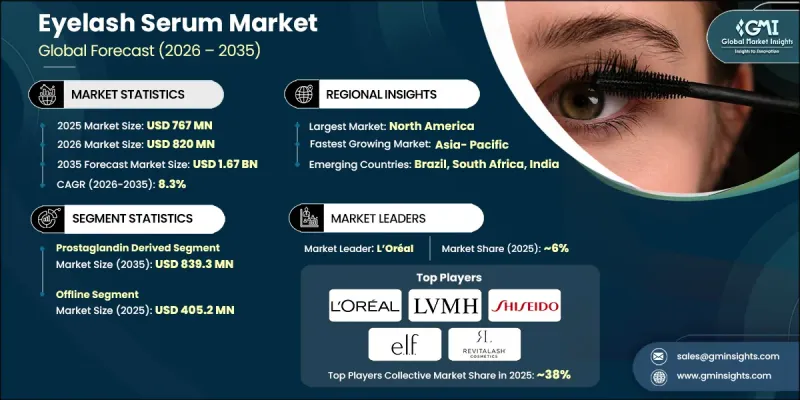
The Global Eyelash Serum Market was valued at USD 767 million in 2025 and is estimated to grow at a CAGR of 8.3% to reach USD 1.67 billion by 2035.
Market expansion is driven by rising consumer interest in natural beauty enhancement, continuous product innovation, and the industry's increasing emphasis on sustainability. Beauty brands are reformulating products with cleaner ingredient profiles while investing in environmentally responsible packaging solutions. Eyelash serums are gaining popularity as a convenient and low-maintenance alternative to artificial lash applications, aligning with the growing preference for subtle, natural-looking results. Consumers are increasingly seeking cost-effective and time-saving beauty solutions that integrate seamlessly into daily self-care routines. Compared to more resource-intensive cosmetic enhancements, serums present a practical option that supports both affordability and eco-conscious consumption. This shift reflects a broader industry transition toward ethical beauty standards and responsible product development practices. As digital marketing accelerates product awareness and accessibility, eyelash serums continue to secure a stronger position within the global eye care and cosmetic treatment landscape.
| Market Scope | |
|---|---|
| Start Year | 2025 |
| Forecast Year | 2026-2035 |
| Start Value | $767 Million |
| Forecast Value | $1.67 Billion |
| CAGR | 8.3% |
North America remains one of the most influential regions in the eyelash serum market, supported by strong beauty consciousness, advanced online retail infrastructure, and rapid consumer adoption of emerging cosmetic technologies. Convenience-driven purchasing behavior, combined with subscription models and direct-to-consumer distribution channels, is reinforcing steady product demand. Consumers increasingly value simple at-home applications and consistent replenishment services, which enhance brand loyalty and long-term engagement within the region.
The prostaglandin-derived segment generated USD 364.2 million in 2025 and is expected to reach USD 839.3 million by 2035. This segment maintains dominance due to its clinically supported performance in enhancing lash length, thickness, and pigmentation. Prostaglandin-based formulations are recognized for extending the active growth phase of hair follicles, delivering more pronounced and longer-lasting results compared to alternative conditioning-based ingredients. Their measurable efficacy continues to position them as a preferred choice among consumers seeking visible improvements.
The offline distribution channel accounted for USD 405.2 million in 2025, representing 50% share. Physical retail outlets remain critical points of purchase, particularly for products applied near sensitive areas such as the eyes. Many consumers prefer in-store shopping experiences that allow ingredient verification and professional guidance prior to purchase. Trust, product demonstration, and personalized consultation continue to sustain offline channel strength within the eyelash serum market.
U.S. Eyelash Serum Market reached USD 198.5 million in 2025 and is anticipated to grow at a CAGR of 7.5% between 2026 and 2035. High consumer spending power and strong demand for premium beauty products contribute to regional leadership. Growing expenditure on personal care reflects sustained interest in specialized cosmetic solutions, including lash enhancement products. Cultural emphasis on aesthetic appearance and non-invasive beauty treatments continues to support product adoption across diverse consumer segments.
Major companies operating in the Global Eyelash Serum Market include L'Oreal, Shiseido, Allergan (AbbVie), Dior, RevitaLash, Grande Cosmetics, RapidLash, and E.l.f. Cosmetics, Benefit Cosmetics, Skin Research Laboratories, Mavala, Neora, Uklash, DHC, and JB Cosmetics. Companies in the Eyelash Serum Market are strengthening their competitive positioning through continuous innovation and brand differentiation strategies. Leading players are investing in advanced research to develop high-performance formulations with improved safety profiles and clinically supported claims. Clean beauty positioning and sustainable packaging initiatives are enhancing brand credibility among environmentally conscious consumers. Firms are expanding digital marketing efforts through influencer collaborations and social media engagement to drive product awareness. Subscription-based sales models and direct-to-consumer platforms are improving customer retention and recurring revenue streams.
Table of Contents
Chapter 1 Methodology & Scope
- 1.1 Market scope and definition
- 1.2 Research design
- 1.2.1 Research approach
- 1.2.2 Data collection methods
- 1.3 Data mining sources
- 1.3.1 Global
- 1.3.2 Regional/Country
- 1.4 Base estimates and calculations
- 1.4.1 Base year calculation
- 1.4.2 Key trends for market estimation
- 1.5 Primary research and validation
- 1.5.1 Primary sources
- 1.6 Forecast model
- 1.7 Research assumptions and limitations
Chapter 2 Executive Summary
- 2.1 Industry 360° synopsis
- 2.2 Key market trends
- 2.2.1 Regional trends
- 2.2.2 Product type trends
- 2.2.3 End-user trends
- 2.2.4 Price trends
- 2.2.5 Distribution channel trends
- 2.3 CXO perspective: Strategic imperatives
- 2.3.1 Key decision points for industry executives
- 2.3.2 Critical success factors for market players
- 2.4 Future outlook and strategic recommendations
- 2.5 Strategic recommendations
- 2.5.1 Supply chain diversification strategy
- 2.5.2 Product portfolio enhancement
- 2.5.3 Partnership and alliance opportunities
- 2.5.4 Cost management and pricing strategy
- 2.6 Decision framework
- 2.6.1 Investment priority matrix
- 2.6.2 ROI analysis
Chapter 3 Industry Insights
- 3.1 Industry ecosystem analysis
- 3.1.1 Supplier Landscape
- 3.1.2 Profit Margin
- 3.1.3 Value addition at each stage
- 3.1.4 Factor affecting the value chain
- 3.2 Industry impact forces
- 3.2.1 Growth drivers
- 3.2.2 Industry pitfalls & challenges
- 3.2.3 Opportunities
- 3.3 Growth potential analysis
- 3.4 Future market trends
- 3.5 Price trends
- 3.5.1 By Region
- 3.5.2 By Product type
- 3.6 Regulatory framework
- 3.7 Consumer buying behavior analysis
- 3.7.1 Demographic trends
- 3.7.2 Factors affecting buying decisions
- 3.7.3 Consumer product adoption
- 3.7.4 Preferred distribution channel
- 3.7.5 Preferred price range
- 3.8 Porter's five forces analysis
- 3.9 PESTEL analysis
Chapter 4 Competitive Landscape, 2025
- 4.1 Introduction
- 4.2 Company market share analysis
- 4.2.1 By region
- 4.2.1.1 North America
- 4.2.1.2 Europe
- 4.2.1.3 Asia Pacific
- 4.2.1.4 Latin America
- 4.2.1.5 Middle East and Africa
- 4.2.1 By region
- 4.3 Company matrix analysis
- 4.4 Competitive analysis of major market players
- 4.5 Competitive positioning matrix
- 4.6 Product portfolio benchmarking
- 4.7 Key developments
- 4.7.1 Mergers & acquisitions
- 4.7.2 Partnerships & collaborations
- 4.7.3 New Product Launches
- 4.7.4 Expansion Plans
Chapter 5 Market Estimates & Forecast, By Product Type, 2022- 2035 (USD Million) (Thousand Units)
- 5.1 Key trends
- 5.2 Prostaglandin derived
- 5.3 Peptide based
- 5.4 Vitamin based
Chapter 6 Market Estimates & Forecast, By End-user, 2022 - 2035 (USD Million) (Thousand Units)
- 6.1 Key trends
- 6.2 Women
- 6.3 Men
Chapter 7 Market Estimates & Forecast, By Price, 2022 - 2035 (USD Million) (Thousand Units)
- 7.1 Key trends
- 7.2 Low
- 7.3 Medium
- 7.4 High
Chapter 8 Market Estimates & Forecast, By Distribution Channel, 2022 - 2035, (USD Million) (Thousand Units)
- 8.1 Key trends
- 8.2 Online
- 8.2.1 E-Commerce website
- 8.2.2 Company owned website
- 8.3 Offline
- 8.3.1 Department stores
- 8.3.2 Pharmaceutical stores
- 8.3.3 Beauty salons
Chapter 9 Market Estimates & Forecast, By Region, 2022 - 2035, (USD Million) (Thousand Units)
- 9.1 Key trends
- 9.2 North America
- 9.2.1 U.S.
- 9.2.2 Canada
- 9.3 Europe
- 9.3.1 Germany
- 9.3.2 U.K.
- 9.3.3 France
- 9.3.4 Italy
- 9.3.5 Spain
- 9.4 Asia Pacific
- 9.4.1 China
- 9.4.2 India
- 9.4.3 Japan
- 9.4.4 South Korea
- 9.4.5 Australia
- 9.5 Latin America
- 9.5.1 Brazil
- 9.5.2 Mexico
- 9.5.3 Argentina
- 9.6 MEA
- 9.6.1 UAE
- 9.6.2 Saudi Arabia
- 9.6.3 South Africa
Chapter 10 Company Profiles (Business Overview, Financial Data, Product Landscape, Strategic Outlook, SWOT Analysis)
- 10.1 Allergan (AbbVie)
- 10.2 Benefit Cosmetics
- 10.3 DHC
- 10.4 Dior
- 10.5 E.l.f. Cosmetics
- 10.6 Grande Cosmetics
- 10.7 JB Cosmetics
- 10.8 L'Oreal
- 10.9 Mavala
- 10.10 Neora
- 10.11 RapidLash
- 10.12 RevitaLash
- 10.13 Shiseido
- 10.14 Skin Research Laboratories
- 10.15 Uklash

