
PUBLISHER: Global Market Insights Inc. | PRODUCT CODE: 1982317

PUBLISHER: Global Market Insights Inc. | PRODUCT CODE: 1982317
Liquid Ring Vacuum Pump Market Opportunity, Growth Drivers, Industry Trend Analysis, and Forecast 2026 - 2035
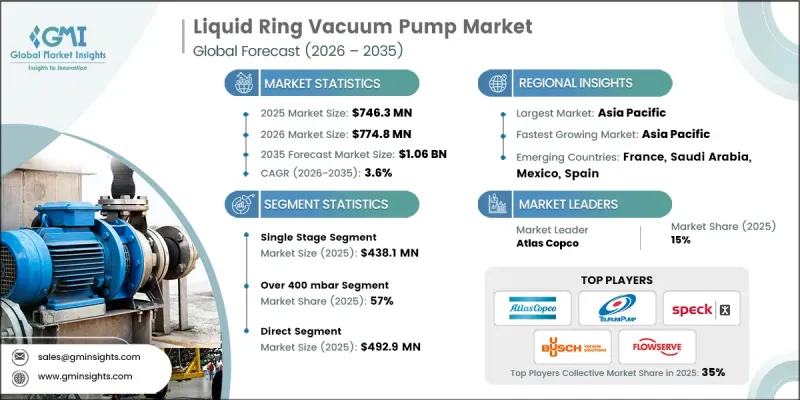
The Global Liquid Ring Vacuum Pump Market was valued at USD 746.3 million in 2025 and is estimated to grow at a CAGR of 3.6% to reach USD 1.06 billion by 2035.
Demand for liquid ring vacuum pumps is primarily driven by core process industries, where handling wet, saturated, or contaminated gases is essential. Industries such as chemicals, pharmaceuticals, food and beverage, oil and gas, and pulp and paper rely heavily on vacuum systems that provide stable, reliable operation under variable process conditions. As production capacity increases and existing systems are modernized, manufacturers are prioritizing vacuum solutions that ensure operational stability, low maintenance, and resilience to contamination. Liquid ring pumps are particularly suitable for applications like distillation, solvent recovery, vacuum drying, filtering, and degassing, making them indispensable for many industrial processes.
| Market Scope | |
|---|---|
| Start Year | 2025 |
| Forecast Year | 2026-2035 |
| Start Value | $746.3 Million |
| Forecast Value | $1.06 Billion |
| CAGR | 3.6% |
The adoption of continuous processing and automation further supports the need for vacuum pumps capable of extended, low-maintenance operation. Liquid ring pumps, with their simple mechanical design and high tolerance for debris, liquids, and corrosive vapors, are ideal for facilities producing gas streams containing solids or moisture. Their reliability and operational flexibility ensure minimal downtime, particularly in demanding industrial environments.
In 2025, the single-stage pumps segment reached USD 438.1 million. Single-stage liquid ring vacuum pumps feature a single compression stage with an impeller rotating eccentrically within a partially liquid-filled casing, forming a stable liquid ring that compresses gas smoothly. This design delivers pulsation-free operation while safely handling wet, saturated, or contaminated gases, making them suitable for processes with variable conditions or high moisture content.
The pumps with discharge capabilities above 400 mbar segment held 57% share in 2025. These pumps maintain steady suction under varying conditions, making them ideal for applications involving high-moisture gases or large particles, where deep vacuum is unnecessary. Their performance at higher discharge pressures allows them to efficiently handle vapors, vacuum degassing, filter support, and fluid transfer without creating extremely low absolute pressure.
U.S. Liquid Ring Vacuum Pump Market accounted for 82.9% share in 2025, generating USD 158.4 million. The strong industrial framework, coupled with significant vacuum technology requirements across chemical, pharmaceutical, food processing, and energy sectors, supports demand for liquid ring vacuum pumps. Their ability to manage saturated gases, variable loads, and extreme operating conditions aligns with the U.S. focus on operational safety, process stability, and environmental compliance.
Key players in the Global Liquid Ring Vacuum Pump Market include Atlas Copco, Dekker Vacuum, Ingersoll Rand, Flowserve, Tsurumi, Samson, Graham Engineering, Vooner, Omel, Speck Pumpen, PPI Pumps, Busch Vacuum Solutions, Finder, Cutes, and Zibo Zhaohan. Companies in the Liquid Ring Vacuum Pump Market are pursuing multiple strategies to strengthen their presence and market foothold. These include expanding manufacturing capacities, developing advanced, energy-efficient, and corrosion-resistant models, and investing in R&D to enhance performance under variable process conditions. Strategic collaborations with end-user industries and after-sales service networks improve market penetration.
Table of Contents
Chapter 1 Methodology and Scope
- 1.1 Market scope and definition
- 1.2 Research design
- 1.2.1 Research approach
- 1.2.2 Data collection methods
- 1.3 Data mining sources
- 1.3.1 Global
- 1.3.2 Regional/Country
- 1.4 Base estimates and calculations
- 1.4.1 Base year calculation
- 1.4.2 Key trends for market estimation
- 1.5 Primary research and validation
- 1.5.1 Primary sources
- 1.6 Forecast model
- 1.7 Research assumptions and limitations
Chapter 2 Executive Summary
- 2.1 Industry 360° synopsis
- 2.2 Key market trends
- 2.2.1 Regional
- 2.2.2 Type
- 2.2.3 Material
- 2.2.4 Capacity
- 2.2.5 Flow rate
- 2.2.6 Application
- 2.2.7 Distribution channel
- 2.3 CXO perspectives: Strategic imperatives
- 2.3.1 Key decision points for industry executives
- 2.3.2 Critical success factors for market players
- 2.4 Future outlook and strategic recommendations
Chapter 3 Industry Insights
- 3.1 Industry ecosystem analysis
- 3.1.1 Supplier landscape
- 3.1.2 Profit margin
- 3.1.3 Value addition at each stage
- 3.1.4 Factor affecting the value chain
- 3.2 Industry impact forces
- 3.2.1 Growth drivers
- 3.2.1.1 Rising demand from process industries
- 3.2.1.2 Growing focus on environmental compliance
- 3.2.1.3 Rising industrialization and automation
- 3.2.2 Industry pitfalls & challenges
- 3.2.2.1 Limited vacuum depth
- 3.2.2.2 High water consumption
- 3.2.3 Opportunities
- 3.2.3.1 Advancements in two-stage LRVP designs
- 3.2.3.2 Sustainability-driven innovations
- 3.2.1 Growth drivers
- 3.3 Growth potential analysis
- 3.4 Future market trends
- 3.5 Technology and innovation landscape
- 3.5.1 Current technological trends
- 3.5.2 Emerging technologies
- 3.6 Price trends
- 3.6.1 By region
- 3.6.2 By type
- 3.7 Regulatory landscape
- 3.7.1 Standards and compliance requirements
- 3.7.2 Regional regulatory frameworks
- 3.7.3 Certification standards
- 3.8 Porter’s analysis
- 3.9 PESTEL analysis
Chapter 4 Competitive Landscape, 2025
- 4.1 Introduction
- 4.2 Company market share analysis
- 4.2.1 By region
- 4.2.1.1 North America
- 4.2.1.2 Europe
- 4.2.1.3 Asia Pacific
- 4.2.1.4 Latin America
- 4.2.1.5 Middle East and Africa
- 4.2.1 By region
- 4.3 Company matrix analysis
- 4.4 Competitive analysis of major market players
- 4.5 Competitive positioning matrix
- 4.6 Key developments
- 4.6.1 Mergers & acquisitions
- 4.6.2 Partnerships & collaborations
- 4.6.3 New product launches
- 4.6.4 Expansion plans
Chapter 5 Market Estimates and Forecast, By Type, 2022 - 2035 (USD Million) (Million Units)
- 5.1 Key trends
- 5.2 Single stage
- 5.3 Two stages
Chapter 6 Market Estimates and Forecast, By Material, 2022 - 2035 (USD Million) (Million Units)
- 6.1 Key trends
- 6.2 Cast iron
- 6.3 Stainless steel
- 6.4 Other
Chapter 7 Market Estimates and Forecast, By Capacity, 2022 - 2035 (USD Million) (Million Units)
- 7.1 Key trends
- 7.2 Up to 200 mbar
- 7.3 200 to 400 mbar
- 7.4 Over 400 mbar
Chapter 8 Market Estimates and Forecast, By Flow Rate, 2022 - 2035 (USD Million) (Million Units)
- 8.1 Key trends
- 8.2 25 - 600 M3H
- 8.3 600 - 3000 M3H
- 8.4 3000 - 10000 M3H
- 8.5 Over 10000 M3
Chapter 9 Market Estimates and Forecast, By Application, 2022 - 2035 (USD Million) (Million Units)
- 9.1 Key trends
- 9.2 Petrochemical & chemical
- 9.3 Pharmaceutical
- 9.4 Food manufacturing
- 9.5 Aircraft
- 9.6 Automobile
- 9.7 Water treatment
- 9.8 Oil & gas
- 9.9 Power generation
- 9.10 EPS and plastics
- 9.11 Pulp & paper
- 9.12 Others
Chapter 10 Market Estimates and Forecast, By Distribution Channel, 2022 - 2035 (USD Million) (Million Units)
- 10.1 Key trends
- 10.2 Direct
- 10.3 Indirect
Chapter 11 Market Estimates and Forecast, By Region, 2022 - 2035 (USD Million) (Million Units)
- 11.1 Key trends
- 11.2 North America
- 11.2.1 U.S.
- 11.2.2 Canada
- 11.3 Europe
- 11.3.1 Germany
- 11.3.2 UK
- 11.3.3 France
- 11.3.4 Italy
- 11.3.5 Spain
- 11.4 Asia Pacific
- 11.4.1 China
- 11.4.2 Japan
- 11.4.3 India
- 11.4.4 Australia
- 11.4.5 South Korea
- 11.5 Latin America
- 11.5.1 Brazil
- 11.5.2 Mexico
- 11.5.3 Argentina
- 11.6 Middle East and Africa
- 11.6.1 South Africa
- 11.6.2 Saudi Arabia
- 11.6.3 UAE
Chapter 12 Company Profiles
- 12.1 Atlas Copco
- 12.2 Busch Vacuum Solutions
- 12.3 Cutes
- 12.4 Dekker Vacuum
- 12.5 Finder
- 12.6 Flowserve
- 12.7 Graham Engineering
- 12.8 Ingersoll Rand
- 12.9 Omel
- 12.10 PPI Pumps
- 12.11 Samson
- 12.12 Speck Pumpen
- 12.13 Tsurumi
- 12.14 Vooner
- 12.15 Zibo Zhaohan

