PUBLISHER: Global Market Insights Inc. | PRODUCT CODE: 1982318

PUBLISHER: Global Market Insights Inc. | PRODUCT CODE: 1982318
Microsurgery Robot Market Opportunity, Growth Drivers, Industry Trend Analysis, and Forecast 2026 - 2035
The Global Microsurgery Robot Market was valued at USD 1.7 billion in 2025 and is estimated to grow at a CAGR of 13.5% to reach USD 6 billion by 2035.
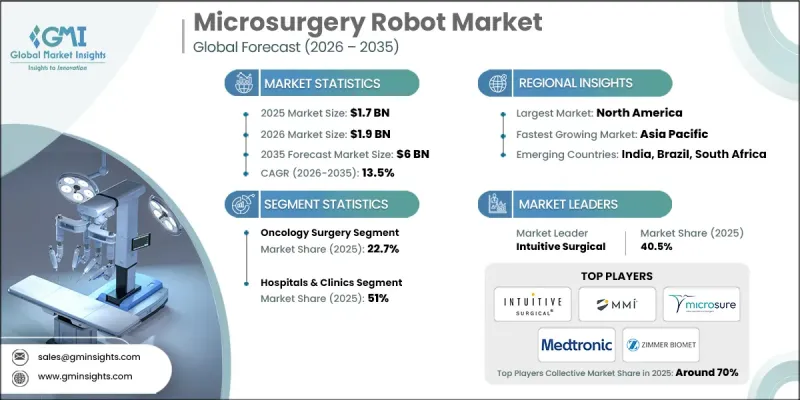
Market expansion is fueled by the growing preference for minimally invasive surgical techniques, rapid innovation in robotic-assisted platforms, and the increasing incidence of chronic health conditions that require precision-based surgical intervention. Rising financial support for advanced robotic development in developed economies, combined with expanding surgeon training initiatives, is strengthening adoption rates. Continuous R&D investments, MedTech collaborations, and the introduction of more affordable robotic systems are further accelerating the commercialization process. Healthcare providers worldwide are shifting toward minimally invasive approaches due to clinical advantages such as reduced trauma, shorter recovery durations, lower complication risks, and improved patient satisfaction. Hospitals are also prioritizing robotic integration to enhance surgical precision, standardize complex procedures, and optimize long-term treatment outcomes, positioning microsurgery robots as a transformative solution in modern operating environments.
| Market Scope | |
|---|---|
| Start Year | 2025 |
| Forecast Year | 2026-2035 |
| Start Value | $1.7 Billion |
| Forecast Value | $6 Billion |
| CAGR | 13.5% |
The increasing global burden of chronic disorders requiring surgical management continues to drive demand for robotic-assisted microsurgical systems. Complex procedures across multiple specialties benefit from enhanced dexterity, tremor filtration, and magnified visualization enabled by robotic platforms. As surgical complexity increases, robotic technologies are being utilized to improve accuracy, consistency, and overall procedural efficiency, strengthening their role in advanced healthcare delivery systems.
The urology surgery segment generated USD 352.3 million in 2025. This segment remains a strong contributor due to early adoption of robotic systems within the specialty and continued integration into routine surgical workflows. Growth momentum is expected to stem from expansion into developing regions, increasing use in technically demanding procedures, and the introduction of procedure-specific robotic platforms designed to enhance surgical performance.
The hospitals and clinics segment held 51% share in 2025. Large tertiary care institutions and academic medical centers account for a substantial portion of installations, often managing multiple robotic systems across diverse surgical disciplines. These facilities benefit from high procedural volumes, structured training ecosystems, supportive reimbursement frameworks, and the capital capacity required for advanced technology acquisition.
U.S. Microsurgery Robot Market was valued at USD 898.8 million in 2025. Rising volumes of specialized surgical procedures are anticipated to stimulate continued expansion. The country maintains leadership due to sophisticated healthcare infrastructure, favorable reimbursement support from public and private payers, well-defined regulatory pathways encouraging innovation, strong procedural demand across specialties, and comprehensive surgeon education programs.
Key companies operating in the Global Microsurgery Robot Market include Intuitive Surgical, Medtronic, Siemens Healthineers, Zimmer Biomet, CMR Surgical, ASENSUS SURGICAL, Distalmotion, Medical Micro Instruments (MMI), MicroSure, meerecompany, and Preceyes. Companies in the microsurgery robot market are strengthening their competitive positioning through sustained investment in next-generation robotic platforms and digital surgical ecosystems. Strategic partnerships with hospitals and academic institutions support training expansion and product validation. Manufacturers are prioritizing system miniaturization, improved haptic feedback, and AI-enabled imaging integration to enhance clinical precision. Portfolio diversification across multiple surgical specialties allows companies to broaden revenue streams. Many players are also expanding geographically through distribution alliances and localized manufacturing to improve accessibility.
Table of Contents
Chapter 1 Research Methodology
- 1.1 Research approach
- 1.2 Quality commitments
- 1.2.1 GMI AI policy & data integrity commitment
- 1.2.1.1 Source consistency protocol
- 1.2.1 GMI AI policy & data integrity commitment
- 1.3 Research trail & confidence scoring
- 1.3.1 Research trail components
- 1.3.2 Scoring components
- 1.4 Data collection
- 1.4.1 Partial list of primary sources
- 1.5 Data mining sources
- 1.5.1 Paid sources
- 1.5.1.1 Sources, by region
- 1.5.1 Paid sources
- 1.6 Base estimates and calculations
- 1.6.1 Base year calculation
- 1.7 Forecast model
- 1.7.1 Quantified market impact analysis
- 1.7.1.1 Mathematical impact of growth parameters on forecast
- 1.7.1 Quantified market impact analysis
- 1.8 Research transparency addendum
- 1.8.1 Source attribution framework
- 1.8.2 Quality assurance metrics
- 1.8.3 Our commitment to trust
Chapter 2 Executive Summary
- 2.1 Industry 360° synopsis
- 2.2 Key market trends
- 2.2.1 Regional trends
- 2.2.2 Application trends
- 2.2.3 End use trends
- 2.3 CXO perspectives: Strategic imperatives
Chapter 3 Industry Insights
- 3.1 Industry ecosystem analysis
- 3.2 Industry impact forces
- 3.2.1 Growth drivers
- 3.2.1.1 Increasing demand for minimally invasive surgical procedures
- 3.2.1.2 Technological advancements
- 3.2.1.3 Rising incidences of chronic conditions
- 3.2.1.4 Increasing funding for development of microsurgery robots in developed countries
- 3.2.2 Industry pitfalls and challenges
- 3.2.2.1 High cost associated with robotic systems
- 3.2.2.2 Dearth of skilled healthcare professionals
- 3.2.3 Opportunities
- 3.2.3.1 Integration with AI and machine learning for predictive surgery
- 3.2.3.2 Miniaturization of robotic instruments for precise procedures
- 3.2.1 Growth drivers
- 3.3 Growth potential analysis
- 3.4 Regulatory landscape
- 3.4.1 North America
- 3.4.2 Europe
- 3.4.3 Asia Pacific
- 3.5 Technology and innovation landscape
- 3.5.1 Current technological trends
- 3.5.2 Emerging technologies
- 3.6 Pricing analysis
- 3.7 Reimbursement scenario
- 3.8 Start-up scenario
- 3.9 Policy outlook
- 3.10 Porter's analysis
- 3.11 PESTEL analysis
- 3.12 Gap analysis
- 3.13 Future market trends
Chapter 4 Competitive Landscape, 2025
- 4.1 Introduction
- 4.2 Company matrix analysis
- 4.3 Company market share analysis
- 4.4 Competitive analysis of major market players
- 4.5 Competitive positioning matrix
- 4.6 Key developments
- 4.6.1 Mergers & acquisitions
- 4.6.2 Partnerships & collaborations
- 4.6.3 New product launches
- 4.6.4 Expansion plans
Chapter 5 Market Estimates and Forecast, By Application, 2022 - 2035 ($ Mn)
- 5.1 Key trends
- 5.2 Oncology surgery
- 5.3 Urology surgery
- 5.4 Obstetrics and gynecology surgery
- 5.5 Micro anastomosis
- 5.6 Reconstructive surgery
- 5.7 ENT surgery
- 5.8 Gastrointestinal surgery
- 5.9 Cardiovascular surgery
- 5.10 Ureterorenoscopy
- 5.11 Neurovascular surgery
- 5.12 Ophthalmology surgery
- 5.13 Other applications
Chapter 6 Market Estimates and Forecast, By End Use, 2022 - 2035 ($ Mn)
- 6.1 Key trends
- 6.2 Hospitals and clinics
- 6.3 Ambulatory surgical centers
- 6.4 Research institutes
- 6.5 Other end-users
Chapter 7 Market Estimates and Forecast, By Region, 2022 - 2035 ($ Mn)
- 7.1 Key trends
- 7.2 North America
- 7.2.1 U.S.
- 7.2.2 Canada
- 7.3 Europe
- 7.3.1 Germany
- 7.3.2 UK
- 7.3.3 France
- 7.3.4 Spain
- 7.3.5 Italy
- 7.3.6 Netherlands
- 7.4 Asia Pacific
- 7.4.1 China
- 7.4.2 Japan
- 7.4.3 India
- 7.4.4 Australia
- 7.4.5 South Korea
- 7.5 Latin America
- 7.5.1 Brazil
- 7.5.2 Mexico
- 7.5.3 Argentina
- 7.6 MEA
- 7.6.1 South Africa
- 7.6.2 Saudi Arabia
- 7.6.3 UAE
Chapter 8 Company Profiles
- 8.1 ASENSUS SURGICAL
- 8.2 CMR Surgical
- 8.3 Distalmotion
- 8.4 Intuitive Surgical
- 8.5 Medical Micro Instruments (MMI)
- 8.6 Medtronic
- 8.7 meerecompany
- 8.8 MicroSure
- 8.9 Preceyes
- 8.10 Siemens Healthineers
- 8.11 Zimmer Biomet

