PUBLISHER: Global Market Insights Inc. | PRODUCT CODE: 1982320

PUBLISHER: Global Market Insights Inc. | PRODUCT CODE: 1982320
Eco-friendly Cleaning Products Market Opportunity, Growth Drivers, Industry Trend Analysis, and Forecast 2026 - 2035
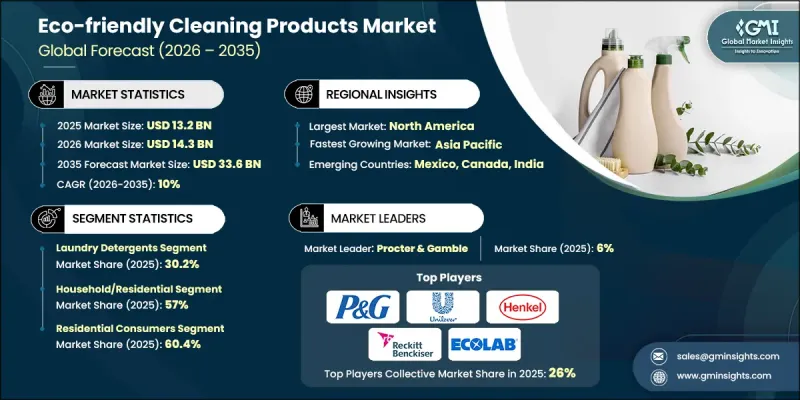
The Global Eco-friendly Cleaning Products Market was valued at USD 13.2 billion in 2025 and is estimated to grow at a CAGR of 10% to reach USD 33.6 billion by 2035.
The industry is undergoing a significant transformation as sustainability, health awareness, and product innovation reshape consumer expectations worldwide. Manufacturers are reformulating products by replacing conventional synthetic ingredients with plant-derived enzymes, bio-based surfactants, and mineral-based disinfecting agents that deliver comparable cleaning performance while reducing environmental impact. Advances in formulation science now allow eco-friendly products to achieve 95%-99% effectiveness against a broad spectrum of household and industrial contaminants, demonstrating that sustainability no longer compromises efficacy. In parallel, companies are redesigning packaging and distribution strategies to minimize environmental footprints. Growing consumer focus on indoor air quality, chemical exposure, and overall wellness is accelerating the transition toward safer and biodegradable cleaning solutions. As regulatory oversight strengthens and eco-label certifications gain influence, manufacturers are aligning product development with environmental compliance standards. Collectively, these shifts are redefining how eco-friendly cleaning products are formulated, produced, marketed, and adopted across residential and commercial markets.
| Market Scope | |
|---|---|
| Start Year | 2025 |
| Forecast Year | 2026-2035 |
| Start Value | $13.2 Billion |
| Forecast Value | $33.6 Billion |
| CAGR | 10% |
The increasing introduction of concentrated, refillable, and water-efficient product formats marks a substantial shift in the eco-friendly cleaning products market. Concentrated solutions reduce packaging waste, lower transportation emissions, and optimize storage efficiency, reinforcing sustainability objectives. Rising public awareness regarding health considerations and exposure to harsh chemicals is significantly boosting demand for environmentally responsible cleaning solutions in both households and commercial environments.
In 2025, the laundry detergents segment accounted for 30.2% share. High usage frequency and growing demand for plant-based, skin-friendly formulations continue to drive this category's dominance. Consumers increasingly favor biodegradable, phosphate-free, and low-toxicity detergent options that help minimize water contamination and reduce irritation risks. Adoption across residential settings and institutional facilities further supports sustained segment growth, particularly in regions with strict wastewater discharge regulations.
The household and residential segment represented 57% share in 2025. This leadership position reflects heightened consumer awareness regarding potential health risks associated with conventional chemical cleaners, especially in homes with vulnerable populations. Broader product availability through retail outlets and expanding e-commerce channels is accelerating adoption and strengthening market penetration within the residential sector.
U.S. Eco-friendly Cleaning Products Market accounted for 76.8% share in 2025, equivalent to USD 3.4 billion, and is projected to grow at a CAGR of 10.2%. Strong consumer awareness, increasing preference for non-toxic and biodegradable products, and rising concern about indoor environmental quality are key drivers of market expansion. The region also benefits from rigorous environmental policies, enforcement of eco-labeling standards, and corporate sustainability mandates that encourage the adoption of green cleaning solutions across commercial facilities, healthcare institutions, and educational establishments.
Major companies operating in the Global Eco-friendly Cleaning Products Market include Procter & Gamble, Unilever, Reckitt Benckiser Group PLC, Henkel AG & Co. KGaA, Ecolab Inc., Seventh Generation, Church & Dwight Co., Inc., BASF SE, Evonik Industries AG, Croda International PLC, Novozymes A/S, Diversey, Inc., Spartan Chemical Company, Inc., Ecover, Earth Friendly Products, Biokleen, and Diamond Wipes International, Inc. Companies competing in the Global Eco-friendly Cleaning Products Market are strengthening their market position through sustainable innovation and strategic brand differentiation. Leading players are investing in bio-based ingredient research, biodegradable formulations, and refillable packaging systems to meet evolving regulatory and consumer expectations. Strategic partnerships with retailers and online platforms are expanding product visibility and distribution reach. Many organizations are enhancing transparency through eco-certifications and sustainability reporting to build consumer trust. Portfolio expansion into concentrated and water-efficient solutions is helping brands address environmental concerns while improving cost efficiency.
Table of Contents
Chapter 1 Methodology and Scope
- 1.1 Market scope and definition
- 1.2 Research design
- 1.2.1 Research approach
- 1.2.2 Data collection methods
- 1.3 Data mining sources
- 1.3.1 Global
- 1.3.2 Regional/Country
- 1.4 Base estimates and calculations
- 1.4.1 Base year calculation
- 1.4.2 Key trends for market estimation
- 1.5 Primary research and validation
- 1.5.1 Primary sources
- 1.6 Forecast model
- 1.7 Research assumptions and limitations
Chapter 2 Executive Summary
- 2.1 Industry 360° synopsis
- 2.2 Key market trends
- 2.2.1 Regional
- 2.2.2 Product type
- 2.2.3 Application
- 2.2.4 Price range
- 2.2.5 Distribution channel
- 2.3 CXO perspectives: Strategic imperatives
- 2.3.1 Key decision points for industry executives
- 2.3.2 Critical success factors for market players
- 2.4 Future outlook and strategic recommendations
Chapter 3 Industry Insights
- 3.1 Industry ecosystem analysis
- 3.1.1 Supplier landscape
- 3.1.2 Profit margin
- 3.1.3 Value addition at each stage
- 3.1.4 Factor affecting the value chain
- 3.2 Industry impact forces
- 3.2.1 Growth drivers
- 3.2.1.1 Rising consumer demand for sustainable & non toxic products
- 3.2.1.2 Stringent environmental regulations & eco label adoption
- 3.2.1.3 Growth of commercial & institutional green cleaning programs
- 3.2.2 Industry pitfalls & challenges
- 3.2.2.1 Higher production costs & raw material price volatility
- 3.2.2.2 Performance perception & consumer skepticism
- 3.2.3 Opportunities
- 3.2.3.1 Concentrated, refill & low waste product formats
- 3.2.3.2 Corporate ESG commitments & green procurement policies
- 3.2.1 Growth drivers
- 3.3 Growth potential analysis
- 3.4 Future market trends
- 3.5 Technology and innovation landscape
- 3.5.1 Current technological trends
- 3.5.2 Emerging technologies
- 3.6 Price trends
- 3.6.1 By region
- 3.6.2 By type
- 3.7 Regulatory landscape
- 3.7.1 Standards and compliance requirements
- 3.7.2 Regional regulatory frameworks
- 3.7.3 Certification standards
- 3.8 Porter’s analysis
- 3.9 PESTEL analysis
Chapter 4 Competitive Landscape, 2025
- 4.1 Introduction
- 4.2 Company market share analysis
- 4.2.1 By region
- 4.2.1.1 North America
- 4.2.1.2 Europe
- 4.2.1.3 Asia Pacific
- 4.2.1.4 Latin America
- 4.2.1.5 Middle East and Africa
- 4.2.1 By region
- 4.3 Company matrix analysis
- 4.4 Competitive analysis of major market players
- 4.5 Competitive positioning matrix
- 4.6 Key developments
- 4.6.1 Mergers & acquisitions
- 4.6.2 Partnerships & collaborations
- 4.6.3 New product launches
- 4.6.4 Expansion plans
Chapter 5 Market Estimates & Forecast, By Product Type, 2022 - 2035 (USD Billion) (Thousand Units)
- 5.1 Key trends
- 5.2 General purpose cleaner
- 5.2.1 Multi-surface household cleaners
- 5.2.2 Commercial all-purpose cleaners
- 5.3 Bathroom & spa cleaners
- 5.3.1 Tub & tile cleaners
- 5.3.2 Toilet bowl cleaners
- 5.4 Shower & glass cleaners
- 5.5 Glass & window cleaners
- 5.5.1 Residential glass cleaners
- 5.5.2 Commercial window cleaning solutions
- 5.5.3 Automotive glass cleaners
- 5.6 Floor cleaners & protectors
- 5.6.1 Hard surface floor cleaners
- 5.6.2 Carpet & upholstery cleaners
- 5.6.3 Floor protectors & finishes
- 5.7 Dishwashing products
- 5.7.1 Manual dishwashing liquids
- 5.7.2 Automatic dishwasher detergents
- 5.7.3 Rinse aids & additives
- 5.8 Laundry detergents
- 5.8.1 General purpose laundry products
- 5.8.2 Concentrated liquid detergents
- 5.8.3 Powder & pod formulations
- 5.8.4 Fabric softeners & conditioners
- 5.9 Disinfectants & sanitizers
- 5.9.1 EPA DFE certified antimicrobial products
- 5.9.2 Hand sanitizers & personal care
- 5.9.3 Surface disinfectants
- 5.10 Specialty cleaners
- 5.10.1 Oven & grill cleaners
- 5.10.2 Metal cleaners & polishes
- 5.10.3 Carpet & upholstery cleaners
- 5.10.4 Drain maintenance products
Chapter 6 Market Estimates & Forecast, By Application, 2022 - 2035 (USD Billion) (Thousand Units)
- 6.1 Key trends
- 6.2 Household/residential
- 6.3 Commercial
- 6.4 Industrial
Chapter 7 Market Estimates & Forecast, By Price Range, 2022 - 2035 (USD Billion) (Thousand Units)
- 7.1 Key trends
- 7.2 Low
- 7.3 Mid
- 7.4 High
Chapter 8 Market Estimates & Forecast, By Distribution Channel, 2022 - 2035 (USD Billion) (Thousand Units)
- 8.1 Key trends
- 8.2 Online
- 8.2.1 E-commerce websites
- 8.2.2 Company-owned websites
- 8.3 Offline
- 8.3.1 Supermarket/hyper market
- 8.3.2 Retailer stores
- 8.3.3 Others
Chapter 9 Market Estimates & Forecast, By Region, 2022 - 2035 (USD Billion) (Thousand Units)
- 9.1 Key trends
- 9.2 North America
- 9.2.1 U.S.
- 9.2.2 Canada
- 9.3 Europe
- 9.3.1 UK
- 9.3.2 Germany
- 9.3.3 France
- 9.3.4 Italy
- 9.3.5 Spain
- 9.3.6 Russia
- 9.4 Asia Pacific
- 9.4.1 China
- 9.4.2 India
- 9.4.3 Japan
- 9.4.4 South Korea
- 9.4.5 Australia
- 9.5 Latin America
- 9.5.1 Brazil
- 9.5.2 Mexico
- 9.5.3 Argentina
- 9.6 MEA
- 9.6.1 South Africa
- 9.6.2 Saudi Arabia
- 9.6.3 UAE
Chapter 10 Company Profiles
- 10.1 BASF SE
- 10.2 Biokleen
- 10.3 Church & Dwight Co., Inc.
- 10.4 Croda International PLC
- 10.5 Diamond Wipes International, Inc.
- 10.6 Diversey, Inc.
- 10.7 Earth Friendly Products
- 10.8 Ecolab Inc.
- 10.9 Ecover
- 10.10 Evonik Industries AG
- 10.11 Henkel AG & Co. KGaA
- 10.12 Novozymes A/S (Novonesis)
- 10.13 Procter & Gamble
- 10.14 Reckitt Benckiser Group PLC
- 10.15 Seventh Generation
- 10.16 Spartan Chemical Company, Inc.
- 10.17 Unilever

