PUBLISHER: Global Market Insights Inc. | PRODUCT CODE: 1982327

PUBLISHER: Global Market Insights Inc. | PRODUCT CODE: 1982327
Dozers Market Opportunity, Growth Drivers, Industry Trend Analysis, and Forecast 2026 - 2035
The Global Dozers Market was valued at USD 15.2 billion in 2025 and is estimated to grow at a CAGR of 6% to reach USD 27 billion by 2035.
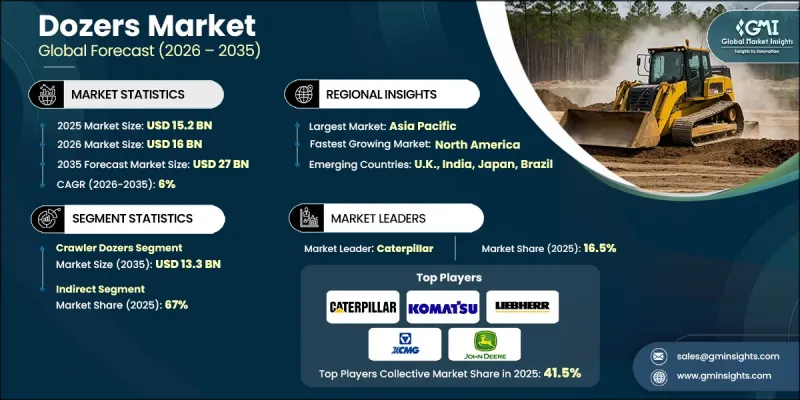
Strong growth in urbanization and large-scale infrastructure development across developed and emerging economies continues to generate consistent demand for earthmoving equipment. Public sector investments in transportation networks, energy facilities, smart cities, and industrial corridors are reinforcing equipment adoption worldwide. At the same time, private sector construction across residential, commercial, and industrial segments is strengthening equipment utilization rates. Manufacturers are accelerating innovation cycles by integrating precision control systems, fuel-efficient powertrains, and advanced machine guidance solutions into next-generation models. The integration of digital technologies, automation, artificial intelligence, and IoT-enabled telematics is transforming fleet management, operational efficiency, and jobsite safety standards. These advancements are reshaping competitive dynamics and encouraging capital investment across the value chain. With modernization of infrastructure remaining a priority across multiple regions, demand for dozers of varying capacities is expected to remain steady throughout the forecast period.
| Market Scope | |
|---|---|
| Start Year | 2025 |
| Forecast Year | 2026-2035 |
| Start Value | $15.2 Billion |
| Forecast Value | $27 Billion |
| CAGR | 6% |
The crawler dozers segment generated USD 7.1 billion in 2025 and is anticipated to reach USD 13.3 billion by 2035. Market demand favors crawler models due to superior traction, stability, and high drawbar pull across challenging terrain conditions. Wheel dozers continue to serve applications where faster repositioning and mobility are essential, while compact variants are increasingly utilized in space-constrained urban and utility projects. Overall, crawler units account for the largest revenue contribution within the equipment mix.
The indirect distribution channels segment held 67% share in 2025. Dealer networks, independent distributors, and third-party sales partners provide broad geographic coverage and strong customer engagement. These channels enable manufacturers to expand market penetration without building an extensive in-house sales infrastructure, reducing operational costs while maintaining effective supply chains. Indirect routes to market remain especially valuable in developing economies where localized relationships and service capabilities drive equipment adoption.
North America Dozers Market held 76.8% share in 2025. Market leadership in the U.S. is supported by sustained capital allocation toward transportation upgrades, utility expansion, energy projects, and urban redevelopment initiatives. Growing construction activity across residential and commercial sectors continues to stimulate demand for high-capacity earthmoving equipment. Rapid adoption of telematics, machine control systems, and semi-autonomous functionality further supports equipment modernization trends. Expanding road networks, site development, and land preparation activities across multiple states continue to reinforce long-term equipment demand.
Key participants operating in the Global Dozers Market include Liugong, Caterpillar, Sany Construction, Deere & Company, Komatsu, Volvo Construction Equipment, Shantui, Hitachi Construction Machinery, XCMG Group, Liebherr Group, CNH Industrial, SDLG, Doosan, Zoomlion, and JCB. Companies in the Global Dozers Market are strengthening their competitive position through continuous product innovation, strategic partnerships, and geographic expansion. Manufacturers are investing heavily in automation, intelligent machine control systems, and fuel-efficient technologies to differentiate their portfolios and align with evolving regulatory standards. Expansion of dealer and service networks enhances aftermarket support and improves customer retention. Many players are optimizing supply chains and localizing production facilities to reduce costs and improve delivery timelines. Strategic collaborations with technology providers are accelerating the integration of AI-driven diagnostics and IoT-based fleet management systems.
Table of Contents
Chapter 1 Methodology & Scope
- 1.1 Research approach
- 1.2 Quality Commitments
- 1.3 GMI AI policy & data integrity commitment
- 1.3.1 Source consistency protocol
- 1.4 Research Trail & Confidence Scoring
- 1.4.1 Research Trail Components
- 1.4.2 Scoring Components
- 1.5 Data Collection
- 1.5.1 Partial list of primary sources
- 1.6 Data mining sources
- 1.7 Paid sources
- 1.7.1 Sources, by region
- 1.8 Base estimates and calculations
- 1.8.1 Base year calculation for any one approach
- 1.9 Forecast model
- 1.9.1 Quantified market impact analysis
- 1.9.1.1 Mathematical impact of growth parameters on forecast
- 1.9.1 Quantified market impact analysis
- 1.10 Research transparency addendum
- 1.10.1 Source attribution framework
- 1.10.2 Quality assurance metrics
- 1.10.3 Our commitment to trust
Chapter 2 Executive Summary
- 2.1 Industry 360° synopsis
- 2.2 Key market trends
- 2.2.1 Regional
- 2.2.2 Product Type
- 2.2.3 Blade Type
- 2.2.4 Engine Power
- 2.2.5 End-use
- 2.2.6 Distribution Channel
Chapter 3 Industry Insights
- 3.1 Industry ecosystem analysis
- 3.1.1 Supplier landscape
- 3.1.2 Profit margin
- 3.1.3 Value addition at each stage
- 3.1.4 Factor affecting the value chain
- 3.2 Industry impact forces
- 3.2.1 Growth drivers
- 3.2.1.1 Expansion of construction & infrastructure sectors globally
- 3.2.1.2 Technological advancements
- 3.2.1.3 Rising demand in mining industry
- 3.2.2 Industry pitfalls & challenges
- 3.2.2.1 High cost of dozers
- 3.2.2.2 Fluctuating raw material costs
- 3.2.3 Opportunities
- 3.2.3.1 Rapid shift toward green, electric & hybrid dozers
- 3.2.3.2 Continued mining expansion and global commodity demand
- 3.2.1 Growth drivers
- 3.3 Growth potential analysis
- 3.4 Future market trends
- 3.5 Technology and innovation landscape
- 3.5.1 Current technological trends
- 3.5.2 Emerging technologies
- 3.6 Price trends
- 3.6.1 By product type
- 3.6.2 By region
- 3.7 Regulatory landscape
- 3.7.1 Standards and compliance requirements
- 3.7.2 Regional regulatory frameworks
- 3.7.3 Certification standards
- 3.7.4 Trade Data Analysis
- 3.7.4.1 Import/Export Volume & Value Trends
- 3.7.4.2 Key Trade Corridors & Tariff Impact
- 3.8 Impact of AI & Generative AI on the Market
- 3.8.1 AI-driven disruption of existing business models
- 3.8.2 Gen AI use cases & adoption roadmap by segment
- 3.8.3 Risks, limitations & regulatory considerations
- 3.9 Porter's analysis
- 3.10 PESTEL analysis
Chapter 4 Competitive Landscape, 2025
- 4.1 Introduction
- 4.2 Company market share analysis
- 4.2.1 By region
- 4.2.1.1 North America
- 4.2.1.2 Europe
- 4.2.1.3 Asia Pacific
- 4.2.1.4 Latin America
- 4.2.1.5 Middle East and Africa
- 4.2.1 By region
- 4.3 Company matrix analysis
- 4.4 Competitive analysis of major market players
- 4.5 Competitive positioning matrix
- 4.6 Key developments
- 4.6.1 Mergers & acquisitions
- 4.6.2 Partnerships & collaborations
- 4.6.3 New product launches
- 4.6.4 Expansion plans
Chapter 5 Market Estimates & Forecast, By Product Type, 2022-2035 (USD Billion) (Million Units)
- 5.1 Key trends
- 5.2 Crawler dozers
- 5.3 Wheel dozers
- 5.4 Mini dozers
Chapter 6 Market Estimates & Forecast, By Blade Type, 2022-2035 (USD Billion) (Million Units)
- 6.1 Key trends
- 6.1.1 Straight Blade (S-Blade)
- 6.1.2 Universal Blade (U-Blade)
- 6.1.3 Angle Blade
- 6.1.4 Others (semi-u blade, pitch blades, etc.)
Chapter 7 Market Estimates & Forecast, By Engine Power, 2022-2035 (USD Billion) (Million Units)
- 7.1 Key trends
- 7.2 Up to 100 HP
- 7.3 100-200 HP
- 7.4 More than 200 HP
Chapter 8 Market Estimates & Forecast, By End-use, 2022-2035 (USD Billion) (Million Units)
- 8.1 Key trends
- 8.2 Building & construction
- 8.3 Mining
- 8.4 Forestry & agriculture
- 8.5 Others (manufacturing, military, etc.)
Chapter 9 Market Estimates & Forecast, By Distribution Channel, 2022-2035 (USD Billion) (Million Units)
- 9.1 Key trends
- 9.1.1 Direct sales
- 9.1.2 Indirect sales
Chapter 10 Market Estimates & Forecast, By Region, 2022-2035 (USD Billion) (Million Units)
- 10.1 Key trends
- 10.2 North America
- 10.2.1 U.S.
- 10.2.2 Canada
- 10.3 Europe
- 10.3.1 Germany
- 10.3.2 France
- 10.3.3 UK
- 10.3.4 Italy
- 10.3.5 Spain
- 10.4 Asia Pacific
- 10.4.1 China
- 10.4.2 India
- 10.4.3 Japan
- 10.4.4 South Korea
- 10.4.5 Australia
- 10.5 Latin America
- 10.5.1 Brazil
- 10.5.2 Mexico
- 10.5.3 Argentina
- 10.6 MEA
- 10.6.1 South Africa
- 10.6.2 Saudi Arabia
- 10.6.3 UAE
Chapter 11 Company Profiles
- 11.1 Caterpillar
- 11.2 CNH Industrial
- 11.3 Deere & Company
- 11.4 Doosan
- 11.5 Hitachi Construction Machinery
- 11.6 JCB
- 11.7 Komatsu
- 11.8 Liebherr Group
- 11.9 Liugong
- 11.10 Sany Construction
- 11.11 SDLG
- 11.12 Shantui
- 11.13 Volvo Construction Equipment
- 11.14 XCMG Group
- 11.15 Zoomlion

