PUBLISHER: Global Market Insights Inc. | PRODUCT CODE: 1982329

PUBLISHER: Global Market Insights Inc. | PRODUCT CODE: 1982329
NIR LED Market Opportunity, Growth Drivers, Industry Trend Analysis, and Forecast 2026 - 2035
The Global NIR LED Market was valued at USD 349.8 million in 2025 and is estimated to grow at a CAGR of 12.4% to reach USD 1.07 billion by 2035.
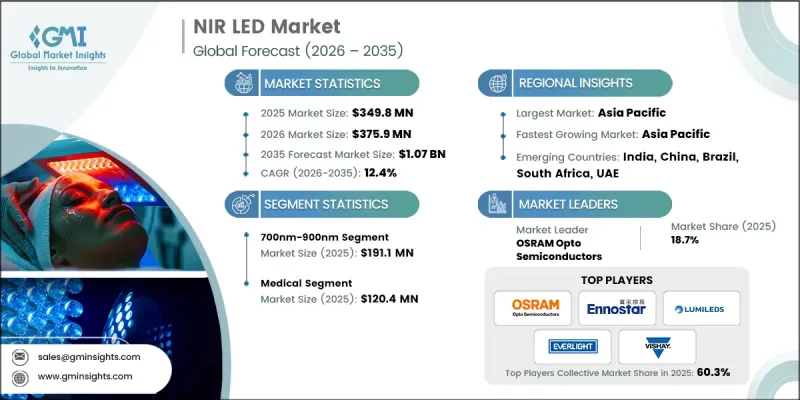
Market expansion is driven by increasing integration of near-infrared LEDs across healthcare, biomedical imaging, industrial automation, security systems, and consumer electronics. Rising demand for non-invasive diagnostic technologies and optical sensing solutions is accelerating adoption in medical devices and monitoring systems. NIR LEDs are widely recognized for their ability to penetrate biological tissue, enabling accurate physiological measurements and imaging capabilities. Governments and research institutions are prioritizing advancements in photonics and optical technologies to enhance diagnostic precision and reduce invasive procedures. At the same time, improvements in LED efficiency, compact design, and miniaturization are supporting broader integration into wearable electronics, surveillance platforms, and industrial inspection tools. The convergence of healthcare innovation, advanced sensing technologies, and growing demand for energy-efficient components is positioning the NIR LED market as a critical segment within the global optoelectronics industry.
| Market Scope | |
|---|---|
| Start Year | 2025 |
| Forecast Year | 2026-2035 |
| Start Value | $349.8 Million |
| Forecast Value | $1.07 Billion |
| CAGR | 12.4% |
Near-infrared wavelengths enable reliable tissue penetration, supporting applications such as physiological monitoring, pulse measurement, and wearable health sensors. These technologies contribute to early disease detection, chronic condition management, and improved accessibility to point-of-care diagnostics while helping reduce overall healthcare costs. Defense organizations and national research bodies are also investing in optical sensing and imaging research, increasing the deployment of NIR LEDs in night vision systems, target identification, and security platforms. Public funding directed toward photonics innovation is further strengthening research in remote sensing and advanced situational awareness technologies.
The 700nm-900nm segment generated USD 191.1 million in 2025. Strong demand from consumer electronics and biometric authentication systems is driving adoption within this spectral range, particularly for facial recognition, proximity detection, and smartphone-based health monitoring functions that require compact and energy-efficient illumination. Expanded deployment in surveillance equipment and automotive driver monitoring solutions is further accelerating growth, as this wavelength range delivers optimal performance for short-range night vision, cabin sensing, and low-light image enhancement.
The medical segment reached USD 120.4 million in 2025. Increasing adoption of non-invasive diagnostic devices, including wearable monitors and imaging platforms, is fueling demand for NIR LEDs capable of precise tissue interaction and real-time physiological measurement. Growth in telehealth services and home-based healthcare systems is encouraging integration of compact and energy-efficient NIR LED components into portable medical technologies. Manufacturers are focusing on developing medically certified, miniaturized, and high-accuracy NIR LED modules tailored for wearable diagnostics and clinical imaging applications to strengthen long-term partnerships with healthcare device manufacturers.
North America NIR LED Market accounted for 32.7% share in 2025. The region remains a leading center for adoption, supported by strong implementation across security systems, automotive safety technologies, industrial automation platforms, and advanced healthcare solutions. Robust research infrastructure, high technology spending, and strong demand for biometric and machine vision applications continue to drive innovation. Public sector support for semiconductor and photonics development, combined with manufacturing incentives, is reinforcing regional market growth. Manufacturers are prioritizing scalable production capabilities for automotive sensing and industrial inspection applications while leveraging advanced automation infrastructure to meet demand from defense, healthcare, and industrial sectors.
Key companies operating in the Global NIR LED Market include OSRAM Opto Semiconductors Inc., Lumileds, ON Semiconductor, Vishay Intertechnology, ROHM Semiconductor, Hamamatsu Photonics, Excelitas Technologies Corporation, Everlight Electronics Co Ltd, Epistar Corporation, Lextar Electronics Corporation, Lite-On Inc., Marktech Optoelectronics, Kingbright, Ushio OPTO Semiconductors Inc., Sensors Unlimited, Wurth Electronics Inc., EPILEDS, DOWA Electronics Materials Co., Ltd., Alpha One Electronics Ltd, High Power Lighting Corporation, and Brightek (Europe) Limited. Companies in the NIR LED Market are strengthening their competitive positioning through continuous innovation, product miniaturization, and strategic collaborations with OEMs across healthcare, automotive, and consumer electronics industries. Leading players are investing in advanced chip design, improved thermal management, and higher optical output efficiency to differentiate their offerings. Many manufacturers are expanding fabrication capacity and adopting automated production systems to achieve cost optimization and scalability. Partnerships with medical device manufacturers and automotive system integrators enable tailored solutions and long-term supply agreements.
Table of Contents
Chapter 1 Methodology and Scope
- 1.1 Market scope and definition
- 1.2 Research design
- 1.2.1 Research approach
- 1.2.2 Data collection methods
- 1.3 Data mining sources
- 1.3.1 Global
- 1.3.2 Regional/Country
- 1.4 Base estimates and calculations
- 1.4.1 Base year calculation
- 1.4.2 Key trends for market estimation
- 1.5 Primary research and validation
- 1.5.1 Primary sources
- 1.6 Forecast model
- 1.7 Research assumptions and limitations
Chapter 2 Executive Summary
- 2.1 Industry 360° synopsis
- 2.2 Key market trends
- 2.2.1 Spectral range trends
- 2.2.2 Application trends
- 2.2.3 Regional trends
- 2.3 TAM Analysis, 2026-2035 (USD Million)
- 2.4 CXO perspectives: Strategic imperatives
- 2.4.1 Executive decision points
- 2.4.2 Critical success factors
- 2.5 Future outlook and strategic recommendations
Chapter 3 Industry Insights
- 3.1 Industry ecosystem analysis
- 3.1.1 Supplier landscape
- 3.1.2 Profit margin
- 3.1.3 Cost structure
- 3.1.4 Value addition at each stage
- 3.1.5 Factor affecting the value chain
- 3.1.6 Disruptions
- 3.2 Industry impact forces
- 3.2.1 Growth drivers
- 3.2.1.1 Rising adoption in biomedical and healthcare applications
- 3.2.1.2 Increasing demand for night vision and surveillance systems
- 3.2.1.3 Growing use in industrial inspection and quality control
- 3.2.1.4 Advancements in LED efficiency and miniaturization
- 3.2.1.5 Rising consumer electronics integration
- 3.2.2 Pitfalls and challenges
- 3.2.2.1 High manufacturing costs of high-performance NIR LEDs
- 3.2.2.2 Limited wavelength range for specific applications
- 3.2.1 Growth drivers
- 3.3 Growth potential analysis
- 3.4 Regulatory landscape
- 3.4.1 North America
- 3.4.2 Europe
- 3.4.3 Asia Pacific
- 3.4.4 Latin America
- 3.4.5 Middle East & Africa
- 3.5 Porter’s analysis
- 3.6 PESTEL analysis
- 3.7 Technology and Innovation landscape
- 3.7.1 Current technological trends
- 3.7.2 Emerging technologies
- 3.8 Emerging Business Models
- 3.9 Compliance Requirements
- 3.10 Supply Chain Resilience
- 3.11 Geopolitical Analysis
Chapter 4 Competitive Landscape, 2025
- 4.1 Introduction
- 4.2 Company market share analysis
- 4.2.1 By region
- 4.2.1.1 North America
- 4.2.1.2 Europe
- 4.2.1.3 Asia Pacific
- 4.2.1.4 Latin America
- 4.2.1.5 Middle East & Africa
- 4.2.2 Market concentration analysis
- 4.2.1 By region
- 4.3 Competitive benchmarking of key players
- 4.3.1 Product portfolio comparison
- 4.3.1.1 Product range breadth
- 4.3.1.2 Technology
- 4.3.1.3 Innovation
- 4.3.2 Geographic presence comparison
- 4.3.2.1 Global footprint analysis
- 4.3.2.2 Service network coverage
- 4.3.2.3 Market penetration by region
- 4.3.3 Competitive positioning matrix
- 4.3.3.1 Leaders
- 4.3.3.2 Challengers
- 4.3.3.3 Followers
- 4.3.3.4 Niche players
- 4.3.4 Strategic outlook matrix
- 4.3.1 Product portfolio comparison
- 4.4 Key developments, 2022-2025
- 4.4.1 Mergers and acquisitions
- 4.4.2 Partnerships and collaborations
- 4.4.3 Technological advancements
- 4.4.4 Expansion and investment strategies
- 4.4.5 Sustainability initiatives
- 4.4.6 Digital transformation initiatives
- 4.5 Emerging/ startup competitors landscape
Chapter 5 Market Estimates and Forecast, By Spectral Range, 2022 - 2035 (USD Million)
- 5.1 Key trends
- 5.2 700nm-900nm
- 5.3 900nm-1500nm
- 5.4 1500nm-2500nm
- 5.5 Custom Wavelength Bands
Chapter 6 Market Estimates and Forecast, By Application, 2022 - 2035 (USD Million)
- 6.1 Key trends
- 6.2 Medical
- 6.2.1 Pulse Oximetry
- 6.2.2 Dermatology
- 6.2.3 Photodynamic Therapy
- 6.2.4 Others
- 6.3 Solar simulator
- 6.3.1 Simulating Sunlight for Solar Cell Testing
- 6.3.2 Spacecraft Solar Panel Simulation
- 6.3.3 Others
- 6.4 Machine vision
- 6.4.1 Food Inspection
- 6.4.2 Product Sorting
- 6.4.3 Quality Control
- 6.4.4 Others
- 6.5 Optical sorting
- 6.5.1 Sorting and recycling of materials
- 6.5.2 Others
- 6.6 Sensor and Detection
- 6.6.1 Gas Detection
- 6.6.2 Environmental Monitoring
- 6.6.3 Proximity Sensors
- 6.6.4 Others
- 6.7 Security and Surveillance
- 6.7.1 Facial Recognition
- 6.7.2 Night Vision Cameras
- 6.7.3 Security Cameras
- 6.7.4 Others
Chapter 7 Market Estimates and Forecast, By Region, 2022 - 2035 (USD Million)
- 7.1 Key trends
- 7.2 North America
- 7.2.1 U.S.
- 7.2.2 Canada
- 7.3 Europe
- 7.3.1 Germany
- 7.3.2 UK
- 7.3.3 France
- 7.3.4 Spain
- 7.3.5 Italy
- 7.3.6 Netherlands
- 7.4 Asia Pacific
- 7.4.1 China
- 7.4.2 India
- 7.4.3 Japan
- 7.4.4 Australia
- 7.4.5 South Korea
- 7.5 Latin America
- 7.5.1 Brazil
- 7.5.2 Mexico
- 7.5.3 Argentina
- 7.6 Middle East and Africa
- 7.6.1 Saudi Arabia
- 7.6.2 South Africa
- 7.6.3 UAE
Chapter 8 Company Profiles
- 8.1 Global Key Players
- 8.1.1 OSRAM Opto Semiconductors Inc.
- 8.1.2 Lumileds
- 8.1.3 ON Semiconductor
- 8.1.4 Excelitas Technologies Corporation
- 8.1.5 Hamamatsu Photonics
- 8.2 Regional Key Players
- 8.2.1 North America
- 8.2.1.1 Vishay Intertechnology
- 8.2.1.2 Marktech Optoelectronics
- 8.2.1.3 High Power Lighting Corporation
- 8.2.2 Europe
- 8.2.2.1 Brightek (Europe) Limited
- 8.2.2.2 Wurth Electronics Inc.
- 8.2.2.3 Alpha One Electronics Ltd
- 8.2.3 Asia Pacific
- 8.2.3.1 Epistar Corporation
- 8.2.3.2 Everlight Electronics Co Ltd
- 8.2.3.3 Lextar Electronics Corporation
- 8.2.3.4 Lite-On Inc.
- 8.2.3.5 Kingbright
- 8.2.3.6 DOWA Electronics Materials Co., Ltd.
- 8.2.1 North America
- 8.3 Niche / Disruptors
- 8.3.1 EPILEDS
- 8.3.2 Sensors Unlimited
- 8.3.3 Ushio OPTO Semiconductors Inc.

