
PUBLISHER: Global Market Insights Inc. | PRODUCT CODE: 1982330

PUBLISHER: Global Market Insights Inc. | PRODUCT CODE: 1982330
Electric Scooter Lift and Carrier Market Opportunity, Growth Drivers, Industry Trend Analysis, and Forecast 2026 - 2035
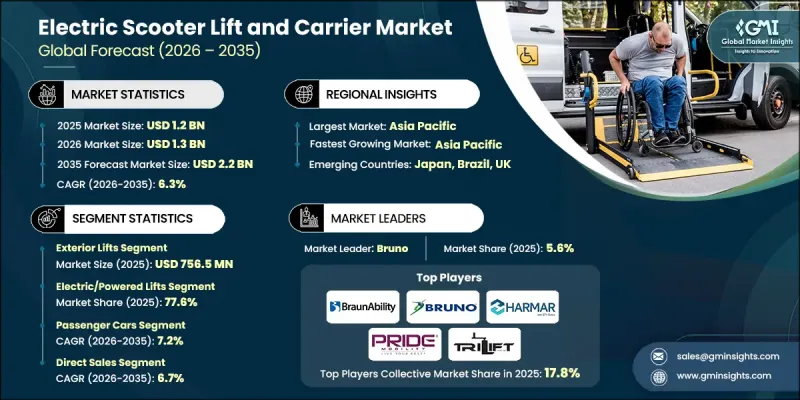
The Global Electric Scooter Lift and Carrier Market was valued at USD 1.2 billion in 2025 and is estimated to grow at a CAGR of 6.3% to reach USD 2.2 billion by 2035.
The rising need for convenient and secure transportation solutions for mobility scooters drives market expansion. These systems are widely used by aging populations and individuals with mobility limitations who require dependable equipment to move scooters between locations. Demand is also supported by caregivers, healthcare providers, and residential care environments seeking efficient loading and storage solutions. Technological progress is significantly enhancing product functionality, with modern systems incorporating powered mechanisms, wireless controls, and advanced safety components to simplify operation. The use of lightweight yet durable materials, along with modular construction, allows improved vehicle compatibility and easier installation. Industry innovation is aligning with broader mobility trends that emphasize independence, comfort, and seamless integration with electric and hybrid vehicles. As electric vehicle adoption increases, manufacturers are focusing on energy-efficient lift systems engineered to consume minimal power while maintaining high performance and structural strength.
| Market Scope | |
|---|---|
| Start Year | 2025 |
| Forecast Year | 2026-2035 |
| Start Value | $1.2 Billion |
| Forecast Value | $2.2 Billion |
| CAGR | 6.3% |
Product development is centered on improving safety, usability, and convenience. Advanced configurations now feature automated lifting mechanisms, simplified control interfaces, and reinforced stabilization systems that minimize physical strain and enhance reliability. Design enhancements such as slip-resistant platforms and adaptable mounting structures enable compatibility with a wide range of vehicle types while maintaining secure scooter positioning during transport.
The exterior lifts segment held 64.9% share, generating USD 756.5 million in 2025. Its strong position is attributed to broad vehicle compatibility and straightforward installation processes that eliminate the need for interior vehicle modifications. Exterior-mounted systems preserve cabin space and often incorporate foldable or powered platforms that streamline loading and unloading procedures. Their practicality and ease of operation have made them a preferred choice among both individual users and professional caregivers seeking efficient transport solutions without structural vehicle alterations.
The electric or powered lifts segment held 77.6% share in 2025 and is forecast to reach USD 1.8 billion by 2035. Powered systems dominate due to their user-friendly design, enabling scooter handling with minimal physical effort. These solutions significantly reduce lifting strain and lower the risk of injury, making them especially appealing to users with limited strength or mobility challenges. Their growing popularity continues to outpace manually operated alternatives.
U.S. Electric Scooter Lift and Carrier Market reached USD 394.6 million in 2025. Increasing demand for accessible mobility solutions is driving adoption across the country. As mobility scooters become more widely used, the need for reliable transportation systems has intensified. Vehicle-mounted lifting platforms and compact carrier configurations are designed to simplify loading and unloading processes while reducing the physical burden on users. Manufacturers are integrating smart functionality and lightweight structural components to improve operational efficiency and overall user experience.
Key companies operating in the Global Electric Scooter Lift and Carrier Market include Bruno, Harmar, BraunAbility, Drive Mobility, Pride, American Wheelchairs, EZ Carrier, Comfygo, TriLift, and Himor Lift. Companies in the Electric Scooter Lift and Carrier Market are strengthening their competitive position through product innovation, strategic partnerships, and geographic expansion. Manufacturers are investing in research and development to introduce lighter, energy-efficient, and technologically advanced lifting systems that enhance user convenience and safety. Collaboration with vehicle manufacturers and mobility equipment distributors helps expand market reach and improve product compatibility. Businesses are also focusing on expanding distribution networks and improving after-sales service to build customer loyalty.
Table of Contents
Chapter 1 Methodology
- 1.1 Research approach
- 1.2 Quality commitments
- 1.2.1 GMI AI policy & data integrity commitment
- 1.3 Research trail & confidence scoring
- 1.3.1 Research trail components
- 1.3.2 Scoring components
- 1.4 Data collection
- 1.4.1 Partial list of primary sources
- 1.5 Data mining sources
- 1.5.1 Paid sources
- 1.6 Base estimates and calculations
- 1.6.1 Base year calculation
- 1.7 Forecast model
- 1.8 Research transparency addendum
Chapter 2 Executive Summary
- 2.1 Industry 360° synopsis
- 2.2 Key market trends
- 2.2.1 Regional
- 2.2.2 Product
- 2.2.3 Operation
- 2.2.4 Weight Capacity
- 2.2.5 Vehicle
- 2.2.6 End-Use
- 2.2.7 Distribution Channel
- 2.3 TAM analysis, 2026-2035
- 2.4 CXO perspectives: Strategic imperatives
Chapter 3 Industry Insights
- 3.1 Industry ecosystem analysis
- 3.1.1 Supplier landscape
- 3.1.2 Profit margin
- 3.1.3 Cost structure
- 3.1.4 Value addition at each stage
- 3.1.5 Factor affecting the value chain
- 3.1.6 Disruptions
- 3.2 Industry impact forces
- 3.2.1 Growth drivers
- 3.2.1.1 Rising global elderly population & mobility impairment cases
- 3.2.1.2 Increasing prevalence of disabilities & chronic conditions
- 3.2.1.3 Growing adoption of mobility scooters & electric wheelchairs
- 3.2.1.4 Rising consumer awareness of mobility solutions
- 3.2.2 Industry pitfalls and challenges
- 3.2.2.1 High initial purchase & installation costs
- 3.2.2.2 Vehicle compatibility & modification challenges
- 3.2.3 Market opportunities
- 3.2.3.1 Expansion in Asia Pacific & emerging markets
- 3.2.3.2 Integration with electric & autonomous vehicles
- 3.2.3.3 Development of lightweight & compact designs
- 3.2.1 Growth drivers
- 3.3 Growth potential analysis
- 3.4 Regulatory landscape
- 3.4.1 North America
- 3.4.1.1 U.S. Department of Transportation
- 3.4.1.2 National Highway Traffic Safety Administration
- 3.4.1.3 U.S. Access Board
- 3.4.1.4 Transport Canada
- 3.4.1.5 Canadian Standards Association
- 3.4.2 Europe
- 3.4.2.1 European Commission
- 3.4.2.2 European Committee for Standardization
- 3.4.2.3 European Union Agency for Railways
- 3.4.2.4 Vehicle Certification Agency
- 3.4.2.5 TUV Rheinland
- 3.4.3 Asia Pacific
- 3.4.3.1 Ministry of Land, Infrastructure, Transport and Tourism
- 3.4.3.2 Ministry of Transport of the People's Republic of China
- 3.4.3.3 Automotive Research Association of India
- 3.4.3.4 Land Transport Authority
- 3.4.4 Latin America
- 3.4.4.1 Agencia Nacional de Transportes Terrestres
- 3.4.4.2 Instituto Nacional de Metrologia, Calidad y Tecnologia
- 3.4.4.3 Secretaria de Infraestructura, Comunicaciones y Transportes
- 3.4.4.4 Instituto Nacional de Tecnologia Industrial
- 3.4.4.5 Superintendencia de Industria y Comercio
- 3.4.5 Middle East & Africa
- 3.4.5.1 Ministry of Energy and Infrastructure
- 3.4.5.2 Saudi Standards, Metrology and Quality Organization
- 3.4.5.3 South African Bureau of Standards
- 3.4.5.4 Gulf Standardization Organization
- 3.4.1 North America
- 3.5 Porter's analysis
- 3.6 PESTEL analysis
- 3.7 Technology and innovation landscape
- 3.7.1 Current technologies
- 3.7.1.1 Hydraulic lift systems
- 3.7.1.2 Electric motorized platform lifts
- 3.7.1.3 Hitch-mounted carrier systems
- 3.7.1.4 Inside-vehicle hoist and crane lifts
- 3.7.1.5 Remote-control operated lifting mechanisms
- 3.7.2 Emerging technologies
- 3.7.2.1 IoT-enabled smart lift systems
- 3.7.2.2 AI-based load sensing and safety control
- 3.7.2.3 Lightweight composite material structures
- 3.7.2.4 Automated self-deploying lift platforms
- 3.7.2.5 EV-integrated power management systems
- 3.7.1 Current technologies
- 3.8 Production statistics
- 3.8.1 Production hubs
- 3.8.2 Consumption hubs
- 3.8.3 Export and import
- 3.9 Price trends
- 3.9.1 By region
- 3.9.2 By product
- 3.10 Cost breakdown analysis
- 3.11 Sustainability and environmental impact
- 3.11.1 Environmental impact assessment
- 3.11.2 Social impact & community benefits
- 3.11.3 Governance & corporate responsibility
- 3.11.4 Sustainable finance & investment trends
- 3.12 Integration with EV ecosystems
- 3.12.1 EV-specific design requirements
- 3.12.2 Battery load impact on EV range
- 3.12.3 Charging infrastructure compatibility
- 3.12.4 Smart vehicle integration
- 3.12.5 Future ev platform opportunities
- 3.13 Installation & user experience analysis
- 3.13.1 Installation complexity by vehicle type
- 3.13.2 Professional vs DIY installation
- 3.13.3 Installation time & cost analysis
- 3.13.4 Accessibility for elderly & disabled users
- 3.13.5 User interface & controls usability
- 3.14 Impact of AI on the market
- 3.14.1 Smart load management
- 3.14.2 Autonomous operation features
- 3.14.3 Personalized user experience
- 3.14.4 Customer support & troubleshooting
- 3.15 Case studies
- 3.16 Future outlook & opportunities
Chapter 4 Competitive Landscape, 2025
- 4.1 Introduction
- 4.2 Company market share analysis
- 4.2.1 North America
- 4.2.2 Europe
- 4.2.3 Asia Pacific
- 4.2.4 LATAM
- 4.2.5 MEA
- 4.3 Competitive analysis of major market players
- 4.4 Competitive positioning matrix
- 4.5 Key developments
- 4.5.1 Mergers & acquisitions
- 4.5.2 Partnerships & collaborations
- 4.5.3 New product launches
- 4.5.4 Expansion plans and funding
Chapter 5 Market Estimates & Forecast, By Product, 2022 - 2035 ($Mn, Units)
- 5.1 Key trends
- 5.2 Interior lifts
- 5.2.1 Platform lifts
- 5.2.2 Hoist/Crane lifts
- 5.3 Exterior lifts
- 5.3.1 Hitch-mounted carriers
- 5.3.2 Truck bed-mounted lifts
Chapter 6 Market Estimates & Forecast, By Operation, 2022 - 2035 ($Mn, Units)
- 6.1 Key trends
- 6.2 Electric/Powered lifts
- 6.3 Manual lifts
Chapter 7 Market Estimates & Forecast, By Weight Capacity, 2022 - 2035 ($Mn, Units)
- 7.1 Key trends
- 7.2 Light duty
- 7.3 Medium duty
- 7.4 Heavy duty
Chapter 8 Market Estimates & Forecast, By Vehicle, 2022 - 2035 ($Mn, Units)
- 8.1 Key trends
- 8.2 Passenger cars
- 8.2.1 Hatchback
- 8.2.2 SUV
- 8.2.3 Sedan
- 8.2.4 MPV
- 8.3 Pickup Trucks
- 8.4 Minivans
Chapter 9 Market Estimates & Forecast, By End-Use, 2022 - 2035 ($Mn, Units)
- 9.1 Key trends
- 9.2 Individual/Personal use
- 9.3 Healthcare facilities
- 9.4 Mobility & transportation services
- 9.5 Commercial/Rental services
Chapter 10 Market Estimates & Forecast, By Sales Channel, 2022 - 2035 ($Mn, Units)
- 10.1 Key trends
- 10.2 Direct sales
- 10.3 Indirect sales
Chapter 11 Market Estimates & Forecast, By Region, 2022 - 2035 ($Mn, Units)
- 11.1 Key trends
- 11.2 North America
- 11.2.1 US
- 11.2.2 Canada
- 11.3 Europe
- 11.3.1 Germany
- 11.3.2 UK
- 11.3.3 France
- 11.3.4 Italy
- 11.3.5 Spain
- 11.3.6 Belgium
- 11.3.7 Russia
- 11.3.8 Netherlands
- 11.4 Asia Pacific
- 11.4.1 China
- 11.4.2 India
- 11.4.3 Japan
- 11.4.4 South Korea
- 11.4.5 Australia
- 11.4.6 Singapore
- 11.4.7 Indonesia
- 11.4.8 Vietnam
- 11.5 Latin America
- 11.5.1 Brazil
- 11.5.2 Mexico
- 11.5.3 Argentina
- 11.5.4 Colombia
- 11.6 MEA
- 11.6.1 South Africa
- 11.6.2 Saudi Arabia
- 11.6.3 UAE
Chapter 12 Company Profiles
- 12.1 Global players
- 12.1.1 Bruno
- 12.1.2 Harmar Mobility
- 12.1.3 BraunAbility
- 12.1.4 Ricon
- 12.1.5 Pride Mobility
- 12.1.6 American Wheelchairs
- 12.1.7 Invacare
- 12.1.8 Drive Mobility
- 12.2 Regional players
- 12.2.1 Wheelchair Carrier
- 12.2.2 EZ Carrier
- 12.2.3 Vantage Mobility
- 12.2.4 TriLift
- 12.2.5 Autolift
- 12.2.6 Savaria
- 12.2.7 Mobility Innovations
- 12.2.8 HandiRamp
- 12.3 Emerging players
- 12.3.1 ComfyGO
- 12.3.2 Fotona Mobility
- 12.3.3 Memo Europe
- 12.3.4 Himor Lift

