
PUBLISHER: Global Market Insights Inc. | PRODUCT CODE: 1982337

PUBLISHER: Global Market Insights Inc. | PRODUCT CODE: 1982337
Construction Equipment Tire Market Opportunity, Growth Drivers, Industry Trend Analysis, and Forecast 2026 - 2035
The Global Construction Equipment Tire Market was valued at USD 4.29 billion in 2025 and is estimated to grow at a CAGR of 5.7% to reach USD 7.17 billion by 2035.
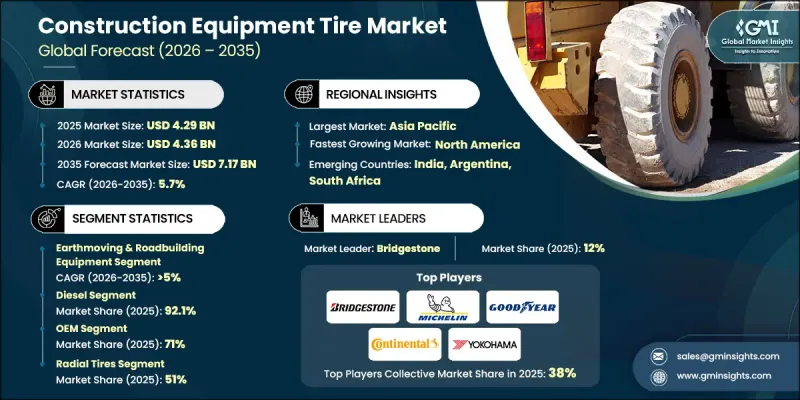
Strong momentum in global infrastructure modernization is a key factor driving demand for construction equipment tires. Governments across developed and emerging economies are allocating substantial investments toward transportation networks, urban development, and energy infrastructure, which require extensive deployment of heavy machinery. Equipment operating in demanding environments must be fitted with durable, high-load-bearing, and high-performance radial off-the-road tires capable of withstanding extreme pressure and terrain conditions. Market participants are actively pursuing inorganic growth strategies, including product introductions, mergers and acquisitions, and strategic alliances to reinforce their competitive positioning. In parallel, expanding surface and underground mining operations are generating sustained demand for ultra-large and heavy-duty off-road tires. Rising mineral extraction activities to support electrification and renewable energy technologies are increasing equipment usage in harsh landscapes, accelerating tire wear cycles, and strengthening both OEM installations and replacement demand. Continuous advancements in tire engineering, such as heat-resistant compounds, reinforced sidewall construction, and integrated tire monitoring technologies that track real-time pressure, temperature, and wear, are further enhancing operational efficiency and total lifecycle performance.
| Market Scope | |
|---|---|
| Start Year | 2025 |
| Forecast Year | 2026-2035 |
| Start Value | $4.29 Billion |
| Forecast Value | $7.17 Billion |
| CAGR | 5.7% |
The earthmoving and roadbuilding equipment segment accounted for 57% share in 2025 and is anticipated to grow at a CAGR of 5% from 2026 to 2035. Expanding transportation infrastructure projects and improved regional connectivity are driving higher utilization of heavy machinery used in grading, compaction, loading, and paving operations. These machines frequently function under high load intensity and abrasive surface conditions, leading to accelerated tire degradation. The long project timelines associated with road construction directly contribute to sustained demand for durable, heat-resistant, and high-traction tires across both original equipment and aftermarket channels.
The diesel-powered machinery segment held 92.1% share in 2025 and is forecast to grow at a CAGR of 5% through 2035. Diesel equipment remains essential in large-scale infrastructure and mining applications due to its operational durability and extended service life. Continuous operation in demanding conditions increases heat buildup and mechanical stress on tires, shortening replacement intervals and reinforcing recurring demand for high-capacity, heavy-duty tire solutions. In many developing regions, diesel-powered equipment continues to be more accessible and cost-effective compared to alternative powertrains.
China Construction Equipment Tire Market held 50% share, generating USD 994.4 million in 2025. The country's strong position as a global construction equipment manufacturing hub significantly supports domestic tire consumption. A large concentration of machinery production facilities serving both domestic and export markets drives consistent OEM tire fitment demand. Rapid urban expansion and infrastructure development across emerging metropolitan areas are further intensifying earthmoving and heavy equipment operations, strengthening regional tire requirements.
Key companies operating in the Global Construction Equipment Tire Market include Michelin, Bridgestone, Goodyear, Continental, Zhongce Rubber, Titan International, Sumitomo Rubber Industries, Pirelli, Linglong Tire, and Yokohama. Companies in the Construction Equipment Tire Market are enhancing their market foothold through continuous product innovation, capacity expansion, and strategic collaborations. Manufacturers are investing in advanced tire technologies that improve durability, load performance, and fuel efficiency while reducing the total cost of ownership for end users. Strategic mergers, acquisitions, and joint ventures enable firms to expand geographic presence and strengthen distribution networks. Partnerships with original equipment manufacturers secure long-term supply agreements and stable revenue streams. Businesses are also increasing their focus on smart tire solutions equipped with monitoring systems to differentiate their offerings.
Table of Contents
Chapter 1 Methodology
- 1.1 Research approach
- 1.2 Quality Commitments
- 1.2.1 GMI AI policy & data integrity commitment
- 1.2.1.1 Source consistency protocol
- 1.2.1 GMI AI policy & data integrity commitment
- 1.3 Research Trail & Confidence Scoring
- 1.3.1 Research Trail Components
- 1.3.2 Scoring Components
- 1.4 Data Collection
- 1.4.1 Partial list of primary sources
- 1.5 Data mining sources
- 1.5.1 Paid sources
- 1.5.2 Sources, by region
- 1.6 Base estimates and calculations
- 1.6.1 Base year calculation for any one approach
- 1.7 Forecast model
- 1.7.1 Quantified market impact analysis
- 1.7.1.1 Mathematical impact of growth parameters on forecast
- 1.7.1 Quantified market impact analysis
- 1.8 Research transparency addendum
- 1.8.1 Source attribution framework
- 1.8.2 Quality assurance metrics
- 1.8.3 Our commitment to trust
Chapter 2 Executive Summary
- 2.1 Industry 360° synopsis, 2022 - 2035
- 2.2 Key market trends
- 2.2.1 Regional
- 2.2.2 Tire
- 2.2.3 Equipment
- 2.2.4 Tread depth
- 2.2.5 Tread pattern
- 2.2.6 Equipment size
- 2.2.7 Propulsion
- 2.2.8 Sales channel
- 2.3 TAM Analysis, 2026-2035
- 2.4 CXO perspectives: Strategic imperatives
Chapter 3 Industry Insights
- 3.1 Industry ecosystem analysis
- 3.1.1 Supplier landscape
- 3.1.2 Profit margin analysis
- 3.1.3 Cost structure
- 3.1.4 Value addition at each stage
- 3.1.5 Factor affecting the value chain
- 3.1.6 Disruptions
- 3.2 Industry impact forces
- 3.2.1 Growth drivers
- 3.2.1.1 Growth in global infrastructure development
- 3.2.1.2 Expansion of mining and quarrying activities
- 3.2.1.3 Technological advancements in tire materials
- 3.2.1.4 Increasing mechanization in agriculture & construction
- 3.2.2 Industry pitfalls and challenges
- 3.2.2.1 Volatility in raw material prices
- 3.2.2.2 High cost of large OTR tires
- 3.2.2.3 Supply chain disruptions
- 3.2.2.4 Intense competition and price pressure
- 3.2.3 Market opportunities
- 3.2.3.1 Infrastructure boom in Asia Pacific
- 3.2.3.2 Growth in electric & autonomous equipment
- 3.2.3.3 Retreading & recycling solutions
- 3.2.3.4 Expansion in emerging mining markets
- 3.2.1 Growth drivers
- 3.3 Growth potential analysis
- 3.4 Regulatory landscape
- 3.4.1 North America
- 3.4.1.1 Environmental Protection Agency (EPA)
- 3.4.1.2 National Highway Traffic Safety Administration (NHTSA)
- 3.4.1.3 Occupational Safety and Health Administration (OSHA)
- 3.4.1.4 U.S. Department of Transportation (DOT)
- 3.4.1.5 Canadian Motor Vehicle Safety Standards (CMVSS)
- 3.4.2 Europe
- 3.4.2.1 EU Machinery Regulation
- 3.4.2.2 CE Marking Compliance
- 3.4.2.3 REACH (Registration, Evaluation, Authorisation and Restriction of Chemicals)
- 3.4.2.4 EU Tire Labelling Regulation
- 3.4.2.5 National Type Approval & Road Homologation Requirements
- 3.4.3 Asia Pacific
- 3.4.3.1 China Compulsory Certification (CCC)
- 3.4.3.2 Indian Central Motor Vehicle Rules (CMVR) - Off-Highway Tire Norms
- 3.4.3.3 Japanese Industrial Standards (JIS) for Tires
- 3.4.3.4 ASEAN Harmonized Technical Regulations
- 3.4.3.5 Australian Design Rules (ADR)
- 3.4.4 Latin America
- 3.4.4.1 Brazilian National Institute of Metrology (INMETRO) Regulations
- 3.4.4.2 Brazilian National Traffic Council (CONTRAN)
- 3.4.4.3 Mexican NOM Tire Safety Standards
- 3.4.4.4 Regional Import & Certification Requirements
- 3.4.5 Middle East & Africa
- 3.4.5.1 GCC Standardization Organization (GSO) Tire Regulations
- 3.4.5.2 Saudi Standards, Metrology and Quality Organization (SASO)
- 3.4.5.3 South African National Regulator for Compulsory Specifications (NRCS)
- 3.4.5.4 National Road Traffic Act (NRTA) Compliance
- 3.4.1 North America
- 3.5 Major market trends and disruptions
- 3.6 Future market trends
- 3.7 Porter’s analysis
- 3.8 PESTEL analysis
- 3.9 Technology and innovation landscape
- 3.9.1 Current technological trends
- 3.9.2 Emerging technologies
- 3.10 Price analysis
- 3.10.1 Historical price trend analysis
- 3.10.1.1 Raw material cost influence on tire prices
- 3.10.1.2 Oem vs aftermarket pricing dynamics
- 3.10.1.3 Regional price variations
- 3.10.2 Pricing strategy by player
- 3.10.2.1 Premium tier strategy
- 3.10.2.2 Value tier strategy
- 3.10.2.3 Cost-plus pricing
- 3.10.1 Historical price trend analysis
- 3.11 Production statistics
- 3.11.1 Production hubs
- 3.11.2 Consumption hubs
- 3.11.3 Export and import
- 3.12 Cost breakdown analysis
- 3.13 Patent analysis
- 3.14 Sustainability and environmental aspects
- 3.14.1 Sustainable practices
- 3.14.2 Waste reduction strategies
- 3.14.3 Energy efficiency in production
- 3.14.4 Eco-friendly Initiatives
- 3.14.5 Carbon footprint considerations
- 3.15 Impact of AI & generative AI on the market
- 3.15.1 AI-driven disruption of existing business models
- 3.15.1.1 Predictive maintenance & fleet management AI
- 3.15.1.2 Automated tire design optimization
- 3.15.1.3 Supply chain AI for demand forecasting
- 3.15.2 GenAI use cases & adoption roadmap by segment
- 3.15.2.1 Tread pattern design generation
- 3.15.2.2 Customer service chatbots & technical support
- 3.15.2.3 Marketing content creation
- 3.15.3 Risks, limitations & regulatory considerations
- 3.15.3.1 Data privacy in IoT-enabled smart tires
- 3.15.3.2 AI algorithm transparency requirements
- 3.15.3.3 Liability in AI-driven product failures
- 3.15.1 AI-driven disruption of existing business models
Chapter 4 Competitive Landscape, 2025
- 4.1 Introduction
- 4.2 Company market share analysis
- 4.2.1 North America
- 4.2.2 Europe
- 4.2.3 Asia Pacific
- 4.2.4 LATAM
- 4.2.5 MEA
- 4.3 Competitive analysis of major market players
- 4.4 Competitive positioning matrix
- 4.5 Key developments
- 4.5.1 Mergers & acquisitions
- 4.5.2 Partnerships & collaborations
- 4.5.3 New Product Launches
- 4.5.4 Expansion Plans and funding
Chapter 5 Market Estimates & Forecast, By Tire, 2022 - 2035 ($Mn, Units)
- 5.1 Key trends
- 5.2 Radial
- 5.3 Bias
- 5.4 Solid
- 5.5 Others
Chapter 6 Market Estimates & Forecast, By Equipment, 2022 - 2035 ($Mn, Units)
- 6.1 Key trends
- 6.2 Earthmoving & Road Building Equipment
- 6.2.1 Backhoes
- 6.2.2 Excavators
- 6.2.3 Loaders
- 6.2.4 Compaction Equipment
- 6.2.5 Others
- 6.3 Material handling & Crane
- 6.3.1 Industrial trucks
- 6.3.2 All-terrain crane
- 6.3.3 Rough terrain crane
- 6.3.4 Truck loader crane
- 6.4 Concrete equipment
- 6.4.1 Concrete pumps
- 6.4.2 Transit mixers
- 6.4.3 Asphalt pavers
Chapter 7 Market Estimates & Forecast, By Sales Channel, 2022 - 2035 ($Mn, Units)
- 7.1 Key trends
- 7.2 OEM
- 7.3 Aftermarket
Chapter 8 Market Estimates & Forecast, By Tread Depth, 2022 - 2035 ($Mn, Units)
- 8.1 Key trends
- 8.2 Normal tread
- 8.3 Deep tread
- 8.4 Extra deep tread
- 8.5 Shallow/smooth tread
Chapter 9 Market Estimates & Forecast, By Tread Pattern, 2022 - 2035 ($Mn, Units)
- 9.1 Key trends
- 9.2 Block tread
- 9.3 Lugged tread
- 9.4 Ribbed tread
- 9.5 Smooth tread
Chapter 10 Market Estimates & Forecast, By Equipment Size, 2022 - 2035 ($Mn, Units)
- 10.1 Key trends
- 10.2 Compact
- 10.3 Medium
- 10.4 Heavy
Chapter 11 Market Estimates & Forecast, By Propulsion, 2022 - 2035 ($Mn, Units)
- 11.1 Key trends
- 11.2 Diesel
- 11.3 CNG/LNG
- 11.4 Electric
Chapter 12 Market Estimates & Forecast, By Region, 2021 - 2034 ($Mn, Units)
- 12.1 Key trends
- 12.2 North America
- 12.2.1 US
- 12.2.2 Canada
- 12.3 Europe
- 12.3.1 UK
- 12.3.2 Germany
- 12.3.3 France
- 12.3.4 Italy
- 12.3.5 Spain
- 12.3.6 Russia
- 12.3.7 Denmark
- 12.3.8 Finland
- 12.3.9 Norway
- 12.3.10 Sweden
- 12.4 Asia Pacific
- 12.4.1 China
- 12.4.2 India
- 12.4.3 Japan
- 12.4.4 South Korea
- 12.4.5 ANZ
- 12.4.6 Singapore
- 12.4.7 Thailand
- 12.4.8 Indonesia
- 12.4.9 Vietnam
- 12.5 Latin America
- 12.5.1 Brazil
- 12.5.2 Mexico
- 12.5.3 Argentina
- 12.6 MEA
- 12.6.1 South Africa
- 12.6.2 Saudi Arabia
- 12.6.3 UAE
Chapter 13 Company Profiles
- 13.1 Global companies
- 13.1.1 Balkrishna Industries
- 13.1.2 Bridgestone
- 13.1.3 Continental
- 13.1.4 Double Coin
- 13.1.5 Goodyear Tire & Rubber Company
- 13.1.6 Linglong Tire
- 13.1.7 Michelin
- 13.1.8 Pirelli
- 13.1.9 Sumitomo Rubber Industries
- 13.1.10 Titan International
- 13.1.11 Triangle Tyre
- 13.1.12 Yokohama Rubber Company
- 13.1.13 Zhongce Rubber
- 13.2 Regional players
- 13.2.1 Aeolus Tyre
- 13.2.2 Apollo Tyres
- 13.2.3 CEAT
- 13.2.4 JK Tyre & Industries
- 13.2.5 Magna Tyres
- 13.2.6 MRF
- 13.3 Emerging players
- 13.3.1 Kal Tire Mining Tire
- 13.3.2 OTR Engineered Solutions
- 13.3.3 Revvo Technologies

