PUBLISHER: Global Market Insights Inc. | PRODUCT CODE: 1982343

PUBLISHER: Global Market Insights Inc. | PRODUCT CODE: 1982343
MEMS Pressure Sensors Market Opportunity, Growth Drivers, Industry Trend Analysis, and Forecast 2026 - 2035
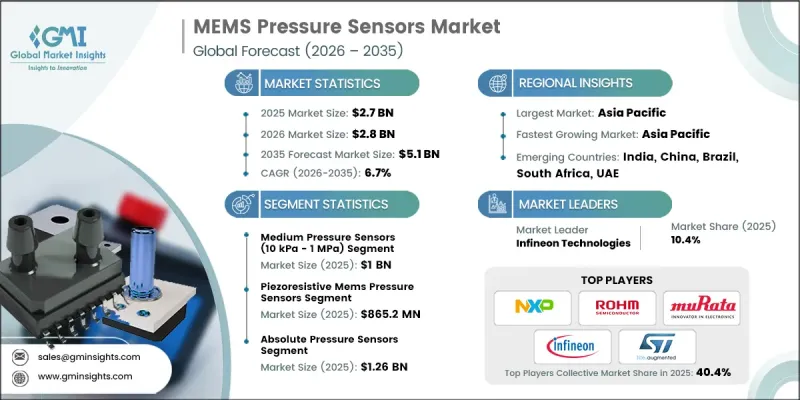
The Global MEMS Pressure Sensors Market was valued at USD 2.7 billion in 2025 and is estimated to grow at a CAGR 6.7% to reach USD 5.1 billion by 2035.
The MEMS pressure sensors industry is gaining steady momentum due to increasing deployment across connected devices, automotive systems, healthcare technologies, industrial automation, and advanced consumer electronics. Rapid expansion of IoT-enabled ecosystems is creating strong demand for compact, low-power sensing solutions capable of delivering accurate real-time data. Automotive manufacturers are integrating MEMS pressure sensors to improve safety, fuel efficiency, and system optimization. In healthcare, the growing use of wearable monitoring devices and portable diagnostic equipment is strengthening adoption. Industrial facilities are implementing advanced pressure sensing solutions to enhance process control, productivity, and regulatory compliance. Additionally, consumer electronics manufacturers are incorporating smart sensing features to improve device performance and user interaction. As industries accelerate digital transformation and automation initiatives, MEMS pressure sensors are becoming critical components in next-generation intelligent systems worldwide.
| Market Scope | |
|---|---|
| Start Year | 2025 |
| Forecast Year | 2026-2035 |
| Start Value | $2.7 Billion |
| Forecast Value | $5.1 Billion |
| CAGR | 6.7% |
MEMS pressure sensors play a vital role in enabling IoT infrastructure by delivering compact and energy-efficient environmental monitoring capabilities. Their small form factor and low power consumption make them ideal for integration into smart infrastructure networks, connected appliances, and advanced mobile devices. Expanding digitalization programs and smart city developments are encouraging broader sensor deployment across utilities, transportation, and energy management systems. Enhanced environmental awareness, altitude detection, and adaptive system control are driving further integration into next-generation smart products.
The medium pressure sensors segment, covering the 10 kPa to 1 MPa range, generated USD 1 billion in 2025, representing the largest market share. Demand is supported by widespread integration into automotive systems that require precise pressure monitoring for safety and operational efficiency. Industrial applications, including process automation and climate control systems, are increasingly adopting medium pressure sensors to ensure accurate fluid and air pressure regulation while maintaining performance standards.
The piezoresistive MEMS pressure sensors segment accounted for USD 865.2 million in 2025. Strong adoption across automotive, industrial, and medical sectors is driven by their high measurement accuracy and dependable performance. Piezoresistive sensors efficiently convert pressure variations into electrical signals, enabling precise monitoring in critical applications. Their cost-effectiveness and established manufacturing processes support large-scale deployment across diverse industries. Manufacturers are focusing on improving sensitivity levels and expanding integration into automotive and industrial platforms while leveraging mature production capabilities for scalable growth.
North America MEMS Pressure Sensors Market captured 28.6% share in 2025. Regional expansion is fueled by robust demand from automotive, aerospace, and healthcare industries, supported by advanced industrial infrastructure and strict safety standards. Adoption of connected vehicle technologies, industrial automation systems, and next-generation manufacturing processes is accelerating growth, with the United States serving as the primary revenue contributor. A strong innovation ecosystem, semiconductor expertise, and sustained research and development investments continue to reinforce North America's leadership in precision sensing technologies.
Key companies operating in the Global MEMS Pressure Sensors Market include Honeywell, Bosch Sensortec, Analog Devices, STMicroelectronics, NXP Semiconductors, Infineon Technologies, Sensata Technologies, Amphenol Advanced Sensors, Murata Manufacturing Co., Ltd., TDK Corporation, Omron Corporation, ROHM Semiconductor, MinebeaMitsumi Inc., Melexis, Silicon Microstructures Inc., Endress+Hauser, Merit Medical Systems, NOVOSENSE Microelectronics, and Winsen. Companies in the MEMS Pressure Sensors Market are strengthening their competitive position through continuous innovation and strategic expansion initiatives. Leading manufacturers are investing in advanced fabrication technologies to enhance sensor accuracy, miniaturization, and energy efficiency. Integration of MEMS sensors into multifunctional modules is enabling broader applications across automotive, healthcare, and industrial sectors. Strategic collaborations with OEMs and system integrators are accelerating product adoption and design integration. Firms are also expanding production capacity to meet rising global demand while optimizing supply chain resilience.
Table of Contents
Chapter 1 Methodology and Scope
- 1.1 Market scope and definition
- 1.2 Research design
- 1.2.1 Research approach
- 1.2.2 Data collection methods
- 1.3 Data mining sources
- 1.3.1 Global
- 1.3.2 Regional/Country
- 1.4 Base estimates and calculations
- 1.4.1 Base year calculation
- 1.4.2 Key trends for market estimation
- 1.5 Primary research and validation
- 1.5.1 Primary sources
- 1.6 Forecast model
- 1.7 Research assumptions and limitations
Chapter 2 Executive Summary
- 2.1 Industry 360° synopsis
- 2.2 Key market trends
- 2.2.1 Type trends
- 2.2.2 Pressure range trends
- 2.2.3 Sensing technology trends
- 2.2.4 Packaging type trends
- 2.2.5 Sales channel trends
- 2.2.6 End-user industry trends
- 2.2.7 Regional trends
- 2.3 TAM Analysis, 2026 - 2035 (USD Million)
- 2.4 CXO perspectives: Strategic imperatives
- 2.4.1 Executive decision points
- 2.4.2 Critical success factors
- 2.5 Future outlook and strategic recommendations
Chapter 3 Industry Insights
- 3.1 Industry ecosystem analysis
- 3.1.1 Supplier landscape
- 3.1.2 Profit margin
- 3.1.3 Cost structure
- 3.1.4 Value addition at each stage
- 3.1.5 Factor affecting the value chain
- 3.1.6 Disruptions
- 3.2 Industry impact forces
- 3.2.1 Growth drivers
- 3.2.1.1 Rising adoption of IoT and connected devices
- 3.2.1.2 Growing automotive industry demand for safety and efficiency
- 3.2.1.3 Expansion of healthcare applications and wearable devices
- 3.2.1.4 Increasing use in industrial automation and process control
- 3.2.1.5 Rising demand for consumer electronics with smart sensing capabilities
- 3.2.2 Pitfalls and challenges
- 3.2.2.1 High manufacturing costs and complexity
- 3.2.2.2 Sensitivity to environmental conditions affecting accuracy
- 3.2.1 Growth drivers
- 3.3 Growth potential analysis
- 3.4 Regulatory landscape
- 3.4.1 North America
- 3.4.2 Europe
- 3.4.3 Asia Pacific
- 3.4.4 Latin America
- 3.4.5 Middle East & Africa
- 3.5 Porter’s analysis
- 3.6 PESTEL analysis
- 3.7 Technology and Innovation landscape
- 3.7.1 Current technological trends
- 3.7.2 Emerging technologies
- 3.8 Emerging Business Models
- 3.9 Compliance Requirements
- 3.10 Supply Chain Resilience
- 3.11 Geopolitical Analysis
Chapter 4 Competitive Landscape, 2025
- 4.1 Introduction
- 4.2 Company market share analysis
- 4.2.1 By region
- 4.2.1.1 North America
- 4.2.1.2 Europe
- 4.2.1.3 Asia Pacific
- 4.2.1.4 Latin America
- 4.2.1.5 Middle East & Africa
- 4.2.2 Market concentration analysis
- 4.2.1 By region
- 4.3 Competitive benchmarking of key players
- 4.3.1 Product portfolio comparison
- 4.3.1.1 Product range breadth
- 4.3.1.2 Technology
- 4.3.1.3 Innovation
- 4.3.2 Geographic presence comparison
- 4.3.2.1 Global footprint analysis
- 4.3.2.2 Service network coverage
- 4.3.2.3 Market penetration by region
- 4.3.3 Competitive positioning matrix
- 4.3.3.1 Leaders
- 4.3.3.2 Challengers
- 4.3.3.3 Followers
- 4.3.3.4 Niche players
- 4.3.4 Strategic outlook matrix
- 4.3.1 Product portfolio comparison
- 4.4 Key developments, 2022-2025
- 4.4.1 Mergers and acquisitions
- 4.4.2 Partnerships and collaborations
- 4.4.3 Technological advancements
- 4.4.4 Expansion and investment strategies
- 4.4.5 Sustainability initiatives
- 4.4.6 Digital transformation initiatives
- 4.5 Emerging/ startup competitors landscape
Chapter 5 Market Estimates and Forecast, By Type, 2022 - 2035 (USD Million)
- 5.1 Key trends
- 5.2 Piezoresistive MEMS Pressure Sensors
- 5.3 Resonant MEMS Pressure Sensors
- 5.4 Capacitive MEMS Pressure Sensors
- 5.5 Optical MEMS Pressure Sensors
- 5.6 Thermal MEMS Pressure Sensors
Chapter 6 Market Estimates and Forecast, By Pressure Range, 2022 - 2035 (USD Million)
- 6.1 Key trends
- 6.2 Low Pressure Sensors (<10 kPa)
- 6.3 Medium Pressure Sensors (10 kPa - 1 MPa)
- 6.4 High Pressure Sensors (>1 MPa)
Chapter 7 Market Estimates and Forecast, By Sensing Technology, 2022 - 2035 (USD Million)
- 7.1 Key Trends
- 7.2 Absolute Pressure Sensors
- 7.3 Gauge Pressure Sensors
- 7.4 Differential Pressure Sensors
Chapter 8 Market Estimates and Forecast, By Packaging Type, 2022 - 2035 (USD Million)
- 8.1 Key trends
- 8.2 Surface-Mount Devices (SMD)
- 8.3 Through-Hole Technology (THT)
- 8.4 Chip-On-Board (COB)
Chapter 9 Market Estimates and Forecast, By Sales Channel, 2022 - 2035 (USD Million)
- 9.1 Key trends
- 9.2 Direct Sales
- 9.3 Online Sales
Chapter 10 Market Estimates and Forecast, By End-User Industry, 2022 - 2035 (USD Million)
- 10.1 Key trends
- 10.2 Automotive
- 10.3 Healthcare
- 10.4 Consumer Electronics
- 10.5 Industrial Manufacturing
- 10.6 Aerospace & Defense
- 10.7 Oil & Gas
- 10.8 Environmental Monitoring
- 10.9 Others
Chapter 11 Market Estimates and Forecast, By Region, 2022 - 2035 (USD Million)
- 11.1 Key trends
- 11.2 North America
- 11.2.1 U.S.
- 11.2.2 Canada
- 11.3 Europe
- 11.3.1 Germany
- 11.3.2 UK
- 11.3.3 France
- 11.3.4 Spain
- 11.3.5 Italy
- 11.3.6 Netherlands
- 11.4 Asia Pacific
- 11.4.1 China
- 11.4.2 India
- 11.4.3 Japan
- 11.4.4 Australia
- 11.4.5 South Korea
- 11.5 Latin America
- 11.5.1 Brazil
- 11.5.2 Mexico
- 11.5.3 Argentina
- 11.6 Middle East and Africa
- 11.6.1 Saudi Arabia
- 11.6.2 South Africa
- 11.6.3 UAE
Chapter 12 Company Profiles
- 12.1 Global Key Players
- 12.1.1 Analog Devices
- 12.1.2 Honeywell
- 12.1.3 STMicroelectronics
- 12.1.4 NXP Semiconductors
- 12.1.5 Infineon Technologies
- 12.1.6 Bosch Sensortec
- 12.1.7 Sensata Technologies
- 12.1.8 Murata Manufacturing Co., Ltd.
- 12.2 Regional Key Players
- 12.2.1 North America
- 12.2.1.1 Amphenol Advanced Sensors
- 12.2.1.2 Silicon Microstructures Inc.
- 12.2.1.3 Merit Medical Systems
- 12.2.2 Europe
- 12.2.2.1 Endress+Hauser
- 12.2.2.2 Melexis
- 12.2.3 Asia Pacific
- 12.2.3.1 MinebeaMitsumi Inc.
- 12.2.3.2 Omron Corporation
- 12.2.3.3 ROHM Semiconductor
- 12.2.3.4 TDK Corporation
- 12.2.3.5 NOVOSENSE Microelectronics
- 12.2.1 North America
- 12.3 Niche / Disruptors
- 12.3.1 Winsen

