PUBLISHER: Global Market Insights Inc. | PRODUCT CODE: 1982344

PUBLISHER: Global Market Insights Inc. | PRODUCT CODE: 1982344
Facial Cleanser Market Opportunity, Growth Drivers, Industry Trend Analysis, and Forecast 2026 - 2035
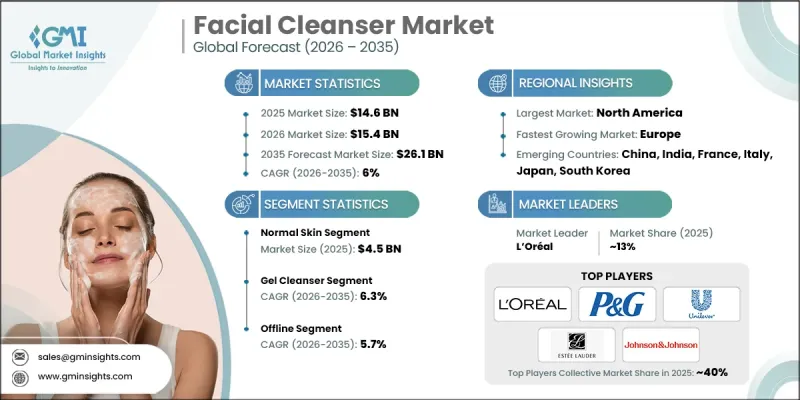
The Global Facial Cleanser Market was valued at USD 14.6 billion in 2025 and is estimated to grow at a CAGR of 6% to reach USD 26.1 billion by 2035.
Consumer awareness about daily skincare routines is driving demand for facial cleansers, as more people recognize the importance of maintaining healthy, clear skin. With increased exposure to urban pollutants and the rising emphasis on personal grooming, consumers are purchasing specialized products that promise effective cleansing without compromising skin health. Social media and beauty content have made it easier for individuals to understand skincare practices, fueling demand for advanced facial cleansers. Younger consumers are particularly influenced by beauty trends, while men are increasingly adopting facial cleansers as part of their daily grooming habits. The growth of e-commerce platforms and online beauty retailing also supports higher sales, offering consumers convenient access to a wide range of products.
| Market Scope | |
|---|---|
| Start Year | 2025 |
| Forecast Year | 2026-2035 |
| Start Value | $14.6 Billion |
| Forecast Value | $26.1 Billion |
| CAGR | 6% |
In 2025, the normal skin segment accounted for USD 4.5 billion and is expected to grow at a CAGR of 6.3% between 2026 and 2035. Normal skin dominates the market as a large portion of consumers prefer mild formulations that cleanse without disturbing natural moisture. Consistent daily use across all age groups, along with widespread product availability in both premium and mass-market categories, ensures steady sales growth.
The offline retail channels segment held 74.96% share in 2025 and is projected to grow at a CAGR of 5.7% from 2026 to 2035. Brick-and-mortar stores remain central to facial cleanser sales, as they offer immediate access, product visibility, and in-store promotions that influence buying decisions. The accessibility of products in supermarkets, pharmacies, and specialty stores allows consumers to evaluate packaging, quality, and brand trust before purchasing.
U.S. Facial Cleanser Market reached USD 3.7 billion in 2025 and is projected to grow at a CAGR of 5.9% from 2026 to 2035. Rising personal care spending and social media awareness encourage consumers to select cleansers suited to their skin types and concerns. Increasing interest in men's grooming and professional dermatology endorsements boosts demand for targeted and clinically recommended facial cleansing products. Subscription-based services also drive repeat purchases and consistent product usage.
Major players in the Global Facial Cleanser Market include Beiersdorf AG, Shiseido Company, L'Oreal, Clarins Group, Coty Inc., Procter & Gamble, Johnson & Johnson, Mary Kay Inc., Unilever, Amorepacific Corporation, Natura &Co, Estee Lauder, Revlon, Inc., Pierre Fabre Group, and Kao Corporation. Leading companies are adopting multiple strategies to strengthen their market presence. They are investing in research and development to launch innovative and skin-specific products, expanding online and offline distribution networks, and collaborating with dermatologists to enhance credibility. Many brands focus on influencer partnerships and social media campaigns to connect with younger consumers, while premium and subscription offerings encourage repeat purchases. Aggressive promotional activities, brand loyalty programs, and global market expansion remain key tactics to maintain competitive positioning and capture a larger share of the growing facial cleanser market.
Table of Contents
Chapter 1 Methodology & Scope
- 1.1 Market scope and definition
- 1.2 Research design
- 1.2.1 Research approach
- 1.2.2 Data collection methods
- 1.3 Data mining sources
- 1.3.1 Global
- 1.3.2 Regional/Country
- 1.4 Base estimates and calculations
- 1.4.1 Base year calculation
- 1.4.2 Key trends for market estimation
- 1.5 Primary research and validation
- 1.5.1 Primary sources
- 1.6 Forecast model
- 1.7 Research assumptions and limitations
Chapter 2 Executive Summary
- 2.1 Industry 360° synopsis
- 2.2 Key market trends
- 2.2.1 Skin Type
- 2.2.2 Product Type
- 2.2.3 Consumer Group
- 2.2.4 End User
- 2.2.5 Distribution channel
- 2.3 CXO perspectives: Strategic imperatives
- 2.3.1 Key decision points for industry executives
- 2.3.2 Critical success factors for market players
- 2.4 Future outlook and strategic recommendations
Chapter 3 Industry Insights
- 3.1 Industry ecosystem analysis
- 3.1.1 Supplier landscape
- 3.1.2 Profit margin
- 3.1.3 Value addition at each stage
- 3.1.4 Factor affecting the value chain
- 3.2 Industry impact forces
- 3.2.1 Growth drivers
- 3.2.1.1 Increasing consumer focus on skincare and personal grooming
- 3.2.1.2 Growth in influencer-led and digital beauty content
- 3.2.1.3 Expansion of e-commerce and online beauty retailing
- 3.2.2 Pitfalls & Challenges
- 3.2.2.1 Intense competitive pressure and brand proliferation
- 3.2.2.2 Regulatory constraints on cosmetic ingredients
- 3.2.3 Opportunities
- 3.2.3.1 Customization and AI-driven skincare recommendations
- 3.2.3.2 Clean, sustainable and refillable packaging innovations
- 3.2.1 Growth drivers
- 3.3 Growth potential analysis
- 3.4 Future market trends
- 3.5 Technology and innovation landscape
- 3.5.1 Current technological trends
- 3.5.2 Emerging technologies
- 3.6 Price trends
- 3.6.1 By region
- 3.6.2 By product
- 3.7 Regulatory landscape
- 3.7.1 Standards and compliance requirements
- 3.7.2 Regional regulatory frameworks
- 3.7.3 Certification standards
- 3.8 Porter’s analysis
- 3.9 PESTEL analysis
Chapter 4 Competitive Landscape, 2025
- 4.1 Introduction
- 4.2 Company market share analysis
- 4.2.1 By Region
- 4.2.1.1 North America
- 4.2.1.2 Europe
- 4.2.1.3 Asia Pacific
- 4.2.1.4 Latin America
- 4.2.1.5 Middle East & Africa
- 4.2.1 By Region
- 4.3 Company matrix analysis
- 4.4 Competitive analysis of major market players
- 4.5 Competitive positioning matrix
- 4.6 Key developments
- 4.6.1 Mergers & acquisitions
- 4.6.2 Partnerships & collaborations
- 4.6.3 New product launches
- 4.6.4 Expansion plans
Chapter 5 Market Estimates & Forecast, By Skin Type, 2022 - 2035, (USD Billion) (Thousand Units)
- 5.1 Key trends
- 5.2 Normal Skin
- 5.3 Oily skin
- 5.4 Dry skin
- 5.5 Sensitive skin
- 5.6 Combination skin
- 5.7 Others
Chapter 6 Market Estimates & Forecast, By Product Type, 2022 - 2035, (USD Billion) (Thousand Units)
- 6.1 Key trends
- 6.2 Gel cleanser
- 6.3 Cream & lotion cleanser
- 6.4 Foaming cleanser
- 6.5 Bar cleanser
- 6.6 Others
Chapter 7 Market Estimates & Forecast, By Consumer Group, 2022 - 2035, (USD Billion) (Thousand Units)
- 7.1 Key trends
- 7.2 Male
- 7.3 Female
- 7.4 Unisex
Chapter 8 Market Estimates & Forecast, By End User, 2022 - 2035, (USD Billion) (Thousand Units)
- 8.1 Key trends
- 8.2 Individual
- 8.3 Commercial
Chapter 9 Market Estimates & Forecast, By Distribution Channel, 2022 - 2035, (USD Billion) (Thousand Units)
- 9.1 Key trends
- 9.2 Online
- 9.2.1 E-commerce websites
- 9.2.2 Company websites
- 9.3 Offline
- 9.3.1 Hypermarket/supermarket
- 9.3.2 Departmental stores
- 9.3.3 Others
Chapter 10 Market Estimates & Forecast, By Region, 2022 - 2035, (USD Billion) (Thousand Units)
- 10.1 Key trends
- 10.2 North America
- 10.2.1 U.S.
- 10.2.2 Canada
- 10.3 Europe
- 10.3.1 Germany
- 10.3.2 UK
- 10.3.3 France
- 10.3.4 Italy
- 10.3.5 Spain
- 10.4 Asia Pacific
- 10.4.1 China
- 10.4.2 India
- 10.4.3 Japan
- 10.4.4 South Korea
- 10.4.5 Australia
- 10.5 Latin America
- 10.5.1 Brazil
- 10.5.2 Mexico
- 10.5.3 Argentina
- 10.6 MEA
- 10.6.1 Saudi Arabia
- 10.6.2 UAE
- 10.6.3 South Africa
Chapter 11 Company Profiles
- 11.1 Amorepacific Corporation
- 11.2 Beiersdorf AG
- 11.3 Clarins Group
- 11.4 Coty Inc.
- 11.5 Estee Lauder
- 11.6 Johnson & Johnson
- 11.7 Kao Corporation
- 11.8 L’Oreal
- 11.9 Mary Kay Inc.
- 11.10 Natura &Co
- 11.11 Pierre Fabre Group
- 11.12 Procter & Gamble
- 11.13 Revlon, Inc.
- 11.14 Shiseido Company
- 11.15 Unilever

