
PUBLISHER: Global Market Insights Inc. | PRODUCT CODE: 1982345

PUBLISHER: Global Market Insights Inc. | PRODUCT CODE: 1982345
Industrial Heat Pump Market Opportunity, Growth Drivers, Industry Trend Analysis, and Forecast 2026 - 2035
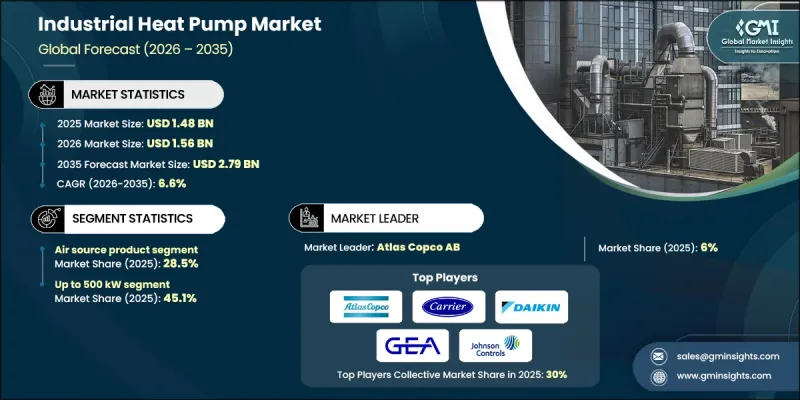
The Global Industrial Heat Pump Market was valued at USD 1.48 billion in 2025 and is estimated to grow at a CAGR of 6.6% to reach USD 2.79 billion by 2035.
Rising environmental concerns and increased efforts to cut carbon emissions in industrial operations are pushing the demand for energy-efficient technologies. Industrial heat pumps have emerged as a key solution for capturing and repurposing low-temperature waste heat, enhancing both efficiency and sustainability. As more industries prioritize reducing reliance on fossil fuels, the adoption of these systems is accelerating. Supportive regulatory policies, combined with increasing energy costs and growing pressure to align with sustainability targets, are reshaping how industries manage thermal energy. The need for efficient heating and cooling across industrial plants, along with growing interest in phasing out outdated systems, continues to boost market momentum. Industrial players are recognizing the potential of heat pumps to improve energy performance while cutting operational expenditures. Coupled with rising investments in clean technologies and smart infrastructure, especially across emerging economies, the market is set to witness robust expansion in the years ahead.
| Market Scope | |
|---|---|
| Start Year | 2025 |
| Forecast Year | 2026-2035 |
| Start Value | $1.48 Billion |
| Forecast Value | $2.79 Billion |
| CAGR | 6.6% |
The air source heat pump segment held 28.5% share in 2025. Rising demand for efficient solutions in space heating, cooling, and hot water across industrial applications, coupled with the increasing focus on reducing carbon emissions, is expected to strengthen the industry outlook. Continuous advancements in component technologies, including improvements in heat pump compressors and refrigerants to enhance overall efficiency, are accelerating adoption. Additionally, the ease of installation, operational versatility, cost-effectiveness, and wide applicability across various industrial processes are further supporting the growth of the air source heat pump market.
The up to 500 kW segment accounted for 45.1% share in 2025 and is projected to grow at over 6.5% CAGR through 2035. Industrial sectors are increasingly deploying energy-efficient heating and cooling systems to lower operational costs and reduce carbon footprints, driving demand in manufacturing, chemical processing, food & beverage, and pulp & paper industries. The adoption of advanced heat pump technologies tailored to specific industrial requirements is reshaping the market, with rapid implementation across diverse sectors further enhancing the growth trajectory.
U.S. Industrial Heat Pump Market held 75.6% share in 2025, generating USD 339.6 million. North America is expected to grow at a strong CAGR of 7.2% from 2026 to 2035. Policies such as the Inflation Reduction Act (IRA) and targeted Department of Energy (DOE) grants are significantly reducing capital expenditure barriers for industrial electrification. Energy-intensive industries, particularly food & beverage and pulp & paper, are increasingly adopting heat pumps to replace aging gas-fired boilers and meet corporate ESG targets. Technological advances in 2026 have introduced high-efficiency units capable of operating under extreme conditions in Canada and northern U.S., broadening the addressable market.
Key players shaping the competitive landscape of the Global Industrial Heat Pump Market include Turboden S.p.A., Ecop, MAN Energy Solutions, Carrier, Qvantum Energi AB, Oilon Group Oy, Dalrada Climate Technology, Armstrong International Inc., Johnson Controls, Atlas Copco AB, GEA Group Aktiengesellschaft, Hien New Energy Equipment Co., Ltd., Daikin Applied Europe S.p.A., Trane Technologies International Limited, Swegon Ltd, Enerin AS, OCHSNER, Emerson Electric Co., Baker Hughes Company, and Piller Blowers & Compressors GmbH. To strengthen their positioning, companies in the industrial heat pump space are prioritizing strategic investments in product innovation and R&D to offer higher efficiency systems compatible with modern industrial demands. Several players are expanding global manufacturing capabilities and establishing local partnerships to cater to region-specific requirements. Firms are also aligning their portfolios with low-carbon and renewable energy trends, introducing systems capable of integrating with waste heat recovery and hybrid setups.
Table of Contents
Chapter 1 Methodology and Scope
- 1.1 Market scope and definition
- 1.2 Research design
- 1.2.1 Research approach
- 1.2.2 Data collection methods
- 1.3 Data mining sources
- 1.3.1 Countrywise
- 1.3.2 Regional/Country
- 1.4 Base estimates and calculations
- 1.4.1 Base year calculation
- 1.4.2 Key trends for market estimation
- 1.5 Primary research and validation
- 1.5.1 Primary sources
- 1.6 Forecast model
- 1.7 Research assumptions and limitations
Chapter 2 Executive Summary
- 2.1 Industry 360° synopsis
- 2.2 Key market trends
- 2.2.1 Regional
- 2.2.2 Product Type
- 2.2.3 By Power Range
- 2.2.4 Material/Construction
- 2.2.5 End-User
- 2.3 CXO perspectives: Strategic imperatives
- 2.3.1 Key decision points for industry executives
- 2.3.2 Critical success factors for market players
- 2.4 Future outlook and strategic recommendations
Chapter 3 Industry Insights
- 3.1 Industry ecosystem analysis
- 3.1.1 Supplier landscape
- 3.1.2 Profit margin
- 3.1.3 Value addition at each stage
- 3.1.4 Factor affecting the value chain
- 3.2 Industry impact forces
- 3.2.1 Growth drivers
- 3.2.1.1 Positive outlook to curb industrial emission levels
- 3.2.1.2 Influx of new investments across heavy-duty industrial applications
- 3.2.1.3 Encouraging regulatory framework by respective authorities
- 3.2.2 Industry pitfalls & challenges
- 3.2.2.1 Significant initial deployment cost
- 3.2.2.2 Supply Chain Volatility for Specialized Alloys
- 3.2.3 Opportunities
- 3.2.3.1 Decarbonization of industrial processes
- 3.2.3.2 Government incentives and supportive policies
- 3.2.1 Growth drivers
- 3.3 Growth potential analysis
- 3.4 Future market trends
- 3.5 Technology and innovation landscape
- 3.5.1 Current technological trends
- 3.5.2 Emerging technologies
- 3.6 Price trends
- 3.6.1 By region
- 3.6.2 By Product Type
- 3.7 Regulatory landscape
- 3.7.1 Standards and compliance requirements
- 3.7.2 Regional regulatory frameworks
- 3.7.3 Certification standards
- 3.8 Porter’s analysis
- 3.9 PESTEL analysis
Chapter 4 Competitive Landscape, 2025
- 4.1 Introduction
- 4.2 Company market share analysis
- 4.2.1 By region
- 4.2.1.1 North America
- 4.2.1.2 Europe
- 4.2.1.3 Asia Pacific
- 4.2.1.4 Latin America
- 4.2.1.5 Middle East and Africa
- 4.2.1 By region
- 4.3 Company matrix analysis
- 4.4 Competitive analysis of major market players
- 4.5 Competitive positioning matrix
- 4.6 Key developments
- 4.6.1 Mergers & acquisitions
- 4.6.2 Partnerships & collaborations
- 4.6.3 New product launches
- 4.6.4 Expansion plans
Chapter 5 Market Estimates and Forecast, By Product, 2022 - 2035 (USD Million) (Thousand Units)
- 5.1 Key trends
- 5.2 Air source
- 5.3 Ground source
- 5.4 Water source
- 5.5 Closed cycle mechanical heat pump
- 5.6 Open cycle mechanical vapor compression heat pump
- 5.7 Open cycle mechanical thermocompression heat pump
- 5.8 Closed cycle absorption heat pump
Chapter 6 Market Estimates and Forecast, By Capacity, 2022 - 2035 (USD Million) (Thousand Units)
- 6.1 Key trends
- 6.2 Up to 500 kW
- 6.3 > 500 kW to 2 MW
- 6.4 2 MW - 5 MW
- 6.5 > 5 MW
Chapter 7 Market Estimates and Forecast, By Temperature, 2022 - 2035 (USD Million) (Thousand Units)
- 7.1 Key trends
- 7.2 80 - 100 °C
- 7.3 100 - 150 °C
- 7.4 150 - 200 °C
- 7.5 > 200 °C
Chapter 8 Market Estimates and Forecast, By Application, 2022 - 2035 (USD Million) (Thousand Units)
- 8.1 Key trends
- 8.2 Industrial
- 8.2.1 Paper
- 8.2.2 Food & beverages
- 8.2.3 Chemical
- 8.2.4 Iron & Steel
- 8.2.5 Machinery
- 8.2.6 Non-Metallic minerals
- 8.2.7 Other industries
- 8.3 District heating
Chapter 9 Market Estimates and Forecast, By Country, 2022 - 2035 (USD Million) (Thousand Units)
- 9.1 Key trends
- 9.2 Key trends
- 9.3 North America
- 9.3.1 U.S.
- 9.3.2 Canada
- 9.4 Europe
- 9.4.1 Germany
- 9.4.2 UK
- 9.4.3 France
- 9.4.4 Italy
- 9.4.5 Spain
- 9.5 Asia Pacific
- 9.5.1 China
- 9.5.2 Japan
- 9.5.3 India
- 9.5.4 Australia
- 9.5.5 South Korea
- 9.6 Latin America
- 9.6.1 Brazil
- 9.6.2 Mexico
- 9.6.3 Argentina
- 9.7 Middle East and Africa
- 9.7.1 South Africa
- 9.7.2 Saudi Arabia
- 9.7.3 UAE
Chapter 10 Company Profiles
- 10.1 Armstrong International Inc.
- 10.2 Atlas Copco AB
- 10.3 Baker Hughes Company
- 10.4 Carrier
- 10.5 Daikin Applied Europe S.p.A.
- 10.6 Dalrada Climate Technology
- 10.7 Ecop
- 10.8 Emerson Electric Co.
- 10.9 Enerin AS
- 10.10 GEA Group Aktiengesellschaft
- 10.11 Hien New Energy Equipment Co., Ltd.
- 10.12 Johnson Controls
- 10.13 MAN Energy Solutions
- 10.14 OCHSNER
- 10.15 Oilon Group Oy
- 10.16 Piller Blowers & Compressors GmbH
- 10.17 Qvantum Energi AB
- 10.18 Swegon Ltd
- 10.19 Trane Technologies International Limited
- 10.20 Turboden S.p.A.

