
PUBLISHER: Global Market Insights Inc. | PRODUCT CODE: 1982346

PUBLISHER: Global Market Insights Inc. | PRODUCT CODE: 1982346
Europe Plate Heat Exchanger Market Opportunity, Growth Drivers, Industry Trend Analysis, and Forecast 2026 - 2035
Europe Plate Heat Exchanger Market was valued at USD 1.9 billion in 2025 and is estimated to grow at a CAGR of 7.8% to reach USD 4.1 billion by 2035.
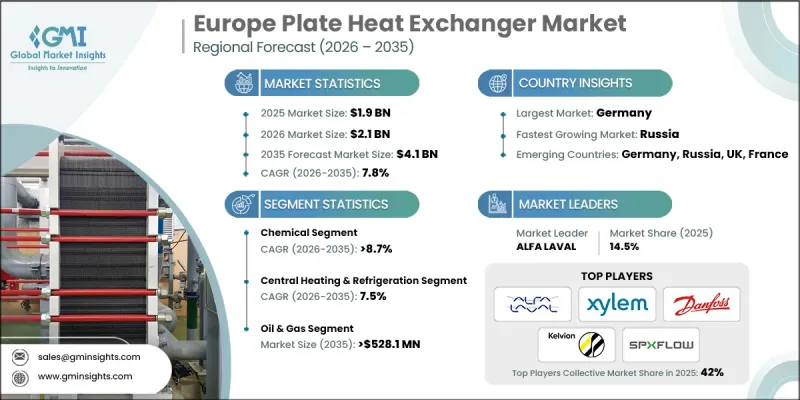
Market growth is driven by rising capital investment across heavy industries and increasing demand for advanced thermal management systems in diverse industrial processes. Companies are rapidly adopting high-efficiency heat exchange equipment designed to lower energy consumption while complying with strict carbon emission regulations. The shift toward low-emission energy systems and sustainable industrial operations is strengthening long-term demand. Growing preference for compact, space-saving heat exchanger designs that optimize thermal performance is also shaping purchasing decisions. Manufacturers are focusing on lightweight and high-performance configurations, utilizing advanced alloys, modular engineering methods, and integrated sensor-based monitoring technologies to improve efficiency, reliability, and maintenance cycles. The implementation of tighter emission standards and broader energy transition policies across Europe is accelerating market expansion. Increasing deployment of heat recovery systems and low-carbon technologies is further reinforcing the outlook, as industries prioritize energy conservation, reduced operational costs, and improved environmental performance. Continuous innovation aimed at enhancing adaptability and efficiency across multiple end-use sectors is supporting steady momentum in the Europe plate heat exchanger market.
| Market Scope | |
|---|---|
| Start Year | 2025 |
| Forecast Year | 2026-2035 |
| Start Value | $1.9 Billion |
| Forecast Value | $4.1 Billion |
| CAGR | 7.8% |
The chemical application segment is projected to grow at a CAGR of 8.7% between 2026 and 2035. Expanding chemical processing facilities, along with increasing use of corrosion-resistant materials and improved gasket and plate configurations, are influencing product demand. Integration of intelligent monitoring systems is also reshaping operational practices within chemical plants. Since chemical manufacturing involves thermally intensive processes such as separation, reaction control, and solvent treatment, high-performance plate heat exchangers offering enhanced heat transfer efficiency and minimized fouling are becoming essential to maintain productivity and system longevity.
UK Plate Heat Exchanger Market is expected to grow at a CAGR of 7.6% by 2035. Accelerated transition toward low-carbon energy systems and increased investment in renewable energy projects are strengthening market prospects. Regulatory commitments focused on long-term carbon neutrality are encouraging industries to upgrade thermal systems. Rising demand from HVAC systems, data center cooling infrastructure, and advanced manufacturing operations is further stimulating adoption. Ongoing modernization of energy and industrial infrastructure is creating opportunities for energy-efficient heat exchangers and advanced heat recovery technologies.
Key companies operating in the Europe Plate Heat Exchanger Market include Alfa Laval, Danfoss, Kelvion Holding, SPX Flow, SWEP International, API Heat Transfer, Hisaka Works, Tranter, Thermowave, HRS Heat Exchangers, Funke Warmeaustauscher Apparatebau, SonFlow, Xylem, Mersen, Hexonic, Wieland Onda, VAU Thermotech, Euro-Apex, Emmegi, Barriquand Group, Farad Heat Exchangers, and Tenez. Companies in the Europe Plate Heat Exchanger Market are strengthening their competitive position through continuous product innovation, energy-efficiency optimization, and strategic collaborations. Leading manufacturers are investing in advanced material technologies and modular system designs to deliver compact, high-performance solutions tailored to industry-specific needs. Many firms are integrating smart monitoring systems and predictive maintenance features to enhance operational reliability and reduce downtime for end users.
Table of Contents
Chapter 1 Methodology & Scope
- 1.1 Research design
- 1.2 Quality commitment
- 1.2.1 GMI AI policy & data integrity commitment
- 1.2.1.1 Source consistency protocol
- 1.2.1 GMI AI policy & data integrity commitment
- 1.3 Research Trail & Confidence Scoring
- 1.3.1 Research Trail Components
- 1.3.2 Scoring components
- 1.4 Data Collection
- 1.4.1 Partial list of primary sources
- 1.5 Data mining sources
- 1.5.1 Paid Sources
- 1.5.1.1 Sources, by country
- 1.5.1 Paid Sources
- 1.6 Base estimates and calculations
- 1.6.1 Base year calculation for any one approach
- 1.7 Forecast model
- 1.8 Research transparency addendum
- 1.8.1 Source attribution framework
- 1.8.2 Quality assurance metrics
- 1.8.3 Our commitment to trust
- 1.9 Market definitions
Chapter 2 Executive Summary
- 2.1 Industry synopsis, 2022 - 2035
- 2.2 Business trends
- 2.3 Application trends
- 2.4 Country trends
Chapter 3 Industry Insights
- 3.1 Industry ecosystem analysis
- 3.1.1 Raw material availability & sourcing analysis
- 3.1.2 Key factors affecting the value chain
- 3.1.3 Disruptions
- 3.2 Industry impact forces
- 3.2.1 Growth drivers
- 3.2.2 Industry pitfalls & challenges
- 3.3 Growth potential analysis
- 3.4 Regulatory landscape
- 3.5 Porter's analysis
- 3.5.1 Bargaining power of suppliers
- 3.5.2 Bargaining power of buyers
- 3.5.3 Threat of new entrants
- 3.5.4 Threat of substitutes
- 3.6 PESTEL analysis
- 3.6.1 Political factors
- 3.6.2 Economic factors
- 3.6.3 Social factors
- 3.6.4 Technological factors
- 3.6.5 Legal factors
- 3.6.6 Environmental factors
- 3.7 Cost structure analysis of plate heat exchanger
- 3.8 Emerging opportunities & trends
- 3.8.1 Digital transformation with IoT technologies
- 3.8.2 Emerging market penetration
- 3.9 Investment analysis & future outlook
Chapter 4 Competitive Landscape, 2025
- 4.1 Introduction
- 4.2 Company market share analysis, by country, 2025
- 4.2.1 Germany
- 4.2.2 UK
- 4.2.3 France
- 4.2.4 Russia
- 4.2.5 Italy
- 4.2.6 Spain
- 4.2.7 Poland
- 4.2.8 Turkey
- 4.3 Competitive positioning matrix
- 4.4 Key developments
- 4.4.1 Mergers & acquisitions
- 4.4.2 Partnerships & collaborations
- 4.4.3 New product launches
- 4.4.4 Expansion plans and funding
Chapter 5 Market Size and Forecast, By Application, 2022 - 2035 (USD Million)
- 5.1 Key trends
- 5.2 Oil & gas
- 5.3 Chemical
- 5.4 Power generation & metallurgy
- 5.5 Marine
- 5.6 Mechanical industry
- 5.7 Central heating & refrigeration
- 5.8 Food processing
- 5.9 Others
Chapter 6 Market Size and Forecast, By Country, 2022 - 2035 (USD Million)
- 6.1 Key trends
- 6.2 Germany
- 6.3 UK
- 6.4 France
- 6.5 Russia
- 6.6 Italy
- 6.7 Spain
- 6.8 Poland
- 6.9 Turkey
Chapter 7 Company Profiles
- 7.1 Alfa Laval
- 7.2 API Heat Transfer
- 7.3 Barriquand Group
- 7.4 Danfoss
- 7.5 Emmegi
- 7.6 Euro-Apex
- 7.7 Farad Heat Exchangers
- 7.8 Funke Warmeaustauscher Apparatebau
- 7.9 Hexonic
- 7.10 Hisaka Works
- 7.11 HRS Heat Exchangers
- 7.12 Kelvion Holding
- 7.13 Mersen
- 7.14 SonFlow
- 7.15 SPX Flow
- 7.16 SWEP International
- 7.17 Tenez
- 7.18 Thermowave
- 7.19 Tranter
- 7.20 VAU Thermotech
- 7.21 Wieland Onda
- 7.22 Xylem

