
PUBLISHER: Global Market Insights Inc. | PRODUCT CODE: 1982357

PUBLISHER: Global Market Insights Inc. | PRODUCT CODE: 1982357
Medical Devices Reimbursement Market Opportunity, Growth Drivers, Industry Trend Analysis, and Forecast 2026 - 2035
The Global Medical Devices Reimbursement Market was valued at USD 617.6 billion in 2025 and is estimated to grow at a CAGR of 6.5% to reach USD 1.2 trillion by 2035.
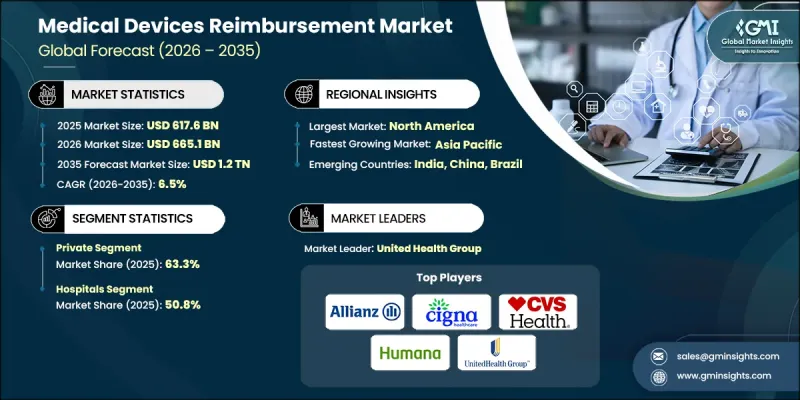
The market expansion is driven by rising healthcare expenditures, increasing prevalence of chronic illnesses, and supportive government initiatives promoting access to medical devices. The adoption of value-based healthcare models has also reshaped reimbursement frameworks, emphasizing clinical effectiveness and cost-efficiency. Medical device reimbursement involves compensating healthcare providers, including hospitals, clinics, and surgical centers, for the acquisition, maintenance, and use of devices in diagnosis, monitoring, and treatment. Reimbursement structures are evolving with new payment models, coverage criteria, and market access pathways, creating opportunities for innovative devices that improve patient outcomes and reduce overall healthcare costs. These transformative trends are strengthening the integration of medical devices into modern healthcare systems while ensuring financial sustainability.
| Market Scope | |
|---|---|
| Start Year | 2025 |
| Forecast Year | 2026-2035 |
| Start Value | $617.6 Billion |
| Forecast Value | $1.2 Trillion |
| CAGR | 6.5% |
The private payer segment held a 63.3% share in 2025. Private insurers, employer-sponsored plans, and supplemental policies generally offer faster coverage decisions and more favorable payment rates than public payers. Private coverage is also more likely to include advanced or premium devices. Growth in this segment is supported by rising middle- and high-income populations, particularly in the Asia-Pacific region, where private insurance adoption is increasing.
The hospitals segment accounted for 50.8% share in 2025. Reimbursement in hospitals includes inpatient, outpatient, ambulatory surgical centers, and emergency departments. Growth is fueled by higher surgical volumes, adoption of advanced technologies, and broader reimbursement for complex procedures. Many devices are reimbursed as part of bundled payments, such as procedure fees or diagnosis-related groups, rather than on an individual device basis.
North America Medical Devices Reimbursement Market held 47.2% share in 2025. The U.S. market benefits from a large healthcare economy, established reimbursement infrastructure, regulatory clarity, and advanced adoption of medical technologies. Public and private spending ensures coverage for premium medical devices and supports market stability.
Key players in the Global Medical Devices Reimbursement Market include Allianz, Anthem Insurance Companies, Inc., Aviva, BNP Paribas, Cigna, CVS Health, Experian Health, Humana Inc., Nippon Life Insurance Company, United Health Group, and WellCare Health Plans, Inc. Companies in the Medical Devices Reimbursement Market strengthen their presence through multiple strategies. They focus on expanding private payer partnerships, offering tailored coverage plans for innovative devices, and negotiating favorable payment terms. Investments in digital claims management, real-time reimbursement analytics, and regulatory compliance tools improve operational efficiency. Firms also develop education programs for healthcare providers to increase adoption of reimbursed devices and demonstrate clinical and economic value. Strategic collaborations with hospitals, insurers, and technology providers enhance market penetration, while ongoing monitoring of evolving policies ensures adaptability to new payment models.
Table of Contents
Chapter 1 Research Methodology
- 1.1 Research approach
- 1.2 Quality commitments
- 1.2.1 GMI AI policy & data integrity commitment
- 1.2.1.1 Source consistency protocol
- 1.2.1 GMI AI policy & data integrity commitment
- 1.3 Research trail & confidence scoring
- 1.3.1 Research trail components
- 1.3.2 Scoring components
- 1.4 Data collection
- 1.4.1 Partial list of primary sources
- 1.5 Data mining sources
- 1.5.1 Paid sources
- 1.5.1.1 Sources, by region
- 1.5.1 Paid sources
- 1.6 Base estimates and calculations
- 1.6.1 Base year calculation
- 1.7 Forecast model
- 1.7.1 Quantified market impact analysis
- 1.7.1.1 Mathematical impact of growth parameters on forecast
- 1.7.1 Quantified market impact analysis
- 1.8 Research transparency addendum
- 1.8.1 Source attribution framework
- 1.8.2 Quality assurance metrics
- 1.8.3 Our commitment to trust
Chapter 2 Executive Summary
- 2.1 Industry 360° synopsis
- 2.2 Key market trends
- 2.2.1 Regional trends
- 2.2.2 Payer trends
- 2.2.3 Healthcare setting trends
- 2.3 CXO perspectives: Strategic imperatives
Chapter 3 Industry Insights
- 3.1 Industry ecosystem analysis
- 3.2 Industry impact forces
- 3.2.1 Growth drivers
- 3.2.1.1 Increasing prevalence of chronic diseases
- 3.2.1.2 Adoption of value-based healthcare models
- 3.2.1.3 Growing burden of healthcare cost
- 3.2.1.4 Supportive government programs
- 3.2.2 Industry pitfalls and challenges
- 3.2.2.1 Complex reimbursement framework
- 3.2.2.2 Underpayment or denial of claims
- 3.2.3 Opportunities
- 3.2.3.1 Growth in remote patient monitoring reimbursement
- 3.2.3.2 Government & private investment in healthcare
- 3.2.1 Growth drivers
- 3.3 Growth potential analysis
- 3.4 Regulatory landscape
- 3.4.1 North America
- 3.4.2 Europe
- 3.4.3 Asia Pacific
- 3.4.4 Latin America
- 3.4.5 MEA
- 3.5 Technology and innovation landscape
- 3.5.1 Current technological trends
- 3.5.2 Emerging technologies
- 3.6 Policy initiatives
- 3.7 Coding systems overview
- 3.8 Reimbursement models outlook
- 3.9 Regional policy differences & harmonization efforts
- 3.10 Porter's analysis
- 3.11 PESTEL analysis
- 3.12 Gap analysis
- 3.13 Future market trends
Chapter 4 Competitive Landscape, 2025
- 4.1 Introduction
- 4.2 Company matrix analysis
- 4.3 Company market share analysis
- 4.3.1 Global
- 4.3.2 North America
- 4.3.3 Europe
- 4.3.4 Asia Pacific
- 4.4 Competitive analysis of major market players
- 4.5 Competitive positioning matrix
- 4.6 Key developments
- 4.6.1 Mergers & acquisitions
- 4.6.2 Partnerships & collaborations
- 4.6.3 New product launches
- 4.6.4 Expansion plans
Chapter 5 Market Estimates and Forecast, By Payer, 2022 - 2035 ($ Mn)
- 5.1 Key trends
- 5.2 Public
- 5.3 Private
Chapter 6 Market Estimates and Forecast, By Healthcare Setting, 2022 - 2035 ($ Mn)
- 6.1 Key trends
- 6.2 Hospitals
- 6.3 Outpatient facilities
- 6.4 Other settings
Chapter 7 Market Estimates and Forecast, By Region, 2022 - 2035 ($ Mn)
- 7.1 Key trends
- 7.2 North America
- 7.2.1 U.S.
- 7.2.2 Canada
- 7.3 Europe
- 7.3.1 Germany
- 7.3.2 UK
- 7.3.3 France
- 7.3.4 Spain
- 7.3.5 Italy
- 7.3.6 Netherlands
- 7.4 Asia Pacific
- 7.4.1 China
- 7.4.2 Japan
- 7.4.3 India
- 7.4.4 Australia
- 7.4.5 South Korea
- 7.5 Latin America
- 7.5.1 Brazil
- 7.5.2 Mexico
- 7.5.3 Argentina
- 7.6 MEA
- 7.6.1 South Africa
- 7.6.2 Saudi Arabia
- 7.6.3 UAE
Chapter 8 Company Profiles
- 8.1 Allianz
- 8.2 Anthem Insurance Companies, Inc.
- 8.3 Aviva
- 8.4 BNP Paribas
- 8.5 Cigna
- 8.6 CVS Health
- 8.7 Experian Health
- 8.8 Humana Inc.
- 8.9 Nippon Life Insurance Company
- 8.10 United Health Group
- 8.11 WellCare Health Plans, Inc.

