PUBLISHER: Global Market Insights Inc. | PRODUCT CODE: 1982358

PUBLISHER: Global Market Insights Inc. | PRODUCT CODE: 1982358
Kitchen Sink Market Opportunity, Growth Drivers, Industry Trend Analysis, and Forecast 2026 - 2035
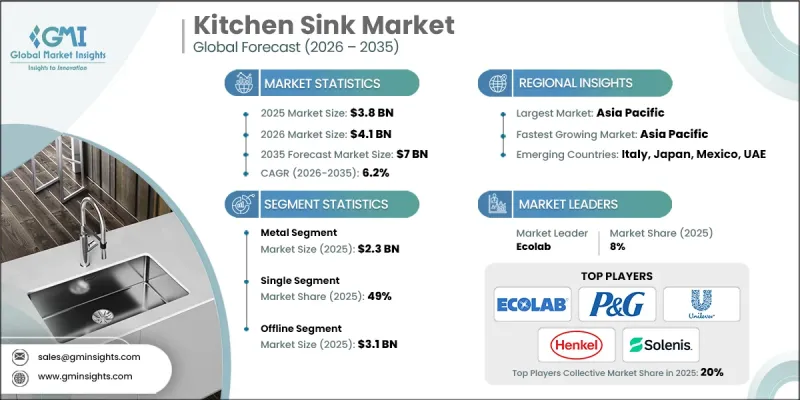
The Global Kitchen Sink Market was valued at USD 3.8 billion in 2025 and is estimated to grow at a CAGR of 6.2% to reach USD 7 billion by 2035.
Growth is fueled by rising urban development, evolving food consumption patterns, and strong demand for convenient dining solutions. The steady expansion of foodservice operations continues to generate consistent demand for commercial kitchen sinks, as every professional kitchen requires reliable washing infrastructure to meet sanitation standards. Operators increasingly prioritize durable, easy-to-maintain sinks that comply with regulatory requirements. Stainless steel remains the preferred material due to its strength, hygienic properties, and long service life. At the same time, infrastructure standardization across foodservice chains and independent establishments is shaping purchasing decisions. Compact kitchen formats and optimized layouts are also influencing product design, encouraging manufacturers to introduce space-efficient models. Across residential applications, remodeling trends and aesthetic upgrades further support sales. Overall, durability, functionality, and compliance remain central purchasing considerations, positioning the kitchen sink industry for sustained long-term growth.
| Market Scope | |
|---|---|
| Start Year | 2025 |
| Forecast Year | 2026-2035 |
| Start Value | $3.8 Billion |
| Forecast Value | $7 Billion |
| CAGR | 6.2% |
The continued rise of franchise-based restaurant networks has encouraged standardized kitchen layouts that require premium-quality sink installations. Foodservice operators must comply with strict sanitation regulations, which drives demand for advanced, multi-compartment, and touchless sink systems. Additionally, the development of delivery-focused kitchens and compact restaurant spaces has accelerated demand for smaller sink configurations that maximize efficiency without compromising performance.
The metal-based products segment generated USD 2.3 billion in 2025. Metal kitchen sinks lead global demand because they offer durability, cost efficiency, and hygiene advantages. Their resistance to corrosion, tolerance to temperature variations, and ability to withstand heavy daily usage make them a preferred option in both commercial and residential environments. Stainless steel models are particularly popular in urban households and professional food preparation spaces, where reliability and longevity are essential purchasing factors.
The single bowl segment accounted for 49% share in 2025. Its popularity stems from a streamlined design that enhances workspace flexibility and optimizes cabinet utilization. A single, uninterrupted basin accommodates large cookware and simplifies cleaning tasks, making it suitable for diverse kitchen layouts. In compact kitchens, this configuration maximizes usable sink area within limited cabinetry, while in larger settings it integrates seamlessly with accessories to create a practical and visually appealing workstation.
U.S. Kitchen Sink Market captured 87.8% share in 2025, generating USD 717.1 million, supported by robust home renovation activity and steady residential construction. Consumers increasingly seek premium-quality, visually appealing, and long-lasting kitchen fixtures, contributing to higher product demand. Custom kitchen installations are gaining traction, alongside growing interest in sustainable and environmentally responsible materials. A competitive retail landscape with well-established brands continues to reinforce the country's leadership within the regional market.
Leading companies operating in the Global Kitchen Sink Market include Franke Kitchen Systems, Elkay Manufacturing Company, Kohler, Blanco, Moen Incorporated, Roca, American Standard Brands, Teka, Carysil Global, Schock, Foster, Houzer, Ruvati USA, Nirali, and Bonke. Companies in the Global Kitchen Sink Market are strengthening their competitive position through product innovation, material advancement, and portfolio diversification. Manufacturers are investing in research and development to introduce scratch-resistant finishes, noise-reduction technology, and integrated workstation features that enhance functionality. Strategic collaborations with distributors and home improvement retailers are expanding market reach, while digital marketing initiatives are improving brand visibility. Many players are focusing on sustainable manufacturing practices and eco-friendly materials to align with shifting consumer preferences. Customization options and modular sink solutions are also being introduced to meet evolving residential and commercial kitchen design trends.
Table of Contents
Chapter 1 Methodology and Scope
- 1.1 Market scope and definition
- 1.2 Research design
- 1.2.1 Research approach
- 1.2.2 Data collection methods
- 1.3 Data mining sources
- 1.3.1 Global
- 1.3.2 Regional/Country
- 1.4 Base estimates and calculations
- 1.4.1 Base year calculation
- 1.4.2 Key trends for market estimation
- 1.5 Primary research and validation
- 1.5.1 Primary sources
- 1.6 Forecast model
- 1.7 Research assumptions and limitations
Chapter 2 Executive Summary
- 2.1 Industry 360° synopsis
- 2.2 Key market trends
- 2.2.1 Regional
- 2.2.2 Material
- 2.2.3 Bowl
- 2.2.4 Installation
- 2.2.5 Price
- 2.2.6 End use
- 2.2.7 Distribution channel
- 2.3 CXO perspectives: Strategic imperatives
- 2.3.1 Key decision points for industry executives
- 2.3.2 Critical success factors for market players
- 2.4 Future outlook and strategic recommendations
Chapter 3 Industry Insights
- 3.1 Industry ecosystem analysis
- 3.1.1 Supplier landscape
- 3.1.2 Profit margin
- 3.1.3 Value addition at each stage
- 3.1.4 Factor affecting the value chain
- 3.2 Industry impact forces
- 3.2.1 Growth drivers
- 3.2.1.1 Increasing numbers of quick service restaurants & food joints across the globe
- 3.2.1.2 Rising residential construction and renovation activities
- 3.2.1.3 Consumer preference for sustainable and durable materials
- 3.2.2 Industry pitfalls & challenges
- 3.2.2.1 High installation and maintenance costs
- 3.2.2.2 Market saturation
- 3.2.3 Opportunities
- 3.2.3.1 Expansion in smart and IoT-enabled kitchen fixtures
- 3.2.3.2 Growing demand for modular and space-saving kitchen designs
- 3.2.1 Growth drivers
- 3.3 Growth potential analysis
- 3.4 Future market trends
- 3.5 Technology and innovation landscape
- 3.5.1 Current technological trends
- 3.5.2 Emerging technologies
- 3.6 Price trends
- 3.6.1 By region
- 3.6.2 By material
- 3.7 Regulatory landscape
- 3.7.1 Standards and compliance requirements
- 3.7.2 Regional regulatory frameworks
- 3.7.3 Certification standards
- 3.8 Porter's analysis
- 3.9 PESTEL analysis
Chapter 4 Competitive Landscape, 2025
- 4.1 Introduction
- 4.2 Company market share analysis
- 4.2.1 By region
- 4.2.1.1 North America
- 4.2.1.2 Europe
- 4.2.1.3 Asia Pacific
- 4.2.1.4 Latin America
- 4.2.1.5 Middle East and Africa
- 4.2.1 By region
- 4.3 Company matrix analysis
- 4.4 Competitive analysis of major market players
- 4.5 Competitive positioning matrix
- 4.6 Key developments
- 4.6.1 Mergers & acquisitions
- 4.6.2 Partnerships & collaborations
- 4.6.3 New product launches
- 4.6.4 Expansion plans
Chapter 5 Market Estimates and Forecast, By Material, 2022 - 2035 (USD Billion) (Million Units)
- 5.1 Key trends
- 5.2 Metal
- 5.2.1 Stainless steel
- 5.2.2 Copper
- 5.2.3 Cast Iron
- 5.2.4 Bronze
- 5.2.5 Aluminium
- 5.3 Non-metal
- 5.3.1 Granite
- 5.3.2 Quartz composite
- 5.3.3 Fireclay
- 5.3.4 Ceramic
- 5.3.5 Acrylic
- 5.3.6 Others (marble, soapstone etc.)
Chapter 6 Market Estimates and Forecast, By Bowl, 2022 - 2035 (USD Billion) (Million Units)
- 6.1 Key trends
- 6.2 Single
- 6.3 Double
- 6.4 Multiple
Chapter 7 Market Estimates and Forecast, By Installation, 2022 - 2035 (USD Billion) (Million Units)
- 7.1 Key trends
- 7.2 Drop-in or top mount
- 7.3 Undermount
- 7.4 Farmhouse or apron-front
- 7.5 Others (workstation sinks etc.)
Chapter 8 Market Estimates and Forecast, By Price, 2022 - 2035 (USD Billion) (Million Units)
- 8.1 Key trends
- 8.2 Low (up to $299)
- 8.3 Medium ($300-$699)
- 8.4 High ($700 and above)
Chapter 9 Market Estimates and Forecast, By End User, 2022 - 2035 (USD Billion) (Million Units)
- 9.1 Key trends
- 9.2 Residential
- 9.3 Commercial
Chapter 10 Market Estimates and Forecast, By Distribution Channel, 2022 - 2035 (USD Billion) (Million Units)
- 10.1 Key trends
- 10.2 Online
- 10.3 Offline
Chapter 11 Market Estimates and Forecast, By Region, 2022 - 2035 (USD Billion) (Million Units)
- 11.1 Key trends
- 11.2 North America
- 11.2.1 U.S.
- 11.2.2 Canada
- 11.3 Europe
- 11.3.1 Germany
- 11.3.2 UK
- 11.3.3 France
- 11.3.4 Italy
- 11.3.5 Spain
- 11.4 Asia Pacific
- 11.4.1 China
- 11.4.2 Japan
- 11.4.3 India
- 11.4.4 Australia
- 11.4.5 South Korea
- 11.5 Latin America
- 11.5.1 Brazil
- 11.5.2 Mexico
- 11.5.3 Argentina
- 11.6 Middle East and Africa
- 11.6.1 South Africa
- 11.6.2 Saudi Arabia
- 11.6.3 UAE
Chapter 12 Company Profiles
- 12.1 American Standard Brands
- 12.2 Blanco GmbH + Co KG
- 12.3 Bonke
- 12.4 Carysil Global
- 12.5 Elkay Manufacturing Company
- 12.6 Foster
- 12.7 Franke Kitchen Systems
- 12.8 Houzer
- 12.9 Kohler
- 12.10 Moen Incorporated
- 12.11 Nirali
- 12.12 Roca
- 12.13 Ruvati USA
- 12.14 Schock
- 12.15 Teka

