PUBLISHER: Global Market Insights Inc. | PRODUCT CODE: 1982367

PUBLISHER: Global Market Insights Inc. | PRODUCT CODE: 1982367
Proteomics Market Opportunity, Growth Drivers, Industry Trend Analysis, and Forecast 2026 - 2035
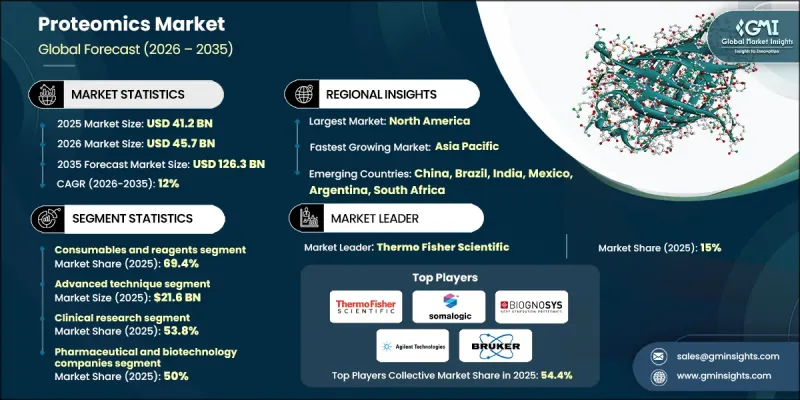
The Global Proteomics Market was valued at USD 41.2 billion in 2025 and is estimated to grow at a CAGR of 12% to reach USD 126.3 billion by 2035.
Proteomics encompasses the study of proteins within biological systems, including their identification, quantification, and functional analysis. Tools in this market include mass spectrometry platforms, protein microarrays, and label-free quantification systems that support high-throughput protein profiling. Rapid advancements in technology and the integration of AI and machine learning into proteomic workflows are driving market expansion. The rise of single-cell proteomics is revolutionizing research by enabling protein analysis at the individual cell level, providing deep insights into tumor heterogeneity, disease progression, and immune system dynamics. These advances are not only transforming research but are also making proteomics increasingly applicable in clinical diagnostics. Modern high-throughput systems continue to improve sensitivity, speed, and accuracy, enhancing data quality for large-scale studies and accelerating precision medicine development worldwide.
| Market Scope | |
|---|---|
| Start Year | 2025 |
| Forecast Year | 2026-2035 |
| Start Value | $41.2 Billion |
| Forecast Value | $126.3 Billion |
| CAGR | 12% |
The consumables and reagents segment accounted for 69.4% share in 2025 and is projected to grow at a CAGR of 12.3%. This segment includes protein chips, assay kits, reagents, buffers, chromatography columns, and electrophoresis gels, which are repeatedly used in mass spectrometry, chromatography, and microarray analyses, ensuring recurring revenue.
The advanced techniques segment reached USD 21.6 billion in 2025. This category includes mass spectrometry, protein microarrays, gel-based techniques, and other advanced methods. These approaches provide superior sensitivity, precision, and throughput compared to conventional methods, driving innovation in research, clinical diagnostics, drug development, and personalized therapies.
North America Proteomics Market reached USD 19.9 billion in 2025 and is projected to reach USD 61.9 billion by 2035, at a CAGR of 12.2%. Growth in the region is fueled by strong biomedical research infrastructure, rapid technology adoption, and an advanced healthcare ecosystem. The integration of AI and machine learning for data analysis, alongside collaboration among academic institutions, biotech firms, and pharmaceutical companies, is accelerating protein profiling, biomarker development, and precision medicine applications.
Key players in the Global Proteomics Market include Agilent Technologies, Biognosys, Bio-Rad, Bruker, Creative Proteomics, F. Hoffmann-La Roche, Merck KGaA, PREOMICS, Promega, Quantum-Si, Seer, SomaLogic, Thermo Fisher Scientific (Olink), and Waters. Companies in the Proteomics Market are strengthening their position by investing heavily in R&D to improve the sensitivity, accuracy, and throughput of proteomics platforms. They are forming strategic partnerships with academic institutions, pharmaceutical firms, and biotech startups to expand their service offerings and enhance collaborative innovation. Firms are also integrating AI and machine learning to streamline workflows and generate actionable insights from large proteomic datasets. Additionally, they are launching comprehensive consumable and reagent portfolios to ensure recurring revenue, expanding geographically to capture emerging markets, and participating in clinical validation programs to support regulatory approvals and adoption in clinical diagnostics.
Table of Contents
Chapter 1 Methodology and Scope
- 1.1 Research approach
- 1.2 Quality commitments
- 1.2.1 GMI AI policy & data integrity commitment
- 1.2.1.1 Source consistency protocol
- 1.2.1 GMI AI policy & data integrity commitment
- 1.3 Research trail & confidence scoring
- 1.3.1 Research trail components
- 1.3.2 Scoring components
- 1.4 Data collection
- 1.4.1 Partial list of primary sources
- 1.5 Data mining sources
- 1.5.1 Paid sources
- 1.5.1.1 Sources, by region
- 1.5.1 Paid sources
- 1.6 Base estimates and calculations
- 1.6.1 Base year calculation for any one approach
- 1.7 Forecast model
- 1.7.1 Quantified market impact analysis
- 1.7.1.1 Mathematical impact of growth parameters on forecast
- 1.7.1 Quantified market impact analysis
- 1.8 Research transparency addendum
- 1.8.1 Source attribution framework
- 1.8.2 Quality assurance metrics
- 1.8.3 Our commitment to trust
Chapter 2 Executive Summary
- 2.1 Industry 360° synopsis
- 2.2 Key market trends
- 2.2.1 Regional trends
- 2.2.2 Component trends
- 2.2.3 Technique trends
- 2.2.4 Application trends
- 2.2.5 End use trends
- 2.3 CXO perspectives: Strategic imperatives
- 2.3.1 Key decision points for industry executives
- 2.3.2 Critical success factors for market players
- 2.4 Future outlook and strategic recommendations
Chapter 3 Industry Insights
- 3.1 Industry ecosystem analysis
- 3.1.1 Supplier landscape
- 3.1.2 Value addition at each stage
- 3.1.3 Factors affecting the value chain
- 3.2 Industry impact forces
- 3.2.1 Growth drivers
- 3.2.1.1 Rising prevalence of chronic and complex diseases
- 3.2.1.2 Increasing demand for personalized and precision medicine
- 3.2.1.3 Advancements in mass spectrometry and bioinformatics technologies
- 3.2.1.4 Growing investments in proteomics-based drug discovery and diagnostics
- 3.2.2 Industry pitfalls and challenges
- 3.2.2.1 High cost of instruments and reagents
- 3.2.2.2 Complexity in data interpretation and analysis
- 3.2.3 Market opportunities
- 3.2.3.1 Expansion of clinical proteomics for early disease detection
- 3.2.3.2 Development of novel biomarkers for targeted therapies
- 3.2.1 Growth drivers
- 3.3 Growth potential analysis
- 3.4 Regulatory landscape
- 3.4.1 North America
- 3.4.1.1 U.S.
- 3.4.1.2 Canada
- 3.4.2 Europe
- 3.4.3 Asia Pacific
- 3.4.1 North America
- 3.5 Technology landscape
- 3.5.1 Current technological trends
- 3.5.2 Emerging technologies
- 3.6 Future market trends
- 3.7 Porter's analysis
- 3.8 PESTEL analysis
Chapter 4 Competitive Landscape, 2025
- 4.1 Introduction
- 4.2 Company market share analysis
- 4.3 Company matrix analysis
- 4.4 Competitive analysis of major market players
- 4.5 Competitive positioning matrix
- 4.6 Key developments
- 4.6.1 Merger and acquisition
- 4.6.2 Partnership and collaboration
- 4.6.3 New product launches
- 4.6.4 Expansion plans
Chapter 5 Market Estimates and Forecast, By Component, 2022 - 2035 ($ Mn)
- 5.1 Key trends
- 5.2 Instruments
- 5.3 Consumables and reagents
- 5.4 Services
Chapter 6 Market Estimates and Forecast, By Technique, 2022 - 2035 ($ Mn)
- 6.1 Key trends
- 6.2 Advanced technique
- 6.2.1 Protein microarray
- 6.2.2 Gel-based technique
- 6.2.3 Mass spectrometry
- 6.2.4 Other advanced techniques
- 6.3 Conventional technique
- 6.3.1 ELISA
- 6.3.2 Chromatography based technique
- 6.3.3 Edman sequencing
- 6.3.4 Western blotting
- 6.4 Bioinformatics and computational analysis
- 6.5 Other techniques
Chapter 7 Market Estimates and Forecast, By Application, 2022 - 2035 ($ Mn)
- 7.1 Key trends
- 7.2 Clinical diagnostics
- 7.3 Clinical research
Chapter 8 Market Estimates and Forecast, By End Use, 2022 - 2035 ($ Mn)
- 8.1 Key trends
- 8.2 Pharmaceutical and biopharmaceutical companies
- 8.3 Academic and research institutions
- 8.4 Laboratories
- 8.5 Other end users
Chapter 9 Market Estimates and Forecast, By Region, 2022 - 2035 ($ Mn)
- 9.1 Key trends
- 9.2 North America
- 9.2.1 U.S.
- 9.2.2 Canada
- 9.3 Europe
- 9.3.1 Germany
- 9.3.2 UK
- 9.3.3 France
- 9.3.4 Spain
- 9.3.5 Italy
- 9.3.6 Netherlands
- 9.4 Asia Pacific
- 9.4.1 China
- 9.4.2 India
- 9.4.3 Japan
- 9.4.4 Australia
- 9.4.5 South Korea
- 9.5 Latin America
- 9.5.1 Brazil
- 9.5.2 Mexico
- 9.5.3 Argentina
- 9.6 Middle East and Africa
- 9.6.1 South Africa
- 9.6.2 Saudi Arabia
- 9.6.3 UAE
Chapter 10 Company Profiles
- 10.1 Agilent Technologies
- 10.2 Biognosys
- 10.3 Bio-Rad
- 10.4 Bruker
- 10.5 Creative Proteomics
- 10.6 F. Hoffmann-La Roche
- 10.7 Merck KGaA
- 10.8 PREOMICS
- 10.9 Promega
- 10.10 Quantum-Si
- 10.11 Seer
- 10.12 SomaLogic Operating
- 10.13 Thermo Fisher Scientific (Olink)
- 10.14 Waters

