
PUBLISHER: Global Market Insights Inc. | PRODUCT CODE: 1982368

PUBLISHER: Global Market Insights Inc. | PRODUCT CODE: 1982368
Poly Aluminum Chloride Market Opportunity, Growth Drivers, Industry Trend Analysis, and Forecast 2026 - 2035
The Global Poly Aluminum Chloride Market was valued at USD 1.83 billion in 2025 and is estimated to grow at a CAGR of 9.5% to reach USD 4.46 billion by 2035.
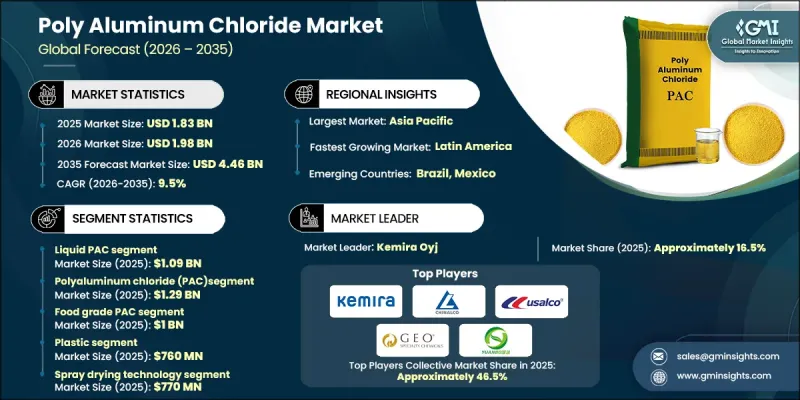
The poly aluminum chloride industry is experiencing strong expansion driven by rising demand across municipal and industrial water treatment applications. Rapid urban growth and large-scale infrastructure development in emerging economies are prompting significant public and private investments in drinking water and wastewater treatment facilities. This trend is increasing the consumption of poly aluminum chloride due to its high efficiency in removing turbidity, suspended particles, and other contaminants. Tightening water quality regulations and stricter discharge standards are further accelerating the shift toward advanced coagulants. Expanding industrial operations across textiles, pulp and paper, chemicals, and food processing sectors are generating substantial wastewater volumes that require effective treatment before discharge. Compared to conventional coagulants, poly aluminum chloride delivers faster coagulation and produces lower sludge volumes, enhancing operational efficiency and reducing disposal costs. Sustained industrialization and continuous regulatory enforcement are therefore translating into consistent and long-term demand growth for poly aluminum chloride worldwide.
| Market Scope | |
|---|---|
| Start Year | 2025 |
| Forecast Year | 2026-2035 |
| Start Value | $1.83 Billion |
| Forecast Value | $4.46 Billion |
| CAGR | 9.5% |
The liquid PAC segment accounted for USD 1.09 billion in 2025 and is expected to grow at a CAGR of 9.2% from 2026 to 2035. Demand for different product forms is closely linked to application-specific handling, storage, and dosing requirements. Liquid poly aluminum chloride is increasingly preferred in large municipal and industrial treatment plants due to its ease of pumping, consistent dosing capability, and rapid reaction performance. Meanwhile, powdered, granular, and flake forms are gaining traction in decentralized or smaller-scale treatment facilities where extended shelf life, simplified transportation, and flexible application are critical considerations. This diversification in product formats reflects a broader industry shift toward operational adaptability rather than reliance on standardized solutions.
The poly aluminum chloride (PAC) segment was valued at USD 1.29 billion in 2025 and is estimated to grow at a CAGR of 9.2% through 2035. Market development across various PAC grades highlights growing product differentiation based on treatment efficiency and water chemistry requirements. Conventional PAC continues to maintain strong adoption due to its balanced cost-to-performance ratio across municipal and industrial uses. At the same time, enhanced variants such as poly aluminum chlorosulfate and composite PAC formulations are being adopted for more complex wastewater compositions requiring improved stability and coagulation efficiency. This evolution underscores a transition toward tailored chemical treatment solutions instead of a uniform treatment approach.
North America Poly Aluminum Chloride Market generated USD 0.46 billion in 2025. Regional expansion is supported by increased investments in aging water infrastructure and stricter regulatory frameworks governing potable water and wastewater discharge. Municipal utilities and industrial operators are allocating greater budgets to advanced coagulation technologies that improve treatment performance while lowering sludge management expenses. Within the region, the United States is witnessing accelerated adoption of high-performance PAC grades, supported by public funding initiatives aimed at modernizing treatment facilities and improving long-term system reliability.
Key companies operating in the Global Poly Aluminum Chloride Market include Kemira Oyj, USALCO, CHALCO Advanced Material Co., Ltd., GEO Specialty Chemicals, Henan Yuanbo Environmental Technology Co., Ltd., and other regional participants. Companies in the Global Poly Aluminum Chloride Market are reinforcing their competitive position through investments in research and development focused on high-efficiency and low-sludge formulations. Strategic partnerships with municipal authorities and industrial operators are expanding long-term supply agreements and strengthening distribution networks. Many manufacturers are enhancing production capacities and optimizing supply chains to ensure consistent quality and cost competitiveness. Product portfolio diversification, including specialized PAC grades tailored to complex wastewater conditions, is improving market differentiation.
Table of Contents
Chapter 1 Methodology
- 1.1 Market scope and definition
- 1.2 Research design
- 1.2.1 Research approach
- 1.2.2 Data collection methods
- 1.3 Data mining sources
- 1.3.1 Global
- 1.3.2 Regional/Country
- 1.4 Base estimates and calculations
- 1.4.1 Base year calculation
- 1.4.2 Key trends for market estimation
- 1.5 Primary research and validation
- 1.5.1 Primary sources
- 1.6 Forecast model
- 1.7 Research assumptions and limitations
Chapter 2 Executive Summary
- 2.1 Industry 360° synopsis
- 2.2 Key market trends
- 2.2.1 Regional
- 2.2.2 Form
- 2.2.3 Product Type
- 2.2.4 Grade
- 2.2.5 Basicity
- 2.2.6 Manufacturing Process
- 2.2.7 End-User Industry
- 2.2.8 Application
- 2.3 TAM Analysis, 2026-2035
- 2.4 CXO perspectives: Strategic imperatives
- 2.4.1 Executive decision points
- 2.4.2 Critical success factors
- 2.5 Future Outlook and Strategic Recommendations
Chapter 3 Industry Insights
- 3.1 Industry ecosystem analysis
- 3.1.1 Supplier Landscape
- 3.1.2 Profit Margin
- 3.1.3 Value addition at each stage
- 3.1.4 Factor affecting the value chain
- 3.1.5 Disruptions
- 3.2 Industry impact forces
- 3.2.1 Growth drivers
- 3.2.2 Industry pitfalls and challenges
- 3.2.3 Market opportunities
- 3.3 Growth potential analysis
- 3.4 Regulatory landscape
- 3.4.1 North America
- 3.4.2 Europe
- 3.4.3 Asia Pacific
- 3.4.4 Latin America
- 3.4.5 Middle East & Africa
- 3.5 Porter’s analysis
- 3.6 PESTEL analysis
- 3.7 Price trends
- 3.7.1 By region
- 3.7.2 By product
- 3.8 Future market trends
- 3.9 Technology and Innovation landscape
- 3.9.1 Current technological trends
- 3.9.2 Emerging technologies
- 3.10 Patent Landscape
- 3.11 Trade statistics (Note: the trade statistics will be provided for key countries only)
- 3.11.1 Major importing countries
- 3.11.2 Major exporting countries
- 3.12 Sustainability and Environmental Aspects
- 3.12.1 Sustainable Practices
- 3.12.2 Waste Reduction Strategies
- 3.12.3 Energy Efficiency in Production
- 3.12.4 Eco-friendly Initiatives
- 3.13 Carbon Footprint Considerations
Chapter 4 Competitive Landscape, 2025
- 4.1 Introduction
- 4.2 Company market share analysis
- 4.2.1 By region
- 4.2.1.1 North America
- 4.2.1.2 Europe
- 4.2.1.3 Asia Pacific
- 4.2.1.4 LATAM
- 4.2.1.5 MEA
- 4.2.1 By region
- 4.3 Company matrix analysis
- 4.4 Competitive analysis of major market players
- 4.5 Competitive positioning matrix
- 4.6 Key developments
- 4.6.1 Mergers & acquisitions
- 4.6.2 Partnerships & collaborations
- 4.6.3 New Product Launches
- 4.6.4 Expansion Plans
Chapter 5 Market Estimates and Forecast, By Form, 2022- 2035 (USD Billion, Kilo Tons)
- 5.1 Key trends
- 5.2 Liquid PAC
- 5.3 Powder PAC (spray-dried)
- 5.4 Granular PAC
- 5.5 Flaky PAC (drum-dried)
Chapter 6 Market Estimates and Forecast, By Product Type, 2022- 2035 (USD Billion, Kilo Tons)
- 6.1 Key trends
- 6.2 Poly aluminum chloride (PAC)
- 6.3 Polyaluminum chlorosulfate (PACS)
- 6.4 Aluminum chlorohydrate (ACH)
- 6.5 Composite PAC
- 6.6 Nano-PAC
Chapter 7 Market Estimates and Forecast, By Grade, 2022 - 2035 (USD Billion, Kilo Tons)
- 7.1 Key trends
- 7.2 Food grade PAC
- 7.3 Drinking water grade PAC
- 7.4 Industrial grade PAC
- 7.5 Filter grade PAC
Chapter 8 Market Estimates and Forecast, By Basicity, 2022 - 2035 (USD Billion, Kilo Tons)
- 8.1 Key trends
- 8.2 Low basicity
- 8.3 Medium basicity
- 8.4 High basicity
- 8.5 Ultra-high basicity
Chapter 9 Market Estimates and Forecast, By Manufacturing Process, 2022 - 2035 (USD Billion, Kilo Tons)
- 9.1 Key trends
- 9.2 Spray drying technology
- 9.3 Drum drying technology
- 9.4 Electrodialysis process
- 9.5 Acid-soluble aluminum ash method
Chapter 10 Market Estimates and Forecast, By End-User Industry, 2022 - 2035 (USD Billion, Kilo Tons)
- 10.1 Key trends
- 10.2 Water treatment
- 10.3 Pulp & paper industry
- 10.4 Textiles industry
- 10.5 Oil & gas industry
- 10.6 Pharmaceutical & cosmetics
- 10.7 Others
Chapter 11 Market Estimates and Forecast, By Application, 2022 - 2035 (USD Billion, Kilo Tons)
- 11.1 Key trends
- 11.2 Coagulation & flocculation
- 11.3 Sludge dewatering
- 11.4 Membrane pre-treatment
- 11.5 Phosphorus removal
- 11.6 Heavy metal removal
- 11.7 Organic matter & NOM removal
- 11.8 Others
Chapter 12 Market Estimates and Forecast, By Region, 2022 - 2035 (USD Billion, Kilo Tons)
- 12.1 Key trends
- 12.2 North America
- 12.2.1 U.S.
- 12.2.2 Canada
- 12.3 Europe
- 12.3.1 Germany
- 12.3.2 UK
- 12.3.3 France
- 12.3.4 Italy
- 12.3.5 Spain
- 12.3.6 Rest of Europe
- 12.4 Asia Pacific
- 12.4.1 China
- 12.4.2 India
- 12.4.3 Japan
- 12.4.4 Australia
- 12.4.5 South Korea
- 12.4.6 Rest of Asia Pacific
- 12.5 Latin America
- 12.5.1 Brazil
- 12.5.2 Mexico
- 12.5.3 Argentina
- 12.5.4 Rest of Latin America
- 12.6 Middle East & Africa
- 12.6.1 Saudi Arabia
- 12.6.2 South Africa
- 12.6.3 UAE
- 12.6.4 Rest of Middle East & Africa
Chapter 13 Company Profiles
- 13.1 Alumichem A/S
- 13.2 Biosynth
- 13.3 CHALCO Advanced Material Co., Ltd.
- 13.4 EMCO Dyestuff
- 13.5 Fengchen Group Co.,Ltd
- 13.6 GEO Specialty Chemicals
- 13.7 Henan Chemger Group Corporation
- 13.8 Henan Yuanbo Environmental Technology Co., Ltd.
- 13.9 Kavya Pharma
- 13.10 Kemira Oyj
- 13.11 N. R. CHEMICALS
- 13.12 Taki Chemical
- 13.13 USALCO
- 13.14 Venator Materials

