
PUBLISHER: Global Market Insights Inc. | PRODUCT CODE: 1982370

PUBLISHER: Global Market Insights Inc. | PRODUCT CODE: 1982370
Sports Bra Market Opportunity, Growth Drivers, Industry Trend Analysis, and Forecast 2026 - 2035
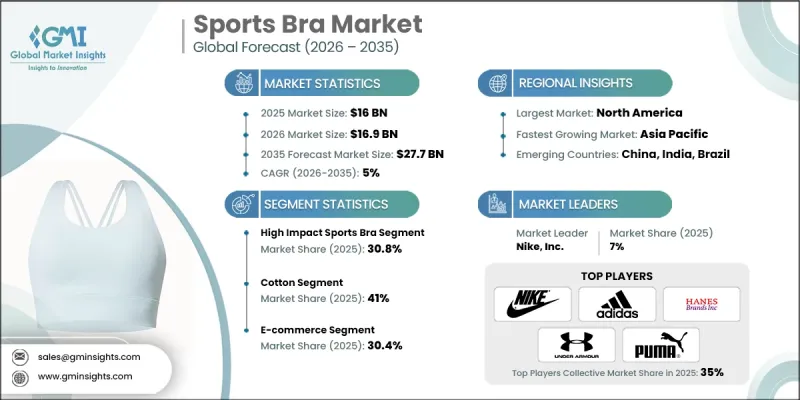
The Global Sports Bra Market was valued at USD 16 billion in 2025 and is estimated to grow at a CAGR of 5% to reach USD 27.7 billion by 2035.
Rising participation in fitness activities, growing popularity of athleisure apparel, and increasing consumer focus on health and wellness are significantly accelerating demand for high-performance sports bras. As the global fitness industry continues to expand, consumers are seeking apparel that delivers superior support, durability, and comfort. Leading brands are reinforcing their global footprint by broadening their performance wear portfolios and introducing technologically advanced fabrics and innovative design features. Compared to traditional bras, sports bras are engineered to provide enhanced stability and movement control, aligning with the evolving requirements of active lifestyles. Continuous product development, combined with strong branding and strategic expansion by major sportswear companies, is further stimulating market growth. Increasing awareness around body support, comfort, and long-term wellness benefits is also encouraging consumers to invest in premium-quality sports bras. The integration of digital retail platforms and data-driven product innovation is reshaping competitive dynamics across the global sports bra market.
| Market Scope | |
|---|---|
| Start Year | 2025 |
| Forecast Year | 2026-2035 |
| Start Value | $16 Billion |
| Forecast Value | $27.7 Billion |
| CAGR | 5% |
Sustainability is becoming a core focus within product development, with manufacturers incorporating eco-friendly materials such as recycled fibers, plant-based blends, and durable stretch fabrics. Production processes are evolving toward seamless knitting and low-waste bonding technologies to improve efficiency and reduce environmental impact. This shift aligns with broader demand for sustainable activewear, particularly across North America and Europe, where eco-conscious purchasing decisions are increasingly influential. Market expansion is further supported by omnichannel retail strategies, digital engagement, and ongoing advancements in fabric engineering.
The high-impact sports bra segment captured 30.8% share, generating USD 4.9 billion in 2025. Growing demand for maximum support, improved motion control, and performance-focused construction is driving segment growth. High-impact and medium-impact categories collectively account for more than 55% of total market value, reflecting strong consumer preference for structured, supportive, and long-lasting designs suited for intensive physical activity.
In 2025, the cotton segment accounted for 41% share. Cotton-based sports bras are widely appreciated for their softness, breathability, and everyday comfort. Their natural fiber composition makes them appealing to consumers seeking gentle skin contact and reduced irritation. Additionally, cotton options are generally positioned at more accessible price points compared to advanced synthetic alternatives, making them attractive to cost-conscious buyers while maintaining comfort and functionality.
U.S. Sports Bra Market reached USD 3.1 billion in 2025, driven by strong demand for premium athletic wear and high-support sports bras. Market growth in the country is supported by widespread fitness adoption, athleisure fashion trends, and rapid expansion of e-commerce platforms, which represent the fastest-growing distribution channel. Consumers show strong preference for engineered support systems, seamless construction techniques, and moisture-managing fabric blends that combine performance with comfort. Rising awareness of physical wellness, increased emphasis on self-care, and growth in home-based fitness routines are further contributing to sustained demand while reducing reliance on traditional retail formats.
Key companies operating in the Global Sports Bra Market include Nike, Inc., Adidas AG, Puma SE, Under Armour, Inc., Hanesbrands Inc., Jockey International, Inc., Calvin Klein, Tommy Hilfiger, Ralph Lauren Corporation, Giorgio Armani S.p.A., Berkshire Hathaway, Bonobos, Mack Weldon, Saxx Underwear Co., and Hugo Boss AG. Companies in the Sports Bra Market are strengthening their competitive position through innovation, brand differentiation, and digital expansion. Leading players are investing in advanced fabric technologies, ergonomic design improvements, and inclusive sizing strategies to address diverse consumer needs. Sustainability initiatives, including recycled materials and responsible sourcing, are becoming central to brand positioning. Firms are also leveraging influencer marketing, social media engagement, and direct-to-consumer e-commerce platforms to enhance visibility and customer loyalty.
Table of Contents
Chapter 1 Methodology and Scope
- 1.1 Market scope and definition
- 1.2 Research design
- 1.2.1 Research approach
- 1.2.2 Data collection methods
- 1.3 Data mining sources
- 1.3.1 Global
- 1.3.2 Regional/Country
- 1.4 Base estimates and calculations
- 1.4.1 Base year calculation
- 1.4.2 Key trends for market estimation
- 1.5 Primary research and validation
- 1.5.1 Primary sources
- 1.6 Forecast model
- 1.7 Research assumptions and limitations
Chapter 2 Executive Summary
- 2.1 Industry 360° synopsis
- 2.2 Key market trends
- 2.2.1 Regional
- 2.2.2 Product Type
- 2.2.3 Consumer Group
- 2.2.4 Power Supply
- 2.2.5 End-Use Vertical
- 2.2.6 Distribution Channel
- 2.3 CXO perspectives: Strategic imperatives
- 2.3.1 Key decision points for industry executives
- 2.3.2 Critical success factors for market players
- 2.4 Future outlook and strategic recommendations
Chapter 3 Industry Insights
- 3.1 Industry ecosystem analysis
- 3.1.1 Supplier landscape
- 3.1.2 Profit margin
- 3.1.3 Value addition at each stage
- 3.1.4 Factor affecting the value chain
- 3.2 Industry impact forces
- 3.2.1 Growth drivers
- 3.2.1.1 Rise in women’s fitness participation & athleisure adoption
- 3.2.1.2 Smart sizing, digital fit tools & virtual try-ons
- 3.2.1.3 Sustainability & eco-conscious materials
- 3.2.2 Industry pitfalls & challenges
- 3.2.2.1 High cost of premium performance bras
- 3.2.2.2 Proliferation of counterfeits in online channels
- 3.2.3 Opportunities
- 3.2.3.1 AI-driven fit personalization
- 3.2.3.2 Travel-friendly, lightweight & seamless designs
- 3.2.1 Growth drivers
- 3.3 Growth potential analysis
- 3.4 Future market trends
- 3.5 Technology and innovation landscape
- 3.5.1 Current technological trends
- 3.5.2 Emerging technologies
- 3.6 Price trends
- 3.6.1 By region
- 3.6.2 By type
- 3.7 Regulatory landscape
- 3.7.1 Standards and compliance requirements
- 3.7.2 Regional regulatory frameworks
- 3.7.3 Certification standards
- 3.8 Porter’s analysis
- 3.9 PESTEL analysis
Chapter 4 Competitive Landscape, 2025
- 4.1 Introduction
- 4.2 Company market share analysis
- 4.2.1 By region
- 4.2.1.1 North America
- 4.2.1.2 Europe
- 4.2.1.3 Asia Pacific
- 4.2.1.4 Latin America
- 4.2.1.5 Middle East and Africa
- 4.2.1 By region
- 4.3 Company matrix analysis
- 4.4 Competitive analysis of major market players
- 4.5 Competitive positioning matrix
- 4.6 Key developments
- 4.6.1 Mergers & acquisitions
- 4.6.2 Partnerships & collaborations
- 4.6.3 New product launches
- 4.6.4 Expansion plans
Chapter 5 Market Estimates & Forecast, By Product, 2022-2035 (USD Billion) (Million Units)
- 5.1 Key trends
- 5.2 High Impact
- 5.3 Medium Impact
- 5.4 Low Impact
- 5.5 Sports Bra with Underwire
- 5.6 Seamless Sports Bra
- 5.7 Front Closure Sports Bra
- 5.8 Others (Underwired, etc.)
Chapter 6 Market Estimates & Forecast, By Material, 2022-2035 (USD Billion) (Million Units)
- 6.1 Key trends
- 6.2 Cotton
- 6.3 Spandex
- 6.4 Polyester
- 6.5 Bamboo
- 6.6 Others
Chapter 7 Market Estimates & Forecast, By Age Group, 2022-2035 (USD Billion) (Million Units)
- 7.1 15 - 30
- 7.2 31 - 45
- 7.3 46 - 60
- 7.4 Above 60
Chapter 8 Market Estimates & Forecast, By Distribution Channel, 2022-2035 (USD Billion) (Million Units)
- 8.1 Key trends
- 8.2 Wholesaler/Distributor
- 8.3 Specialty store
- 8.4 Hypermarket/Supermarket
- 8.5 E-commerce
- 8.6 Others
Chapter 9 Market Estimates and Forecast, By Region, 2022 - 2035 (USD Billion)
- 9.1 Key trends
- 9.2 North America
- 9.2.1 U.S.
- 9.2.2 Canada
- 9.3 Europe
- 9.3.1 Germany
- 9.3.2 UK
- 9.3.3 France
- 9.3.4 Italy
- 9.3.5 Spain
- 9.4 Asia Pacific
- 9.4.1 China
- 9.4.2 Japan
- 9.4.3 India
- 9.4.4 Australia
- 9.4.5 South Korea
- 9.5 Latin America
- 9.5.1 Brazil
- 9.5.2 Mexico
- 9.5.3 Argentina
- 9.6 Middle East and Africa
- 9.6.1 South Africa
- 9.6.2 Saudi Arabia
- 9.6.3 UAE
Chapter 10 Company Profiles
- 10.1 Adidas AG
- 10.2 Berkshire Hathaway
- 10.3 Bonobos
- 10.4 Calvin Klein
- 10.5 Giorgio Armani S.p.A.
- 10.6 Hanesbrands Inc.
- 10.7 Hugo Boss AG
- 10.8 Jockey International, Inc.
- 10.9 Mack Weldon
- 10.10 Nike, Inc.
- 10.11 Puma SE
- 10.12 Ralph Lauren Corporation
- 10.13 Saxx Underwear Co.
- 10.14 Tommy Hilfiger
- 10.15 Under Armour, Inc.

