PUBLISHER: Global Market Insights Inc. | PRODUCT CODE: 1982373

PUBLISHER: Global Market Insights Inc. | PRODUCT CODE: 1982373
Aquaponics Market Opportunity, Growth Drivers, Industry Trend Analysis, and Forecast 2026 - 2035
The Global Aquaponics Market was valued at USD 582.9 million in 2025 and is estimated to grow at a CAGR of 12.4% to reach USD 1.8 billion by 2035.
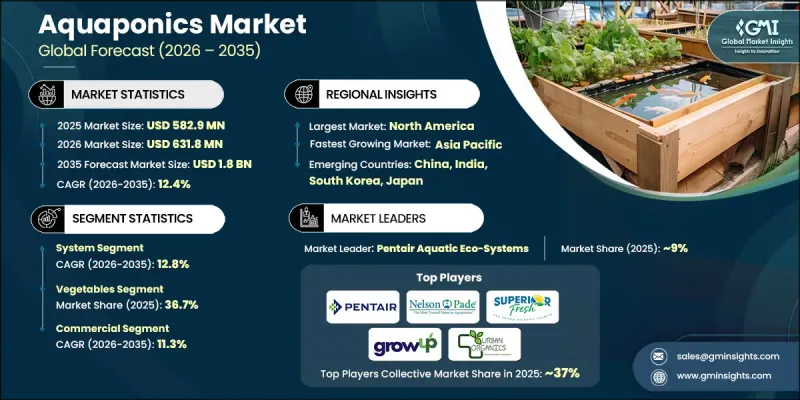
Demand for environmentally friendly and efficient farming solutions is driving growth, as farmers and urban growers increasingly seek alternatives to traditional, water-intensive, and chemical-dependent agriculture. By combining fish farming with vegetable cultivation, aquaponics creates a closed-loop nutrient system that minimizes water usage and eliminates the need for synthetic fertilizers. The method ensures stable yields through controlled environment agriculture, making it ideal for regions facing water scarcity or land constraints. Consumer awareness of sustainable, traceable, and locally produced food is rising, prompting commercial operators to adopt aquaponics. Government initiatives, including financial incentives and supportive legislation, further accelerate adoption. Urban agriculture programs and commercial farmers are investing in aquaponics to meet growing demand for fresh, local produce while maximizing resource efficiency and maintaining high crop quality year-round.
| Market Scope | |
|---|---|
| Start Year | 2025 |
| Forecast Year | 2026-2035 |
| Start Value | $582.9 Million |
| Forecast Value | $1.8 Billion |
| CAGR | 12.4% |
The system segment accounted for USD 443.4 million in 2025 and is expected to grow at a CAGR of 12.8% through 2035. Complete systems dominate the market due to their integrated functionality, which combines tanks, grow beds, pumps, and filtration units into one cohesive setup. Full systems allow commercial operators to synchronize fish and plant production cycles, reduce installation errors, and support scalability from small urban farms to large commercial facilities. Technological integration enhances water circulation, nutrient distribution, and real-time monitoring, further boosting operational efficiency.
The vegetables segment held a 36.7% share in 2025 and is projected to grow at a CAGR of 7.2% by 2035. Leafy greens, herbs, and other fast-growing vegetables thrive in aquaponic systems, offering multiple harvests per year and consistent quality. Controlled environments reduce pesticide use, ensuring safe, high-quality produce that appeals to restaurants, retailers, and health-conscious consumers. Lower cultivation risks compared to fruiting crops also drive farmer adoption.
U.S. Aquaponics Market reached USD 164.8 million in 2025 and is expected to grow at a CAGR of 12.2% through 2035. Rising interest in sustainable food production, urban farming initiatives, and the demand for organic, pesticide-free produce support growth. Educational institutions and research facilities are expanding aquaponics programs, while specialty farms are increasingly investing in commercial-scale systems, further driving market expansion.
Key players in the Global Aquaponics Market include Bright Agrotech, EZ-Aquaponics, FarmTek, GrowUp Urban Farms, Pentair Aquatic Eco-Systems, Urban Organics, Nelson and Pade, Inc., Symbiotic Systems, Aquaponic Solutions, AquaSprouts, Aquaculture Technology Group, Aquaponic Lynx, LLC, Superior Fresh, Greentrees International Pty Ltd., and Backyard Aquaponics. Companies in the Aquaponics Market are focusing on innovation, scalability, and sustainability to strengthen their market presence. They are investing in fully integrated system solutions with advanced automation for water and nutrient management, reducing labor and operational complexity. Strategic partnerships with urban farms, commercial growers, and educational institutions expand adoption and credibility. Product diversification, including modular and customizable systems for small-scale and large-scale operations, allows firms to cater to varied customer segments. Firms are also emphasizing sustainability through energy-efficient equipment, recyclable materials, and organic-friendly solutions.
Table of Contents
Chapter 1 Methodology & Scope
- 1.1 Market scope and definition
- 1.2 Research design
- 1.2.1 Research approach
- 1.2.2 Data collection methods
- 1.3 Data mining sources
- 1.3.1 Global
- 1.3.2 Regional/Country
- 1.4 Base estimates and calculations
- 1.4.1 Base year calculation
- 1.4.2 Key trends for market estimation
- 1.5 Primary research and validation
- 1.5.1 Primary sources
- 1.6 Forecast model
- 1.7 Research assumptions and limitations
Chapter 2 Executive Summary
- 2.1 Industry 360° synopsis
- 2.2 Key market trends
- 2.2.1 Component
- 2.2.2 By Framing Technique
- 2.2.3 Produce
- 2.2.4 Application
- 2.3 CXO perspectives: Strategic imperatives
- 2.3.1 Key decision points for industry executives
- 2.3.2 Critical success factors for market players
- 2.4 Future outlook and strategic recommendations
Chapter 3 Industry Insights
- 3.1 Industry ecosystem analysis
- 3.1.1 Supplier landscape
- 3.1.2 Profit margin
- 3.1.3 Value addition at each stage
- 3.1.4 Factor affecting the value chain
- 3.2 Industry impact forces
- 3.2.1 Growth drivers
- 3.2.1.1 Rising demand for sustainable and resource-efficient agriculture
- 3.2.1.2 Increased investment in urban and vertical farming initiatives
- 3.2.1.3 Growing global food security concerns
- 3.2.2 Pitfalls & Challenges
- 3.2.2.1 High initial setup and capital costs
- 3.2.2.2 Technical complexity and knowledge barriers
- 3.2.3 Opportunities
- 3.2.3.1 Integration of renewable energy to lower operating costs
- 3.2.3.2 Expansion into underserved and remote regions
- 3.2.1 Growth drivers
- 3.3 Growth potential analysis
- 3.4 Future market trends
- 3.5 Technology and innovation landscape
- 3.5.1 Current technological trends
- 3.5.2 Emerging technologies
- 3.6 Price trends
- 3.6.1 By region
- 3.6.2 By product
- 3.7 Regulatory landscape
- 3.7.1 Standards and compliance requirements
- 3.7.2 Regional regulatory frameworks
- 3.7.3 Certification standards
- 3.8 Porter’s analysis
- 3.9 PESTEL analysis
Chapter 4 Competitive Landscape, 2025
- 4.1 Introduction
- 4.2 Company market share analysis
- 4.2.1 By Region
- 4.2.1.1 North America
- 4.2.1.2 Europe
- 4.2.1.3 Asia Pacific
- 4.2.1.4 Latin America
- 4.2.1.5 Middle East & Africa
- 4.2.1 By Region
- 4.3 Company matrix analysis
- 4.4 Competitive analysis of major market players
- 4.5 Competitive positioning matrix
- 4.6 Key developments
- 4.6.1 Mergers & acquisitions
- 4.6.2 Partnerships & collaborations
- 4.6.3 New product launches
- 4.6.4 Expansion plans
Chapter 5 Market Estimates & Forecast, By Component, 2022 - 2035, (USD Million) (Thousand Units)
- 5.1 Key trends
- 5.2 System
- 5.2.1 Grow Lights
- 5.2.2 Pumps and Valves
- 5.2.3 Water Heaters
- 5.2.4 Aeration Systems
- 5.2.5 Monitoring and Control Systems
- 5.2.6 Others
- 5.3 Software
Chapter 6 Market Estimates & Forecast, By Framing Technique, 2022 - 2035, (USD Million) (Thousand Units)
- 6.1 Key trends
- 6.2 Nutrient Film Technique (NFT)
- 6.3 Media-Filled Growbeds
- 6.4 Deep Water Culture (DWC)
- 6.5 Others
Chapter 7 Market Estimates & Forecast, By Produce, 2022 - 2035, (USD Million) (Thousand Units)
- 7.1 Key trends
- 7.2 Fish
- 7.3 Vegetables
- 7.4 Fruits
- 7.5 Others
Chapter 8 Market Estimates & Forecast, By Application, 2022 - 2035, (USD Million) (Thousand Units)
- 8.1 Key trends
- 8.2 Commercial
- 8.3 Home Production
- 8.4 Others
Chapter 9 Market Estimates & Forecast, By Region, 2022 - 2035, (USD Million) (Thousand Units)
- 9.1 Key trends
- 9.2 North America
- 9.2.1 U.S.
- 9.2.2 Canada
- 9.3 Europe
- 9.3.1 Germany
- 9.3.2 UK
- 9.3.3 France
- 9.3.4 Italy
- 9.3.5 Spain
- 9.4 Asia Pacific
- 9.4.1 China
- 9.4.2 India
- 9.4.3 Japan
- 9.4.4 South Korea
- 9.4.5 Australia
- 9.5 Latin America
- 9.5.1 Brazil
- 9.5.2 Mexico
- 9.5.3 Argentina
- 9.6 MEA
- 9.6.1 Saudi Arabia
- 9.6.2 UAE
- 9.6.3 South Africa
Chapter 10 Company Profiles
- 10.1 Aquaculture Technology Group
- 10.2 Aquaponic Lynx, LLC
- 10.3 Aquaponic Solutions
- 10.4 AquaSprouts
- 10.5 Backyard Aquaponics
- 10.6 Bright Agrotech
- 10.7 EZ-Aquaponics
- 10.8 FarmTek
- 10.9 Greentrees International Pty Ltd
- 10.10 GrowUp Urban Farms
- 10.11 Nelson and Pade, Inc.
- 10.12 Pentair Aquatic Eco-Systems
- 10.13 Superior Fresh
- 10.14 Symbiotic Systems
- 10.15 Urban Organics

