PUBLISHER: Global Market Insights Inc. | PRODUCT CODE: 1998660

PUBLISHER: Global Market Insights Inc. | PRODUCT CODE: 1998660
Residential Window Rolling Shutters Market Opportunity, Growth Drivers, Industry Trend Analysis, and Forecast 2026 - 2035
The Global Residential Window Rolling Shutters Market was valued at USD 16.6 billion in 2025 and is estimated to grow at a CAGR of 6% to reach USD 29.5 billion by 2035.
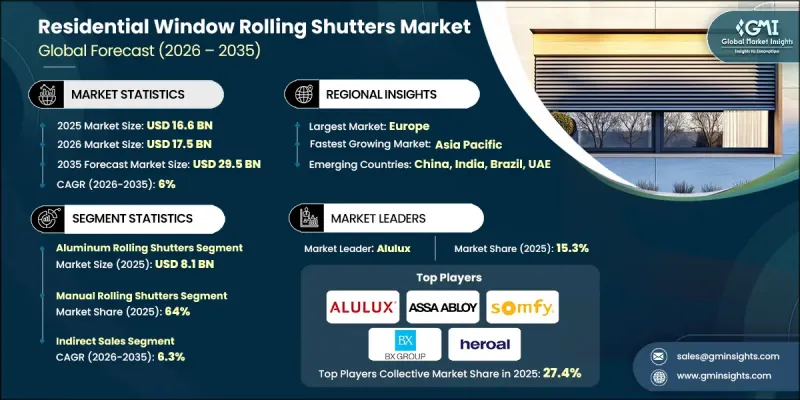
The rising focus on residential safety and personal privacy is significantly increasing demand for rolling shutter systems across modern housing developments. Rapid urban expansion and the continued rise in residential construction projects are also creating favorable conditions for the market's expansion. Homeowners are increasingly incorporating architectural elements that enhance both security and visual appeal, which is strengthening the adoption of advanced window shutter solutions. Growing awareness of energy efficiency is another key factor encouraging adoption, as rolling shutters contribute to better insulation and help regulate indoor temperatures. Consumers are becoming more conscious of reducing energy consumption associated with cooling and heating systems, further supporting market growth. Technological developments in shutter systems are also transforming the industry landscape. Integration of automated and intelligent control features is gaining popularity among homeowners who prefer connected home environments. In addition, manufacturers are offering wider customization possibilities that include various design styles and color options, allowing consumers to match shutters with diverse residential aesthetics while maintaining functional performance.
| Market Scope | |
|---|---|
| Start Year | 2025 |
| Forecast Year | 2026-2035 |
| Start Value | $16.6 Billion |
| Forecast Value | $29.5 Billion |
| CAGR | 6% |
The aluminum rolling shutters segment generated USD 8.1 billion in 2025 and is expected to grow at a CAGR of 6.2% throughout 2035. The increasing preference for aluminum shutters is largely attributed to the material's lightweight structure, long-lasting durability, and strong resistance to environmental wear. These characteristics make aluminum a preferred material choice for modern residential properties seeking reliable and low-maintenance window protection solutions. In addition to strength and longevity, aluminum shutters provide effective insulation and improved security features, further supporting their adoption across newly developed housing units. At the same time, PVC rolling shutters are expected to record steady market growth due to their cost-effective nature and minimal maintenance requirements. Consumers are increasingly selecting PVC options because they provide insulation benefits while offering diverse styling possibilities that accommodate different design preferences and aesthetic choices.
The motorized rolling shutters segment is expected to register a CAGR of 6.8% from 2026 to 2035. Rising consumer interest in automated home solutions is a major factor accelerating the demand for motorized shutter systems. Homeowners increasingly value convenience and ease of operation, which motorized systems provide through automated functionality. The growing integration of automation technologies into residential environments is encouraging wider adoption of these products, particularly within densely populated urban housing developments. As smart home adoption continues to expand, motorized rolling shutters are becoming an increasingly attractive option for consumers seeking both enhanced functionality and modern living convenience.
United States Residential Window Rolling Shutters Market accounted for 76% share, generating USD 3 billion in 2025. Market expansion in the United States is primarily driven by increasing consumer interest in energy-efficient home improvement solutions combined with a strong focus on residential security. Greater awareness of the functional advantages of window rolling shutters is encouraging adoption among homeowners. These systems contribute to improved indoor insulation, reduced external noise levels, and enhanced protection against varying environmental conditions. The growing popularity of smart home technologies is also supporting the adoption of automated window shutter systems equipped with remote and digital control capabilities. In addition, shifting environmental conditions and changing climate patterns across the country are further strengthening demand for reliable window protection solutions, supporting the continued growth of the residential window rolling shutters market in the United States.
Key companies operating in the Global Residential Window Rolling Shutters Market include Alulux, Aluroll, American Industrial Door, Assa Abloy, Bunka Shutter, Croci North America, Heroal, Hormann Group, Novoferm, Pentagon, Roll Shutter Systems, Rollac, ROMA, Sanwa Holdings, and Somfy Group. Companies participating in the Global Residential Window Rolling Shutters Market are implementing several strategic initiatives to strengthen their market position and expand global presence. Manufacturers are investing heavily in research and development to introduce advanced shutter technologies that offer improved durability, enhanced insulation performance, and integrated automation features. Product innovation focused on smart control systems and energy-efficient materials is helping companies differentiate their offerings in a competitive market environment. Many firms are also expanding their distribution networks and strengthening partnerships with construction companies, home improvement retailers, and residential developers to improve product availability.
Table of Contents
Chapter 1 Methodology and scope
- 1.1 Research approach
- 1.2 Quality Commitments
- 1.2.1 GMI AI policy & data integrity commitment
- 1.2.1.1 Source consistency protocol
- 1.2.1 GMI AI policy & data integrity commitment
- 1.3 Research Trail & Confidence Scoring
- 1.3.1 Research Trail Components
- 1.3.2 Scoring Components
- 1.4 Data Collection
- 1.4.1 Partial list of primary sources
- 1.5 Data mining sources
- 1.5.1 Paid sources
- 1.5.1.1 Sources, by region
- 1.5.1 Paid sources
- 1.6 Base estimates and calculations
- 1.6.1 Base year calculation for any one approach
- 1.7 Forecast model
- 1.7.1 Quantified market impact analysis
- 1.7.1.1 Mathematical impact of growth parameters on forecast
- 1.7.1 Quantified market impact analysis
- 1.8 Research transparency addendum
- 1.8.1 Source attribution framework
- 1.8.2 Quality assurance metrics
- 1.8.3 Our commitment to trust
Chapter 2 Executive summary
- 2.1 Industry 360° synopsis
- 2.2 Key market trends
- 2.2.1 Regional
- 2.2.2 Material Type
- 2.2.3 Operation Type
- 2.2.4 Project Type
- 2.2.5 Distribution Channel
Chapter 3 Industry insights
- 3.1 Industry ecosystem analysis
- 3.1.1 Supplier landscape
- 3.1.2 Profit margin
- 3.1.3 Value addition at each stage
- 3.1.4 Factor affecting the value chain
- 3.2 Industry impact forces
- 3.2.1 Growth drivers
- 3.2.2 Industry pitfalls & challenges
- 3.2.3 Opportunities
- 3.3 Growth potential analysis
- 3.4 Future market trends
- 3.5 Technology and innovation landscape
- 3.5.1 Current technological trends
- 3.5.2 Emerging technologies
- 3.6 Price trends
- 3.7 Regulatory landscape
- 3.7.1 North America (Building Codes, Hurricane Standards)
- 3.7.2 Europe (CE Marking, Energy Performance Standards)
- 3.7.3 Asia Pacific (Local Certification Requirements)
- 3.7.4 Certification Standards (ISO, ASTM, EN Standards)
- 3.7.5 Energy Efficiency Regulations & Incentives
- 3.8 Pricing analysis (driven by primary research)
- 3.8.1 Historical price trend analysis (2022-2025)
- 3.8.2 Pricing strategy by player type (premium/value/economy) (driven by primary research)
- 3.8.3 Regional price variation analysis
- 3.8.4 Installation cost benchmarking
- 3.9 Key trade corridors & tariff impact analysis (driven by primary research)
- 3.9.1 HS Code Classification & Trade Statistics (7308.30, 7610.90)
- 3.10 Impact of AI & Generative AI on the Market
- 3.10.1 AI-Driven Disruption of Traditional Business Models
- 3.10.2 GenAI Use Cases & Adoption Roadmap by Customer Segment
- 3.10.3 Risks, Limitations & Regulatory Considerations
- 3.10.4 AI-Enabled Smart Home Ecosystem Integration
- 3.11 Benchmarking (extrusion, roll-forming, assembly automation) capacity & production landscape (driven by primary research)
- 3.11.1 Manufacturing capacity installed by region & key producer (driven by primary research)
- 3.11.2 Capacity utilization rates & expansion pipelines (driven by primary research)
- 3.11.3 Production technology
- 3.12 Porter's analysis
- 3.13 PESTEL analysis
- 3.14 Consumer buying behavior
- 3.14.1 Purchasing patterns
- 3.14.2 Preference analysis
- 3.14.3 Regional variations in consumer behavior
- 3.14.4 Impact of e-commerce on buying decisions
Chapter 4 Competitive landscape, 2025
- 4.1 Introduction
- 4.2 Company market share analysis
- 4.2.1 North America
- 4.2.2 Europe
- 4.2.3 Asia Pacific
- 4.2.4 Latin America
- 4.2.5 MEA
- 4.3 Company matrix analysis
- 4.4 Competitive analysis of major market players
- 4.5 Competitive positioning matrix
- 4.6 Key developments
- 4.6.1 Mergers & acquisitions
- 4.6.2 Partnerships & collaborations
- 4.6.3 New product launches
- 4.6.4 Expansion plans
Chapter 5 Market Estimates & Forecast, By Material Type, 2022 - 2035 ($Billion, Thousand Units)
- 5.1 Key trends
- 5.2 Aluminum rolling shutters
- 5.3 PVC rolling shutters
- 5.4 Steel rolling shutters
- 5.5 Others (wood rolling shutters etc.)
Chapter 6 Market Estimates & Forecast, By Operation Type, 2022 - 2035 ($Billion, Thousand Units)
- 6.1 Key trends
- 6.2 Manual rolling shutters
- 6.3 Motorized rolling shutters
- 6.3.1 Motorized remote
- 6.3.2 Motorized wall switch
- 6.4 Smart/IoT-enabled rolling shutters
Chapter 7 Market Estimates & Forecast, By Project Type, 2022 - 2035 ($Billion, Thousand Units)
- 7.1 Key trends
- 7.2 New construction
- 7.3 Renovation/retrofit
Chapter 8 Market Estimates & Forecast, By Distribution Channel, 2022 - 2035 ($Billion, Thousand Units)
- 8.1 Key trends
- 8.2 Direct sales
- 8.3 Indirect sales
Chapter 9 Market Estimates & Forecast, By Region, 2022 - 2035 ($Billion, Thousand Units)
- 9.1 Key trends
- 9.2 North America
- 9.2.1 U.S.
- 9.2.2 Canada
- 9.3 Europe
- 9.3.1 Germany
- 9.3.2 UK
- 9.3.3 France
- 9.3.4 Spain
- 9.3.5 Italy
- 9.3.6 Netherlands
- 9.4 Asia Pacific
- 9.4.1 China
- 9.4.2 Japan
- 9.4.3 India
- 9.4.4 Australia
- 9.4.5 South Korea
- 9.5 Latin America
- 9.5.1 Brazil
- 9.5.2 Mexico
- 9.5.3 Argentina
- 9.6 MEA
- 9.6.1 South Africa
- 9.6.2 Saudi Arabia
- 9.6.3 UAE
Chapter 10 Company Profiles
- 10.1 Alulux
- 10.2 Aluroll
- 10.3 American Industrial Door
- 10.4 ASSA ABLOY
- 10.5 Bunka Shutter
- 10.6 Croci North America
- 10.7 Heroal
- 10.8 Hormann Group
- 10.9 Novoferm
- 10.10 Pentagon
- 10.11 Roll Shutter Systems
- 10.12 Rollac
- 10.13 ROMA
- 10.14 Sanwa Holdings
- 10.15 Somfy Group

