
PUBLISHER: Global Market Insights Inc. | PRODUCT CODE: 1998661

PUBLISHER: Global Market Insights Inc. | PRODUCT CODE: 1998661
Intramedullary Nail Leg Lengthening Market Opportunity, Growth Drivers, Industry Trend Analysis, and Forecast 2026 - 2035
The Global Intramedullary Nail Leg Lengthening Market was valued at USD 86.8 million in 2025 and is estimated to grow at a CAGR of 7.8% to reach USD 188.1 million by 2035.
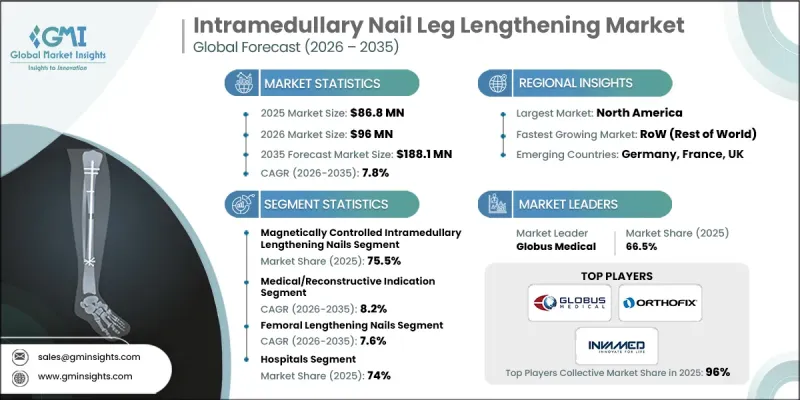
This growth is driven by the increasing occurrence of limb length irregularities and orthopedic conditions that require corrective surgical treatment. At the same time, advancements in implant technology and the growing preference for minimally invasive procedures are significantly supporting adoption. Intramedullary nail leg lengthening refers to a surgical method in which an adjustable metal rod is implanted within the bone canal to extend the limb in a controlled manner. Over time, the device expands incrementally, allowing new bone tissue to form as the limb lengthens. Rising clinical demand for internal lengthening procedures, coupled with ongoing innovation in implant design, is accelerating market expansion. Advanced nail systems that offer improved precision and control are gaining attention among orthopedic specialists. In addition, the growing integration of digital monitoring capabilities and smart implant technologies is transforming treatment outcomes. Increasing interest in elective height correction procedures and the adoption of programmable internal nail systems are also contributing to the rapid development of the intramedullary nail leg lengthening market.
| Market Scope | |
|---|---|
| Start Year | 2025 |
| Forecast Year | 2026-2035 |
| Start Value | $86.8 Million |
| Forecast Value | $188.1 Million |
| CAGR | 7.8% |
The mechanical intramedullary lengthening nails segment is anticipated to grow at a CAGR of 4.9% throughout 2026-2035. These systems remain relevant due to their comparatively affordable pricing structure, making them suitable for healthcare systems that prioritize cost efficiency. Their practical design and accessibility help maintain steady demand, particularly in regions where highly advanced implant technologies may not yet be widely available.
The femoral lengthening nails segment generated USD 62.5 million in 2025 and is expected to register a CAGR of 7.6% during 2026-2035. Differences in femur length can significantly impact mobility, posture, and overall musculoskeletal balance. Addressing these structural issues is an essential aspect of orthopedic treatment, which continues to drive demand for femoral lengthening solutions. Internal femoral nails also support faster rehabilitation processes by enabling earlier mobilization and structured physiotherapy programs. These benefits contribute to improved functional recovery and increased acceptance among both surgeons and patients.
North America Intramedullary Nail Leg Lengthening Market held 51.3% share in 2025. The region benefits from a strong healthcare ecosystem that includes specialized orthopedic facilities, advanced surgical infrastructure, and comprehensive rehabilitation services. Access to modern diagnostic technologies and specialized surgical training programs further strengthens the adoption of advanced internal lengthening systems. The well-established medical framework in North America supports both reconstructive treatments and elective procedures, contributing to continued regional dominance in the market.
Prominent companies operating in the Global Intramedullary Nail Leg Lengthening Market include Globus Medical, INVAMED, JPP Management, Orthofix Medical, and X-os S.A. Companies in the intramedullary nail leg lengthening market are focusing on multiple strategic initiatives to strengthen their competitive position and expand their global footprint. Leading manufacturers are investing heavily in research and development to introduce next-generation nail systems with improved precision, safety, and patient comfort. Strategic collaborations with orthopedic hospitals and surgical centers help companies expand clinical adoption and strengthen professional training programs for surgeons. Many firms are also pursuing geographic expansion strategies by entering emerging healthcare markets where demand for orthopedic reconstruction procedures is rising. Product portfolio diversification and regulatory approvals across multiple regions remain key priorities.
Table of Contents
Chapter 1 Methodology and Scope
- 1.1 Research approach
- 1.2 Quality commitments
- 1.2.1 GMI AI policy & data integrity commitment
- 1.2.1.1 Source consistency protocol
- 1.2.1 GMI AI policy & data integrity commitment
- 1.3 Research trail & confidence scoring
- 1.3.1 Research trail components
- 1.3.2 Scoring components
- 1.4 Data collection
- 1.4.1 Partial list of primary sources
- 1.5 Data mining sources
- 1.5.1 Paid sources
- 1.5.1.1 Sources, by region
- 1.5.1 Paid sources
- 1.6 Base estimates and calculations
- 1.6.1 Base year calculation for any one approach
- 1.7 Forecast model
- 1.7.1 Quantified market impact analysis
- 1.7.1.1 Mathematical impact of growth parameters on forecast
- 1.7.1 Quantified market impact analysis
- 1.8 Research transparency addendum
- 1.8.1 Source attribution framework
- 1.8.2 Quality assurance metrics
- 1.8.3 Our commitment to trust
Chapter 2 Executive Summary
- 2.1 Industry 360° synopsis
- 2.2 Key market trends
- 2.2.1 Regional trends
- 2.2.2 Technology trends
- 2.2.3 Indication trends
- 2.2.4 Bone type/anatomy trends
- 2.2.5 End use trends
- 2.3 CXO perspectives: Strategic imperatives
Chapter 3 Industry Insights
- 3.1 Industry ecosystem analysis
- 3.2 Industry impact forces
- 3.2.1 Growth drivers
- 3.2.1.1 Rising prevalence of limb length discrepancy (LLD)
- 3.2.1.2 Shift from external fixators to internal lengthening systems
- 3.2.1.3 Technological advancements in magnetic nail systems
- 3.2.2 Industry pitfalls and challenges
- 3.2.2.1 High device and procedure cost
- 3.2.2.2 Associated risk and complications
- 3.2.3 Market opportunities
- 3.2.3.1 Development of smart & sensor-enabled intramedullary nails
- 3.2.3.2 Expansion into emerging markets
- 3.2.1 Growth drivers
- 3.3 Growth potential analysis
- 3.4 Regulatory landscape
- 3.4.1 North America
- 3.4.2 Europe
- 3.5 Technology landscape
- 3.5.1 Current technological trends
- 3.5.1.1 Motorized electromechanical intramedullary nails
- 3.5.1.2 High load-bearing magnetic nails
- 3.5.1.3 Reverse planning method (RPM) enabled digital planning platforms
- 3.5.2 Emerging technologies
- 3.5.2.1 High-strength hybrid material nail designs
- 3.5.2.2 Digitally connected and wireless intramedullary lengthening nail systems
- 3.5.2.3 AI-assisted distraction planning and monitoring platforms
- 3.5.1 Current technological trends
- 3.6 Future market trends
- 3.7 Reimbursement scenario
- 3.8 Evolution from external fixation to internal lengthening
- 3.9 Pricing analysis, by product type, 2025
- 3.10 Patent analysis
- 3.11 Patient demographics and epidemiology
- 3.12 Porter's analysis
- 3.13 PESTEL analysis
Chapter 4 Competitive Landscape, 2025
- 4.1 Introduction
- 4.2 Company matrix analysis
- 4.3 Company market share analysis
- 4.4 Competitive positioning matrix
- 4.5 Competitive analysis of major market players
- 4.6 Key developments
- 4.6.1 Mergers & acquisitions
- 4.6.2 Partnerships & collaborations
- 4.6.3 New product launches
- 4.6.4 Expansion plans
Chapter 5 Market Estimates and Forecast, By Technology, 2022 - 2035 ($ Mn)
- 5.1 Key trends
- 5.2 Magnetically controlled intramedullary lengthening nails
- 5.3 Motorized intramedullary lengthening nails
- 5.4 Mechanical intramedullary lengthening nails
Chapter 6 Market Estimates and Forecast, By Indication, 2022 - 2035 ($ Mn)
- 6.1 Key trends
- 6.2 Medical/reconstructive indication
- 6.3 Cosmetic/stature lengthening
Chapter 7 Market Estimates and Forecast, By Bone Type/Anatomy, 2022 - 2035 ($ Mn)
- 7.1 Key trends
- 7.2 Femoral lengthening nails
- 7.3 Tibial lengthening nails
Chapter 8 Market Estimates and Forecast, By End Use, 2022 - 2035 ($ Mn)
- 8.1 Key trends
- 8.2 Hospitals
- 8.3 Specialty orthopedic clinics
- 8.4 Other end users
Chapter 9 Market Estimates and Forecast, By Region, 2022 - 2035 ($ Mn)
- 9.1 Key trends
- 9.2 North America
- 9.2.1 U.S.
- 9.2.2 Canada
- 9.3 Europe
- 9.3.1 Germany
- 9.3.2 UK
- 9.3.3 France
- 9.3.4 Spain
- 9.3.5 Italy
- 9.3.6 Netherlands
- 9.4 RoW (Rest of World)
Chapter 10 Company Profiles
- 10.1 Globus Medical
- 10.2 INVAMED
- 10.3 JPP Management
- 10.4 Orthofix Medical
- 10.5 X-os S.A.

