
PUBLISHER: Global Market Insights Inc. | PRODUCT CODE: 1998665

PUBLISHER: Global Market Insights Inc. | PRODUCT CODE: 1998665
U.S. Memory Care Products Market Opportunity, Growth Drivers, Industry Trend Analysis, and Forecast 2026 - 2035
U.S. Memory Care Products Market was valued at USD 10.2 billion in 2025 and is estimated to grow at a CAGR of 6.2% to reach USD 18.9 billion by 2035.
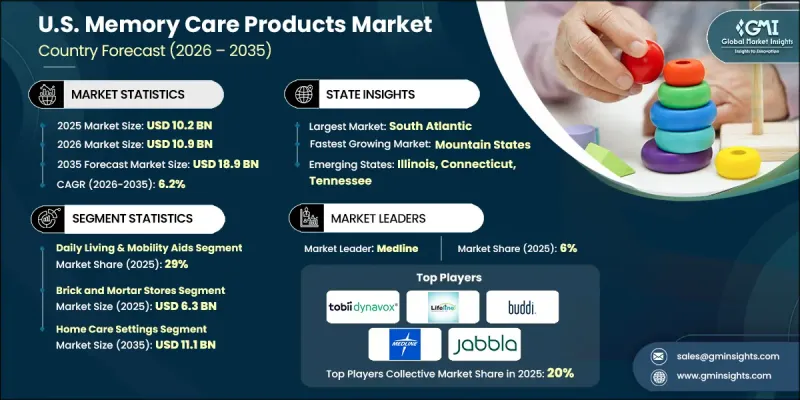
Market expansion is fueled by rising awareness among both patients and the broader population, along with supportive public initiatives and reimbursement frameworks that encourage adoption of memory care solutions. A well-established healthcare system and increasing national healthcare spending are also enabling broader accessibility to these products. Growing demand is closely linked to demographic trends, particularly the increasing proportion of older adults and the rising incidence of cognitive disorders such as dementia and Alzheimer's disease. Technological progress is further shaping the industry, enabling the development of innovative products designed to support individuals experiencing cognitive decline. The integration of such technologies into healthcare systems has improved care coordination across hospitals, long-term care centers, and home-based care environments. Increased spending capacity among healthcare providers has also facilitated the adoption of both basic assistive tools and technologically advanced solutions that enhance patient safety, improve care outcomes, and streamline operational processes. As innovation accelerates, memory care products are transitioning from traditional assistive tools into interconnected, technology-enabled systems capable of working together within a broader care ecosystem.
| Market Scope | |
|---|---|
| Start Year | 2025 |
| Forecast Year | 2026-2035 |
| Start Value | $10.2 Billion |
| Forecast Value | $18.9 Billion |
| CAGR | 6.2% |
The personal safety products category generated USD 2.7 billion in 2025, representing a notable portion of the U.S. memory care products market. This segment focuses on technologies designed to enhance the safety of individuals experiencing cognitive decline while providing reassurance to caregivers and care providers. Solutions in this category help minimize risks associated with accidents or injuries by enabling rapid response in situations where intervention may be required. The increasing emphasis on protecting patient well-being while also addressing caregiver concerns related to safety responsibilities has accelerated the adoption of these products across residential, assisted living, and community-based care environments.
The brick-and-mortar retail outlets segment accounted for USD 6.3 billion in 2025 and remained the leading distribution channel within the U.S. memory care products market. The segment is expected to expand at a CAGR of 5.9% during the forecast period. Physical retail environments continue to play a vital role because many buyers prefer direct interaction with products before making purchasing decisions. Caregivers and healthcare organizations frequently value the opportunity to examine product functionality, comfort, and reliability in person, particularly when selecting assistive solutions intended for daily use. In-store consultation with knowledgeable staff, including professionals familiar with medical equipment, further supports purchasing confidence and informed decision-making. Institutional buyers also often depend on established offline supply chains for bulk procurement.
South Atlantic Memory Care Products Market held 25.1% share in 2025 owing to a rapidly growing elderly population and a higher incidence of age-related cognitive conditions. Many states within this region attract retirees seeking favorable living conditions and affordability, which in turn increases the need for memory care support solutions in residential settings. As a result, home-based care environments play a central role in driving product adoption across the region. Growing investment in specialized care facilities and residential support environments is also contributing to consistent institutional demand for memory care products. The combination of demographic growth and expanding care infrastructure continues to strengthen the region's position within the national market landscape.
Key participants operating in the U.S. Memory Care Products Market include AbleNet, Amazon, Buddi, EasierLiving, Find Memory Care, Jabbla, Lifeline, Lingraphica, Medical Guardian, Medline, MindCare, PRC-Saltillo, and Tobii Dynavox. Companies active in the U.S. Memory Care Products Market are focusing on multiple strategic initiatives to reinforce their competitive position and expand market reach. Organizations are prioritizing product innovation by incorporating advanced technologies that improve functionality, connectivity, and ease of use for individuals experiencing cognitive challenges. Strategic collaborations with healthcare providers, care facilities, and technology partners are also becoming increasingly common to strengthen distribution networks and accelerate adoption. Many companies are expanding their product portfolios to address a wider range of patient needs across home care and institutional settings. Additionally, firms are investing in digital platforms and direct-to-consumer sales channels to increase accessibility and brand visibility.
Table of Contents
Chapter 1 Methodology and Scope
- 1.1 Market scope and definitions
- 1.2 Research design
- 1.2.1 Research approach
- 1.2.2 Data collection methods
- 1.3 Data mining sources
- 1.3.1 Zone/state
- 1.4 Base estimates and calculations
- 1.4.1 Base year calculation
- 1.4.2 Key trends for market estimation
- 1.5 Primary research and validation
- 1.5.1 Primary sources
- 1.6 Forecast model
- 1.7 Research assumptions and limitations
Chapter 2 Executive Summary
- 2.1 Industry 3600 synopsis
- 2.2 Key market trends
- 2.2.1 Zonal trends
- 2.2.2 Product type trends
- 2.2.3 Distribution channel trends
- 2.2.4 End user trends
- 2.3 CXO perspectives: Strategic imperatives
Chapter 3 Industry Insights
- 3.1 Industry ecosystem analysis
- 3.2 Industry impact forces
- 3.2.1 Growth drivers
- 3.2.1.1 Aging population and rising prevalence of dementia/Alzheimer’s disease
- 3.2.1.2 Advanced infrastructure and high healthcare spending
- 3.2.1.3 Technological advancements in care products
- 3.2.1.4 Increasing awareness and supportive government initiatives/programs
- 3.2.2 Industry pitfalls and challenges
- 3.2.2.1 High cost of memory care products
- 3.2.3 Market opportunities
- 3.2.3.1 Integration of advanced technologies
- 3.2.3.2 Expansion of personalized and smart memory care solutions
- 3.2.1 Growth drivers
- 3.3 Growth potential analysis
- 3.4 Regulatory landscape
- 3.5 Technology landscape
- 3.5.1 Current technological trends
- 3.5.2 Emerging technologies
- 3.6 Reimbursement scenario
- 3.7 Consumer insights
- 3.8 Future market trends
- 3.9 Investment outlook
- 3.10 Comparative insights between institutional vs. home care demand
- 3.11 Porter's analysis
- 3.12 PESTEL analysis
- 3.13 Gap analysis
- 3.14 Impact of AI and generative AI on the market
Chapter 4 Competitive Landscape, 2025
- 4.1 Introduction
- 4.2 Company matrix analysis
- 4.3 Competitive positioning matrix
- 4.4 Competitive analysis of major market players
- 4.5 Key developments
- 4.5.1 Mergers & acquisitions
- 4.5.2 Partnerships & collaborations
- 4.5.3 New service launches
- 4.5.4 Expansion plans
Chapter 5 Market Estimates and Forecast, By Product Type, 2022 - 2035 ($ Mn)
- 5.1 Key trends
- 5.2 Daily living & mobility aids
- 5.2.1 Bathroom safety
- 5.2.2 Dining aids
- 5.2.3 Walking aids
- 5.2.4 Other mobility products
- 5.3 Personal safety products
- 5.3.1 Wanderer control
- 5.3.2 Fall detection and prevention
- 5.4 Daily reminder products
- 5.5 Communication products
- 5.5.1 Voice-optimized communication systems
- 5.5.2 Visual & multi-modal communication tools
- 5.6 Memory exercise & activity products
- 5.7 Other product types
Chapter 6 Market Estimates and Forecast, By Distribution Channel, 2022 - 2035 ($ Mn)
- 6.1 Key trends
- 6.2 Brick and mortar stores
- 6.3 Ecommerce
Chapter 7 Market Estimates and Forecast, By End User, 2022 - 2035 ($ Mn)
- 7.1 Key trends
- 7.2 Home care settings
- 7.3 Long-term care centers
- 7.4 Other end users
Chapter 8 Market Estimates and Forecast, By Zone, 2022 - 2035 ($ Mn)
- 8.1 Key trends
- 8.2 East North Central
- 8.2.1 Illinois
- 8.2.2 Indiana
- 8.2.3 Michigan
- 8.2.4 Ohio
- 8.2.5 Wisconsin
- 8.3 West South Central
- 8.3.1 Arkansas
- 8.3.2 Louisiana
- 8.3.3 Oklahoma
- 8.3.4 Texas
- 8.4 South Atlantic
- 8.4.1 Delaware
- 8.4.2 Florida
- 8.4.3 Georgia
- 8.4.4 Maryland
- 8.4.5 North Carolina
- 8.4.6 South Carolina
- 8.4.7 Virginia
- 8.4.8 West Virginia
- 8.4.9 Washington, D.C.
- 8.5 Northeast
- 8.5.1 Connecticut
- 8.5.2 Maine
- 8.5.3 Massachusetts
- 8.5.4 New Hampshire
- 8.5.5 Rhode Island
- 8.5.6 Vermont
- 8.5.7 New Jersey
- 8.5.8 New York
- 8.5.9 Pennsylvania
- 8.6 East South Central
- 8.6.1 Alabama
- 8.6.2 Kentucky
- 8.6.3 Mississippi
- 8.6.4 Tennessee
- 8.7 West North Central
- 8.7.1 Iowa
- 8.7.2 Kansas
- 8.7.3 Minnesota
- 8.7.4 Missouri
- 8.7.5 Nebraska
- 8.7.6 North Dakota
- 8.7.7 South Dakota
- 8.8 Pacific Central
- 8.8.1 Alaska
- 8.8.2 California
- 8.8.3 Hawaii
- 8.8.4 Oregon
- 8.8.5 Washington
- 8.9 Mountain States
- 8.9.1 Arizona
- 8.9.2 Colorado
- 8.9.3 Utah
- 8.9.4 Nevada
- 8.9.5 New Mexico
- 8.9.6 Idaho
- 8.9.7 Montana
- 8.9.8 Wyoming
Chapter 9 Company Profiles
- 9.1 AbleNet
- 9.2 Amazon
- 9.3 Buddi
- 9.4 EasierLiving
- 9.5 Find Memory Care
- 9.6 Jabbla
- 9.7 Lifeline
- 9.8 Lingraphica
- 9.9 Medical Guardian
- 9.10 Medline
- 9.11 MindCare
- 9.12 PRC-Saltillo
- 9.13 Tobii Dynavox

