PUBLISHER: Global Market Insights Inc. | PRODUCT CODE: 1998668

PUBLISHER: Global Market Insights Inc. | PRODUCT CODE: 1998668
Japan Single-use Duodenoscope Market Opportunity, Growth Drivers, Industry Trend Analysis, and Forecast 2026 - 2035
Japan Single-use Duodenoscope Market was valued at USD 4.1 million in 2026 and is estimated to grow at a CAGR of 54.4% to reach USD 204.6 million by 2035.
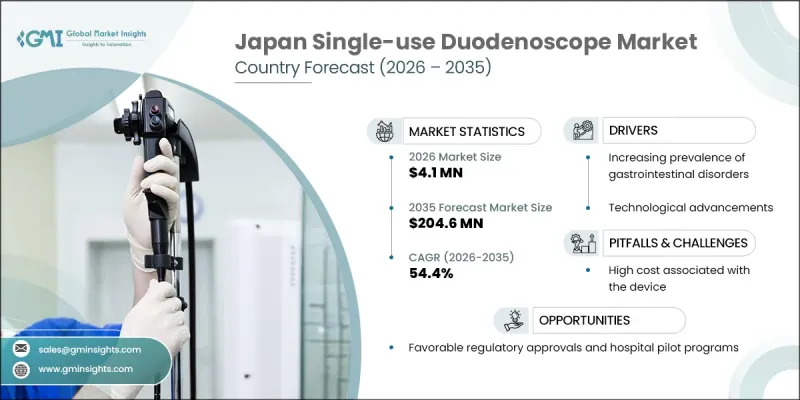
The market growth is primarily driven by rising concerns regarding cross-contamination risks associated with reusable duodenoscopes, increasing prevalence of gastrointestinal and pancreaticobiliary disorders, and growing emphasis on infection prevention in healthcare facilities. Single-use duodenoscopes eliminate the need for complex reprocessing procedures, significantly reducing the risk of hospital-acquired infections (HAIs). Japan's aging population, which is more susceptible to biliary and pancreatic diseases, further supports demand for endoscopic retrograde cholangiopancreatography (ERCP) procedures. Additionally, advancements in disposable endoscopy technology, improved imaging quality, and enhanced maneuverability are strengthening clinicians' confidence in adopting single-use devices across hospitals and specialty clinics.
| Market Scope | |
|---|---|
| Start Year | 2025 |
| Forecast Year | 2026-2035 |
| Start Value | $4.1 Million |
| Forecast Value | $204.6 Million |
| CAGR | 54.4% |
By end-user, the hospitals segment dominated the market in 2025, generating USD 8.1 million. Hospitals account for many ERCP procedures in Japan due to the availability of advanced endoscopy units, skilled gastroenterologists, and comprehensive patient care infrastructure. The growing implementation of strict infection control protocols and regulatory emphasis on patient safety are encouraging hospitals to transition toward disposable duodenoscopes. Moreover, large tertiary care centers are increasingly adopting single-use devices to minimize litigation risks and improve operational efficiency by reducing reprocessing time and maintenance costs. The segment's dominance is further reinforced by higher procedure volumes in urban medical centers.
Based on application, the Pancreatic and Biliary Disorders segment held the largest share in 2025, valued at USD 7.6 million. The high incidence of gallstones, bile duct obstructions, pancreatic cancer, and chronic pancreatitis in Japan is driving the demand for ERCP procedures. Single-use duodenoscopes provide a safer alternative in complex therapeutic interventions, ensuring consistent performance and reducing contamination risks. Increasing early diagnosis initiatives and improved reimbursement policies for minimally invasive procedures are further contributing to segment growth. Physicians are favoring disposable devices in high-risk and immunocompromised patient populations to enhance clinical outcomes and infection control standards.
Regionally, the Kanto region accounted for the largest share in 2025, representing 36% of the Japan Single-use Duodenoscope Market. The region's dominance is attributed to the presence of leading hospitals, advanced healthcare infrastructure, and high patient inflow in metropolitan areas such as Tokyo and surrounding prefectures. Greater awareness of infection prevention practices and higher healthcare expenditure levels further support adoption in the region. Additionally, the concentration of medical research institutions and early adoption of innovative medical technologies contribute to Kanto's leading market position.
Key players operating in the Japan Single-use Duodenoscope Market include Boston Scientific Corporation, Olympus Corporation, Ambu A/S, Fujifilm Holdings Corporation, and PENTAX Medical (HOYA Corporation). These companies are focusing on technological advancements, regulatory approvals, and expanding product portfolios to strengthen their competitive presence. Companies in the Japan Single-use Duodenoscope Market are prioritizing innovation, regulatory compliance, and strategic collaborations to strengthen their market foothold. Leading manufacturers are investing in R&D to enhance the imaging quality, maneuverability, and ergonomic design of disposable duodenoscopes. Partnerships with hospitals and academic institutions are facilitating clinical trials and product validation to accelerate adoption. Firms are also expanding local distribution networks and providing training programs for endoscopists to build product familiarity and trust. Additionally, companies are focusing on cost optimization strategies to make single-use devices more affordable for healthcare providers. Regulatory approvals and alignment with Japan's stringent medical device standards remain a critical strategy.
Table of Contents
Chapter 1 Methodology and Scope
- 1.1 Research approach
- 1.2 Quality commitments
- 1.2.1 GMI AI policy & data integrity commitment
- 1.2.1.1 Source consistency protocol
- 1.2.1 GMI AI policy & data integrity commitment
- 1.3 Research trail & confidence scoring
- 1.3.1 Research trail components
- 1.3.2 Scoring components
- 1.4 Data collection
- 1.4.1 Partial list of primary sources
- 1.5 Data mining sources
- 1.5.1 Paid sources
- 1.5.1.1 Sources, by country
- 1.5.1 Paid sources
- 1.6 Forecast calculations
- 1.6.1 Forecast calculation for any one approach
- 1.7 Forecast model
- 1.7.1 Quantified market impact analysis
- 1.7.1.1 Mathematical impact of growth parameters on forecast
- 1.7.1 Quantified market impact analysis
- 1.8 Research transparency addendum
- 1.8.1 Source attribution framework
- 1.8.2 Quality assurance metrics
- 1.8.3 Our commitment to trust
Chapter 2 Executive Summary
- 2.1 Industry 360° synopsis
- 2.2 Key market trends
- 2.3 CXO perspectives: Strategic imperatives
Chapter 3 Industry Insights
- 3.1 Industry ecosystem analysis
- 3.2 Industry impact forces
- 3.2.1 Growth drivers
- 3.2.1.1 Increasing prevalence of gastrointestinal disorders
- 3.2.1.2 Technological advancements
- 3.2.1.3 Growing shift toward single-use medical devices in the country
- 3.2.2 Industry pitfalls and challenges
- 3.2.2.1 High cost associated with the device
- 3.2.3 Market opportunities
- 3.2.3.1 Favorable regulatory approvals and hospital pilot programs
- 3.2.1 Growth drivers
- 3.3 Regulatory landscape
- 3.4 Technology landscape - Strategic implications for single-use duodenoscope entry
- 3.5 Reimbursement scenario - Strategic implications for single-use duodenoscope adoption
- 3.6 Modelled Pricing Assumptions: Japan (Launch Year 2026)
- 3.7 Pipeline analysis
- 3.8 Channel Segmentation - Japan Single-Use Duodenoscope
- 3.9 End user analysis
- 3.10 Porter's analysis
- 3.11 PESTEL analysis
- 3.12 Gap analysis

