
PUBLISHER: Global Market Insights Inc. | PRODUCT CODE: 1998677

PUBLISHER: Global Market Insights Inc. | PRODUCT CODE: 1998677
Commercial Flour Market Opportunity, Growth Drivers, Industry Trend Analysis, and Forecast 2026 - 2035
The Global Commercial Flour Market was valued at USD 54.7 billion in 2025 and is estimated to grow at a CAGR of 4.5% to reach USD 84.8 billion by 2035.
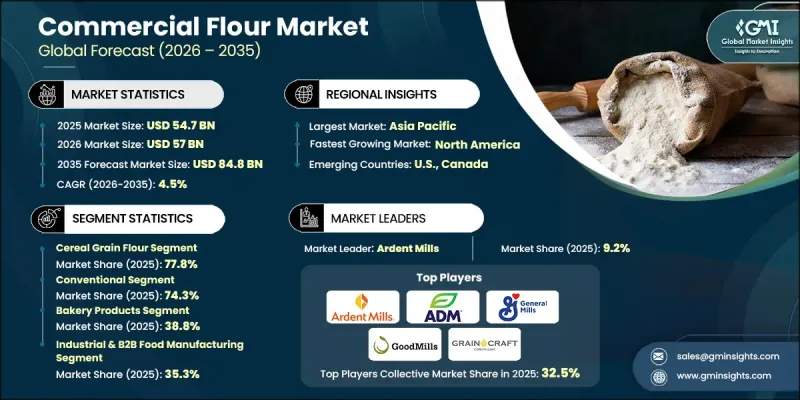
The global commercial flour industry continues to experience steady growth as demand for processed and packaged food products increases across multiple regions. Changing consumer lifestyles, rapid urbanization, and the expansion of modern retail channels are encouraging higher consumption of flour-based food products. Rising demand for convenient meal solutions and ready-to-eat products is further strengthening market expansion. Consumers are increasingly becoming aware of the nutritional advantages associated with whole-grain and fortified flour varieties, which is encouraging a gradual shift toward healthier flour alternatives. At the same time, the expansion of the food service and hospitality sectors is significantly contributing to the consumption of processed flour across commercial kitchens and large-scale food production facilities. Technological advancements in milling operations are also improving production efficiency while lowering operational costs, enabling manufacturers to introduce a wider range of flour products. Growing populations and evolving dietary habits are driving the need for value-added processed foods that incorporate flour as a key ingredient. In addition, the increasing influence of health-focused consumers is encouraging the development of specialty flour varieties such as organic, gluten-free, fortified, and whole-grain products. Continuous improvements in milling techniques and processing technologies are enhancing product consistency, improving flour quality, and increasing manufacturing productivity across the global commercial flour market.
| Market Scope | |
|---|---|
| Start Year | 2025 |
| Forecast Year | 2026-2035 |
| Start Value | $54.7 Billion |
| Forecast Value | $84.8 Billion |
| CAGR | 4.5% |
The conventional segment accounted for 74.3% share in 2025 and is expected to grow at a CAGR of 4.6% from 2026 to 2035. Conventional flour products continue to dominate the market due to their widespread availability, affordability, and versatility across multiple food preparation applications. Food manufacturers, bakeries, and foodservice establishments rely heavily on conventional flour for the large-scale production of everyday food products. Strong supply chain infrastructure ensures that this segment maintains consistent availability across both retail and commercial distribution channels. Additionally, conventional flour remains a staple ingredient for numerous food processing activities, making it a critical component of the global flour industry. High production volumes and established milling processes further strengthen the stability and reliability of this segment within the broader commercial flour market.
The bakery products segment held a 38.8% share in 2025 and is projected to grow at a CAGR of 4.4% through 2035. Flour remains a fundamental ingredient in the preparation of a wide variety of baked foods, which makes the bakery industry a major driver of commercial flour consumption. Rising global demand for baked goods continues to encourage large-scale production across both industrial bakeries and packaged food manufacturers. Increasing consumer interest in healthier bakery products is also supporting the expansion of flour varieties designed to enhance nutritional value. Manufacturers are responding to these evolving preferences by introducing improved formulations that incorporate nutrient-rich ingredients and alternative flour types. In addition, the growing popularity of packaged baked products is contributing to sustained demand for commercial flour as consumers increasingly seek convenient and ready-to-consume food options.
Europe Commercial Flour Market generated USD 19.6 billion in 2025. The Europe commercial flour industry is characterized by a strong focus on product quality, sustainability, and strict regulatory compliance. Consumers in the region demonstrate a growing preference for premium flour varieties produced through environmentally responsible manufacturing practices. The region's long-established culinary traditions encourage the use of high-quality flour products, particularly those designed for specialized food preparation. Food producers in Europe continue to expand their use of specialty flour varieties as demand for differentiated food products increases. Regulatory frameworks related to food safety, labeling, and ingredient transparency strongly influence product development strategies and supply chain operations across the region.
Major companies operating in the Global Commercial Flour Market include ADM (Archer Daniels Midland), Ardent Mills, Bob's Red Mill, General Mills, GoodMills Group, Grain Craft, Ingredion, King Arthur Baking Company, North Dakota Mill, and Wheat Montana. Companies participating in the Global Commercial Flour Market are implementing a variety of strategies to strengthen their competitive positioning and expand their market reach. Product innovation remains a key priority, with manufacturers developing specialty flour varieties that align with growing consumer interest in healthier and functional food ingredients. Many companies are also investing in advanced milling technologies to improve production efficiency and maintain consistent product quality. Expansion of distribution networks across retail, foodservice, and industrial channels is another important strategy used to increase market penetration. Businesses are also focusing on sustainable sourcing practices and environmentally responsible production processes to appeal to environmentally conscious consumers.
Table of Contents
Chapter 1 Methodology & Scope
- 1.1 Market scope and definition
- 1.2 Research design
- 1.2.1 Research approach
- 1.2.2 Data collection methods
- 1.3 Data mining sources
- 1.3.1 Global
- 1.3.2 Regional/Country
- 1.4 Base estimates and calculations
- 1.4.1 Base year calculation
- 1.4.2 Key trends for market estimation
- 1.5 Primary research and validation
- 1.5.1 Primary sources
- 1.6 Forecast model
- 1.7 Research assumptions and limitations
Chapter 2 Executive Summary
- 2.1 Industry 360° synopsis
- 2.2 Key market trends
- 2.2.1 Regional
- 2.2.2 Product type
- 2.2.3 Source
- 2.2.4 Application
- 2.2.5 Distribution channel
- 2.3 TAM Analysis, 2026-2035
- 2.4 CXO perspectives: Strategic imperatives
- 2.4.1 Executive decision points
Chapter 3 Industry Insights
- 3.1 Industry ecosystem analysis
- 3.1.1 Supplier landscape
- 3.1.2 Profit margin
- 3.1.3 Value addition at each stage
- 3.1.4 Factor affecting the value chain
- 3.1.5 Disruptions
- 3.2 Industry impact forces
- 3.2.1 Growth drivers
- 3.2.2 Industry pitfalls and challenges
- 3.2.3 Market opportunities
- 3.3 Growth potential analysis
- 3.4 Regulatory landscape
- 3.4.1 North America
- 3.4.2 Europe
- 3.4.3 Asia Pacific
- 3.4.4 Latin America
- 3.4.5 Middle East & Africa
- 3.5 Porter's analysis
- 3.6 PESTEL analysis
- 3.7 Price trends
- 3.7.1 By region
- 3.7.2 By type
- 3.8 Future market trends
- 3.9 Technology and Innovation landscape
- 3.9.1 Current technological trends
- 3.9.2 Emerging technologies
- 3.10 Patent Landscape
- 3.11 Trade statistics (HS code)
- 3.11.1 Major importing countries
- 3.11.2 Major exporting countries
- 3.12 Sustainability and environmental aspects
- 3.12.1 Sustainable practices
- 3.12.2 Waste reduction strategies
- 3.12.3 Energy efficiency in production
- 3.12.4 Eco-friendly initiatives
- 3.13 Carbon footprint consideration
Chapter 4 Competitive Landscape, 2025
- 4.1 Introduction
- 4.2 Company market share analysis
- 4.2.1 By region
- 4.2.1.1 North America
- 4.2.1.2 Europe
- 4.2.1.3 Asia Pacific
- 4.2.1.4 LATAM
- 4.2.1.5 MEA
- 4.2.1 By region
- 4.3 Company matrix analysis
- 4.4 Competitive analysis of major market players
- 4.5 Competitive positioning matrix
- 4.6 Key developments
- 4.6.1 Mergers & acquisitions
- 4.6.2 Partnerships & collaborations
- 4.6.3 New Product Launches
- 4.6.4 Expansion Plans
Chapter 5 Market Estimates and Forecast, By Product Type, 2022-2035 (USD Billion) (Kilo Tons)
- 5.1 Key trends
- 5.2 Cereal grain flours
- 5.2.1 Wheat flour
- 5.2.2 Corn flour
- 5.2.3 Rice flour
- 5.2.4 Barley flour
- 5.2.5 Oat flour
- 5.2.6 Sorghum flour
- 5.2.7 Millet flour
- 5.2.8 Others
- 5.3 Pulse & legume flours
- 5.3.1 Chickpea flour (garbanzo/besan)
- 5.3.2 Lentil flour
- 5.3.3 Pea flour
- 5.3.4 Soy flour
- 5.4 Nut & seed flours
- 5.5 Ancient & heritage grain flours
- 5.5.1 Quinoa flour
- 5.5.2 Amaranth flour
- 5.5.3 Buckwheat flour
- 5.6 Specialty blends & functional flours
Chapter 6 Market Estimates and Forecast, By Source, 2022-2035 (USD Billion) (Kilo Tons)
- 6.1 Key trends
- 6.2 Conventional
- 6.3 Organic
Chapter 7 Market Estimates and Forecast, By Application, 2022-2035 (USD Billion) (Kilo Tons)
- 7.1 Key trends
- 7.2 Bakery products
- 7.2.1 Artisan & hearth breads
- 7.2.2 Pan breads & buns
- 7.2.3 Pastries & donuts
- 7.2.4 Cakes & brownies
- 7.2.5 Cookies & biscuits
- 7.2.6 Pizza dough
- 7.2.7 Bagels
- 7.2.8 Tortillas & flatbreads
- 7.3 Noodles & pasta
- 7.4 Confectionery
- 7.5 Sauces, gravies & fillings
- 7.6 Coatings & breading
- 7.7 Pet food
- 7.7.1 Pet treats & biscuits
- 7.7.2 Kibble & dry food
- 7.7.3 Dental sticks
- 7.7.4 Grain-free pet food
- 7.8 Animal feed
- 7.8.1 Ruminant feed
- 7.8.2 Swine feed
- 7.8.3 Poultry feed
- 7.9 Others
Chapter 8 Market Estimates and Forecast, By Distribution Channel, 2022-2035 (USD Billion) (Kilo Tons)
- 8.1 Key trends
- 8.2 Industrial & B2B food manufacturing
- 8.3 Foodservice & HoReCa
- 8.4 Wholesale & distributor networks
- 8.5 Retail (supermarkets, hypermarkets, convenience)
- 8.6 Online retail & e-commerce
- 8.7 Direct sales
Chapter 9 Market Estimates and Forecast, By Region, 2022-2035 (USD Billion) (Kilo Tons)
- 9.1 Key trends
- 9.2 North America
- 9.2.1 U.S.
- 9.2.2 Canada
- 9.3 Europe
- 9.3.1 Germany
- 9.3.2 UK
- 9.3.3 France
- 9.3.4 Spain
- 9.3.5 Italy
- 9.3.6 Rest of Europe
- 9.4 Asia Pacific
- 9.4.1 China
- 9.4.2 India
- 9.4.3 Japan
- 9.4.4 Australia
- 9.4.5 South Korea
- 9.4.6 Rest of Asia Pacific
- 9.5 Latin America
- 9.5.1 Brazil
- 9.5.2 Mexico
- 9.5.3 Argentina
- 9.5.4 Rest of Latin America
- 9.6 Middle East and Africa
- 9.6.1 Saudi Arabia
- 9.6.2 South Africa
- 9.6.3 UAE
- 9.6.4 Rest of Middle East and Africa
Chapter 10 Company Profiles
- 10.1 ADM (Archer Daniels Midland)
- 10.2 Ardent Mills
- 10.3 Bobs Red Mill
- 10.4 General Mills
- 10.5 GoodMills Group
- 10.6 Grain Craft
- 10.7 Ingredion
- 10.8 King Arthur Baking Company
- 10.9 North Dakota Mill
- 10.10 Wheat Montana

