PUBLISHER: Global Market Insights Inc. | PRODUCT CODE: 1998679

PUBLISHER: Global Market Insights Inc. | PRODUCT CODE: 1998679
Artificial Intelligence in Drug Discovery Market Opportunity, Growth Drivers, Industry Trend Analysis, and Forecast 2026 - 2035
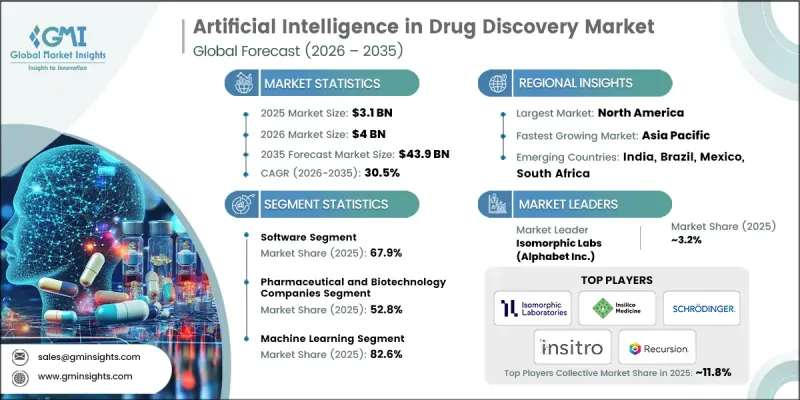
The Global Artificial Intelligence in Drug Discovery Market was valued at USD 3.1 billion in 2025 and is estimated to grow at a CAGR of 30.5% to reach USD 43.9 billion by 2035.
The artificial intelligence in the drug discovery industry is witnessing rapid expansion as pharmaceutical and biotechnology companies increasingly integrate advanced computational technologies into research processes. The growing burden of complex and long-term health conditions is encouraging organizations to accelerate the development of innovative therapeutics, which in turn is driving the adoption of AI-driven discovery tools. Artificial intelligence technologies are transforming traditional drug development methods by improving efficiency, reducing research timelines, and optimizing decision-making across the discovery pipeline. These platforms support various research activities by enabling advanced data analysis and predictive modeling across extensive biomedical datasets. Solutions powered by artificial intelligence are widely used to identify biological targets, optimize candidate compounds, design novel molecular structures, and improve early-stage testing processes. Rising concerns regarding the high cost and lengthy duration associated with conventional research and development activities are also encouraging the integration of AI platforms that enhance productivity and accuracy. Furthermore, increasing interest in precision medicine and personalized therapeutic approaches is creating additional demand for intelligent drug discovery solutions capable of analyzing complex biological information. Expanding digital healthcare infrastructure and growing investments in biotechnology innovation across several regions are also contributing to market growth. Continuous research initiatives aimed at developing more transparent and reliable artificial intelligence models are further strengthening the outlook of the global artificial intelligence in drug discovery market.
| Market Scope | |
|---|---|
| Start Year | 2025 |
| Forecast Year | 2026-2035 |
| Start Value | $3.1 Billion |
| Forecast Value | $43.9 Billion |
| CAGR | 30.5% |
The software segment accounted for 67.9% share in 2025 and is projected to grow at a CAGR of 30.2% throughout 2026-2035. Software platforms have become a fundamental component of the AI-driven drug discovery ecosystem as organizations increasingly rely on digital solutions to manage vast biomedical datasets and conduct complex predictive analyses. These platforms support critical stages of the drug discovery workflow by enabling researchers to perform computational simulations, molecular modeling, and advanced data interpretation. Continuous advancements in artificial intelligence architectures, including machine learning and deep learning techniques, are enhancing the analytical capabilities of these software tools. The integration of sophisticated algorithms allows researchers to perform large-scale chemical simulations and identify promising therapeutic candidates more efficiently.
The machine learning segment held 82.6% share in 2025. Machine learning technologies have become the primary engine driving innovation in AI-based drug discovery because of their ability to process and interpret highly complex scientific datasets. These algorithms analyze diverse biological and chemical data sources, allowing researchers to generate predictive insights that improve early-stage drug development decisions. Machine learning models enable scientists to identify patterns within genomic information, molecular libraries, and experimental datasets, which significantly accelerates the identification of viable therapeutic candidates. In addition, the growing integration of clinical and real-world data into machine learning models is strengthening the development of personalized treatment strategies. Advancements in cloud computing infrastructure and scalable data processing platforms are further supporting the widespread deployment of machine learning technologies within pharmaceutical research environments.
North America Artificial Intelligence in Drug Discovery Market held 47.7% share in 2025. The North America artificial intelligence in drug discovery industry is experiencing strong growth due to the rapid adoption of advanced digital technologies across pharmaceutical and biotechnology organizations. The region benefits from a highly developed innovation ecosystem that encourages the integration of artificial intelligence solutions into biomedical research activities. Strong financial investment in biotechnology research and digital healthcare infrastructure is further accelerating the development of advanced AI-driven drug discovery platforms. Supportive regulatory frameworks also contribute to market expansion by encouraging the safe and effective use of emerging technologies in healthcare research.
Major companies operating in the Global Artificial Intelligence in Drug Discovery Market include Isomorphic Labs (Alphabet), Microsoft Corporation, NVIDIA Corporation, International Business Machines Corporation, Schrodinger, Recursion Pharmaceuticals, Insilico Medicine, BenevolentAI, Atomwise, Insitro, Deep Genomics, Iktos, Deargen, 9Bio Therapeutics, Aureka Biotechnologies, CellCodex Technology Limited, chAIron, DenovAI Biotech, Examol, Helical.AI, Orakl Oncology, and Therenia. Companies operating in the Global Artificial Intelligence in Drug Discovery Market are implementing multiple strategies to strengthen their technological capabilities and expand market influence. One key approach involves investing heavily in research and development to enhance the performance of AI algorithms used in molecular modeling and predictive analytics. Many organizations are also forming strategic collaborations with pharmaceutical firms, biotechnology companies, and research institutions to accelerate the development of innovative therapeutic solutions. Expanding cloud-based computing infrastructure and high-performance data platforms is another major focus area that allows companies to process large biomedical datasets more efficiently. Additionally, firms are prioritizing the integration of advanced analytics, automation tools, and scalable machine learning models to improve drug discovery workflows.
Table of Contents
Chapter 1 Methodology and Scope
- 1.1 Market scope and definition
- 1.2 Research approach
- 1.3 Quality commitments
- 1.3.1 GMI AI policy and data integrity commitment
- 1.3.1.1 Source consistency protocol
- 1.3.1 GMI AI policy and data integrity commitment
- 1.4 Research trail and confidence scoring
- 1.4.1 Research trail components
- 1.4.2 Scoring components
- 1.5 Data collection
- 1.5.1 Partial list of primary sources
- 1.6 Data mining sources
- 1.6.1 Paid sources
- 1.6.1.1 Sources, by region
- 1.6.1 Paid sources
- 1.7 Base estimates and calculations
- 1.7.1 Revenue share analysis
- 1.7.2 Base year calculation
- 1.8 Forecast model
- 1.9 Research transparency addendum
- 1.9.1 Source attribution framework
- 1.9.2 Quality assurance metrics
- 1.9.3 Our commitment to trust
Chapter 2 Executive Summary
- 2.1 Industry 3600 synopsis
- 2.2 Market Trends
- 2.2.1 Business trends
- 2.2.2 Regional trends
- 2.2.3 Component trends
- 2.2.4 Technology trends
- 2.2.5 Application type trends
- 2.2.6 Therapeutic area trends
- 2.2.7 End use trends
- 2.3 CXO perspectives: Strategic imperatives
Chapter 3 Industry Insights
- 3.1 Industry ecosystem analysis
- 3.2 Industry impact forces
- 3.2.1 Growth drivers
- 3.2.1.1 Increasing prevalence of complex and chronic diseases
- 3.2.1.2 Data explosion and digitization in healthcare
- 3.2.1.3 Advancements in AI algorithms and computing power
- 3.2.1.4 Growing collaboration between tech and pharma companies
- 3.2.2 Industry pitfalls and challenges
- 3.2.2.1 Data quality and integration issues
- 3.2.2.2 Regulatory and ethical concerns
- 3.2.3 Market opportunities
- 3.2.3.1 Expansion of personalized and precision medicine
- 3.2.3.2 Emergence of generative AI in molecule design
- 3.2.1 Growth drivers
- 3.3 Growth potential analysis
- 3.4 Regulatory landscape (Driven by Primary Research)
- 3.4.1 North America
- 3.4.1.1 U.S.
- 3.4.1.2 Canada
- 3.4.2 Europe
- 3.4.3 Asia Pacific
- 3.4.4 Latin America
- 3.4.5 Middle East and Africa
- 3.4.1 North America
- 3.5 Future market trends (Driven by Primary Research)
- 3.6 Technological landscape
- 3.6.1 Current technologies
- 3.6.2 Emerging technologies
- 3.7 Investment and funding landscape
- 3.8 Impact of AI and generative AI on the market
- 3.9 Porter's analysis
- 3.10 PESTEL analysis
Chapter 4 Competitive Landscape, 2025
- 4.1 Introduction
- 4.2 Company market share analysis
- 4.2.1 North America
- 4.2.2 Europe
- 4.2.3 Asia Pacific
- 4.3 Company matrix analysis
- 4.4 Competitive analysis of major market players
- 4.5 Competitive positioning matrix
- 4.6 Key developments
- 4.6.1 Merger and acquisition
- 4.6.2 Partnership and collaboration
- 4.6.3 New product launches
- 4.6.4 Expansion plans
Chapter 5 Market Estimates and Forecast, By Component, 2022 - 2035 ($ Mn)
- 5.1 Key trends
- 5.2 Software
- 5.2.1 On-premise
- 5.2.2 Cloud-based
- 5.3 Services
Chapter 6 Market Estimates and Forecast, By Technology, 2022 - 2035 ($ Mn)
- 6.1 Key trends
- 6.2 Machine learning
- 6.2.1 Deep learning
- 6.2.2 Supervised learning
- 6.2.3 Unsupervised learning
- 6.2.4 Other machine learning technologies
- 6.3 Other technologies
Chapter 7 Market Estimates and Forecast, By Application Type, 2022 - 2035 ($ Mn)
- 7.1 Key trends
- 7.2 Molecular library screening
- 7.3 Target identification
- 7.4 Drug optimization and repurposing
- 7.5 De novo drug designing
- 7.6 Preclinical testing
Chapter 8 Market Estimates and Forecast, By Therapeutic Area, 2022 - 2035 ($ Mn)
- 8.1 Key trends
- 8.2 Oncology
- 8.3 Neurodegenerative diseases
- 8.4 Inflammatory
- 8.5 Infectious diseases
- 8.6 Metabolic diseases
- 8.7 Rare diseases
- 8.8 Cardiovascular diseases
- 8.9 Other therapeutic areas
Chapter 9 Market Estimates and Forecast, By End Use, 2022 - 2035 ($ Mn)
- 9.1 Key trends
- 9.2 Pharmaceutical and biotechnology companies
- 9.3 Contract research organizations (CROs)
- 9.4 Other end users
Chapter 10 Market Estimates and Forecast, By Region, 2022 - 2035 ($ Mn)
- 10.1 Key trends
- 10.2 North America
- 10.2.1 U.S.
- 10.2.2 Canada
- 10.3 Europe
- 10.3.1 Germany
- 10.3.2 UK
- 10.3.3 France
- 10.3.4 Spain
- 10.3.5 Italy
- 10.3.6 Netherlands
- 10.4 Asia Pacific
- 10.4.1 China
- 10.4.2 Japan
- 10.4.3 India
- 10.4.4 Australia
- 10.4.5 South Korea
- 10.5 Latin America
- 10.5.1 Brazil
- 10.5.2 Mexico
- 10.5.3 Argentina
- 10.6 Middle East and Africa
- 10.6.1 South Africa
- 10.6.2 Saudi Arabia
- 10.6.3 UAE
Chapter 11 Company Profiles
- 11.1 Isomorphic Labs (Alphabet)
- 11.2 Microsoft Corporation
- 11.3 NVIDIA Corporation
- 11.4 International Business Machines Corporation
- 11.5 Schrodinger
- 11.6 Recursion Pharmaceuticals
- 11.7 Insilico Medicine
- 11.8 BenevolentAI
- 11.9 Atomwise
- 11.10 Insitro
- 11.11 Deep Genomics
- 11.12 Iktos
- 11.13 Deargen
- 11.14. 9Bio Therapeutics
- 11.15 Aureka Biotechnologies
- 11.16 CellCodex Technology Limited
- 11.17 chAIron
- 11.18 DenovAI Biotech
- 11.19 Examol
- 11.20 Helical.AI
- 11.21 Orakl Oncology
- 11.22 Therenia

