PUBLISHER: Global Market Insights Inc. | PRODUCT CODE: 1998683

PUBLISHER: Global Market Insights Inc. | PRODUCT CODE: 1998683
EV Charging Management Software Platform Market Opportunity, Growth Drivers, Industry Trend Analysis, and Forecast 2026 - 2035
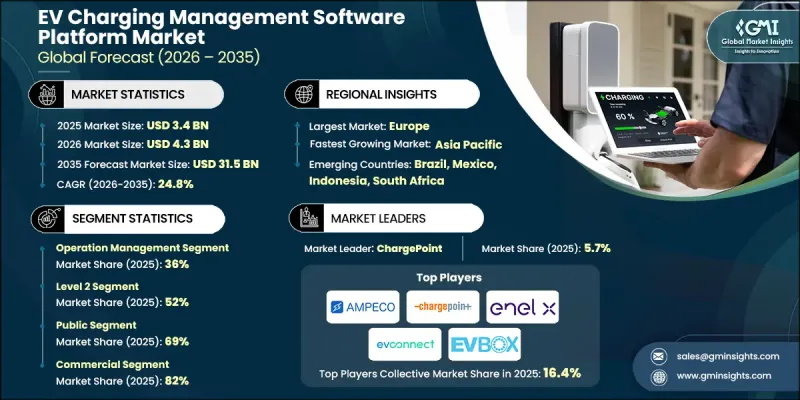
The Global EV Charging Management Software Platform Market was valued at USD 3.4 billion in 2025 and is estimated to grow at a CAGR of 24.8% to reach USD 31.5 billion by 2035.
The global EV charging management software platform industry is witnessing rapid expansion as electric vehicle adoption accelerates across multiple regions. As EV infrastructure grows, there is an increasing requirement for centralized digital platforms capable of managing complex charging networks. These software platforms enable operators to monitor charging activities, manage billing systems, authenticate users, and balance energy loads across different types of charging environments. The increasing deployment of charging infrastructure in residential, commercial, and fleet environments is creating strong demand for integrated management systems that ensure reliable and efficient operation. Public policies supporting the transition toward cleaner transportation are also contributing to market growth by encouraging the expansion of EV charging networks. As governments and organizations intensify their efforts to reduce carbon emissions and promote sustainable energy use, software platforms that support energy optimization and emissions monitoring are gaining greater importance. Technological advancements in connectivity and digital infrastructure are further strengthening the capabilities of EV charging platforms by enabling real-time analytics, predictive maintenance, and remote diagnostics. Integration with smart energy networks and advanced grid systems is allowing charging operators to manage distributed charging assets more effectively. These developments are collectively supporting the long-term growth of the EV charging management software platform market worldwide.
| Market Scope | |
|---|---|
| Start Year | 2025 |
| Forecast Year | 2026-2035 |
| Start Value | $3.4 Billion |
| Forecast Value | $31.5 Billion |
| CAGR | 24.8% |
The operation management segment accounted for 36% share in 2025 and is expected to grow at a CAGR of 24.1% from 2026 to 2035. Operation management software plays a critical role in ensuring the smooth functioning of EV charging infrastructure by providing centralized control and oversight of charging networks. These solutions allow operators to monitor station performance in real time, schedule charging sessions, and control energy distribution across multiple charging points. The software also enables early detection of operational issues by generating alerts when technical faults occur, helping operators initiate maintenance activities quickly. Detailed performance analytics provided by these platforms allow charging network operators to evaluate station utilization, optimize operational efficiency, and maintain high service availability.
The public segment held 69% share in 2025 and is projected to grow at a CAGR of 25.3% between 2026 and 2035. Public charging infrastructure requires advanced software platforms to manage a wide range of operational functions. These include user authentication, transaction processing, charging session monitoring, and network interoperability across different charging service providers. Software platforms also help operators manage electricity loads across charging points to prevent system overloads and maintain stable network performance. As public charging infrastructure expands, digital tools are increasingly used to support features such as flexible pricing models and reservation-based charging services. These capabilities allow operators to manage station capacity more efficiently while improving the overall charging experience for users.
US EV Charging Management Software Platform Market reached USD 680.6 million in 2025. In the United States, increasing EV adoption is encouraging the development of advanced software platforms that optimize charging operations and energy consumption. Charging networks across the country are increasingly integrating intelligent scheduling systems that allow charging sessions to adapt to variable electricity pricing structures. These capabilities help reduce operational costs for charging operators and EV owners while also minimizing strain on the electricity grid. The growing number of EV users is generating large volumes of operational and payment data, making data security and user privacy a critical priority for network operators. As a result, companies are investing in advanced cybersecurity technologies to ensure secure authentication and encrypted transaction systems. Collaboration between energy providers, technology developers, and infrastructure operators is also supporting the continued development of sophisticated EV charging software platforms across the US EV charging management software platform industry.
Major companies operating in the Global EV Charging Management Software Platform Market include ABB, Ampeco, Blink Charging, ChargePoint, Driivz, Enel X, EVBox, Schneider Electric, Shell Recharge Solutions, Siemens, and Tesla. Companies active in the Global EV Charging Management Software Platform Market are adopting several strategic initiatives to strengthen their competitive position and expand their technological capabilities. A primary strategy involves continuous investment in research and development to enhance software functionalities such as real-time analytics, predictive maintenance, and advanced energy management features. Many companies are also focusing on expanding cloud-based platforms that support scalable and interoperable charging network management. Strategic partnerships with energy providers, mobility service companies, and infrastructure developers are helping software providers integrate their platforms into larger transportation and energy ecosystems. Additionally, companies are enhancing cybersecurity frameworks and data protection systems to safeguard sensitive user information.
Table of Contents
Chapter 1 Methodology
- 1.1 Research approach
- 1.2 Quality commitments
- 1.3 GMI AI policy & data integrity commitment
- 1.4 Research trail & confidence scoring
- 1.4.1 Research trail components
- 1.4.2 Scoring components
- 1.5 Data collection
- 1.5.1 Partial list of primary sources
- 1.6 Data mining sources
- 1.6.1 Paid sources
- 1.7 Base estimates and calculations
- 1.7.1 Base year calculation
- 1.8 Forecast model
- 1.9 Research transparency addendum
Chapter 2 Executive Summary
- 2.1 Industry 360° synopsis
- 2.2 Key market trends
- 2.2.1 Regional
- 2.2.2 Module
- 2.2.3 Charging type
- 2.2.4 Charging site
- 2.2.5 Application
- 2.2.6 End use
- 2.3 TAM analysis, 2026-2035
- 2.4 CXO perspectives: Strategic imperatives
Chapter 3 Industry Insights
- 3.1 Industry ecosystem analysis
- 3.1.1 Supplier landscape
- 3.1.2 Profit margin
- 3.1.3 Cost structure
- 3.1.4 Value addition at each stage
- 3.1.5 Factor affecting the value chain
- 3.1.6 Disruptions
- 3.2 Industry impact forces
- 3.2.1 Growth drivers
- 3.2.1.1 Growing adoption of electric vehicles (EVs)
- 3.2.1.2 Government policies & incentives
- 3.2.1.3 Focus on sustainability & energy optimization
- 3.2.1.4 Integration with smart grid & digital technologies
- 3.2.2 Industry pitfalls and challenges
- 3.2.2.1 High initial costs & complex implementation
- 3.2.2.2 Interoperability & standardization barriers
- 3.2.3 Market opportunities
- 3.2.3.1 Expansion into emerging regions
- 3.2.3.2 Renewable energy & grid services integration
- 3.2.3.3 AI and predictive analytics integration
- 3.2.3.4 Ecosystem partnerships & interoperable services
- 3.2.1 Growth drivers
- 3.3 Growth potential analysis
- 3.4 Regulatory landscape
- 3.4.1 North America
- 3.4.1.1 U.S. Department of Energy
- 3.4.1.2 SAE International / American National Standards Institute (ANSI)
- 3.4.2 Europe
- 3.4.2.1 European Commission
- 3.4.2.2 CharIN / Eurovent Certita Certification
- 3.4.3 Asia Pacific
- 3.4.3.1 BCA - Building and Construction Authority (Singapore)
- 3.4.3.2 JIS - Japanese Industrial Standards
- 3.4.4 Latin America
- 3.4.4.1 Associacao Brasileira de Normas Tecnicas
- 3.4.4.2 Comision Nacional de Energia
- 3.4.5 Middle East & Africa
- 3.4.5.1 UAE Ministry of Energy and Infrastructure
- 3.4.5.2 Saudi Standards, Metrology and Quality Organization
- 3.4.1 North America
- 3.5 Porter's analysis
- 3.6 PESTEL analysis
- 3.7 Technology and innovation landscape
- 3.7.1 Current technological trends
- 3.7.2 Emerging technologies
- 3.8 Pricing Analysis (Driven by Primary Research)
- 3.8.1 Historical Price Trend Analysis
- 3.8.2 Pricing Strategy by Player Type (Premium / Value / Cost-plus)
- 3.9 Cost breakdown analysis
- 3.10 Patent analysis (Driven by Primary Research)
- 3.11 Sustainability and environmental aspects
- 3.11.1 Sustainable practices
- 3.11.2 Waste reduction strategies
- 3.11.3 Energy efficiency in production
- 3.11.4 Eco-friendly initiatives
- 3.11.5 Carbon footprint considerations
- 3.12 Impact of AI & Generative AI on the Market
- 3.12.1 AI-Driven Disruption of Existing Business Models
- 3.12.2 GenAI Use Cases & Adoption Roadmap by Segment
- 3.12.3 Risks, limitations & regulatory considerations
- 3.13 Infrastructure & deployment landscape (driven by primary research)
- 3.13.1 Deployment penetration by region & buyer segment
- 3.13.2 Scalability constraints & infrastructure investment trends
- 3.14 Forecast assumptions & scenario analysis (Driven by Primary Research)
- 3.14.1 Base Case - key macro & industry variables driving CAGR
- 3.14.2 Optimistic Scenarios - Favorable macro and industry tailwinds
- 3.14.3 Pessimistic Scenario - Macroeconomic slowdown or industry headwinds
Chapter 4 Competitive Landscape, 2025
- 4.1 Introduction
- 4.2 Company market share analysis
- 4.2.1 North America
- 4.2.2 Europe
- 4.2.3 Asia Pacific
- 4.2.4 LATAM
- 4.2.5 MEA
- 4.3 Competitive analysis of major market players
- 4.4 Competitive positioning matrix
- 4.5 Key developments
- 4.5.1 Mergers & acquisitions
- 4.5.2 Partnerships & collaborations
- 4.5.3 New product launches
- 4.5.4 Expansion plans and funding
Chapter 5 Market Estimates & Forecast, By Module, 2022 - 2035 ($Mn)
- 5.1 Key trends
- 5.2 Operation management
- 5.3 Energy management
- 5.4 Billing & payment
- 5.5 Others
Chapter 6 Market Estimates & Forecast, By Charging Type, 2022 - 2035 ($Mn)
- 6.1 Key trends
- 6.2 Level 1
- 6.3 Level 2
- 6.4 Level 3
Chapter 7 Market Estimates & Forecast, By Charging Site, 2022 - 2035 ($Mn)
- 7.1 Key trends
- 7.2 Public
- 7.3 Private
Chapter 8 Market Estimates & Forecast, By Application, 2022 - 2035 ($Mn)
- 8.1 Key trends
- 8.2 Commercial
- 8.3 Residential
Chapter 9 Market Estimates & Forecast, By End Use, 2022 - 2035 ($Mn)
- 9.1 Key trends
- 9.2 Charge point operators (CPOs)
- 9.3 Fleet operators
- 9.4 Property owners & managers
- 9.5 Utilities & energy companies
- 9.6 Automotive OEMs & dealerships
- 9.7 eMobility service providers (eMSPs)
Chapter 10 Market Estimates & Forecast, By Region, 2022 - 2035 ($Mn)
- 10.1 Key trends
- 10.2 North America
- 10.2.1 US
- 10.2.2 Canada
- 10.3 Europe
- 10.3.1 Germany
- 10.3.2 UK
- 10.3.3 France
- 10.3.4 Italy
- 10.3.5 Spain
- 10.3.6 Nordics
- 10.3.7 Russia
- 10.3.8 Poland
- 10.3.9 Romania
- 10.4 Asia Pacific
- 10.4.1 China
- 10.4.2 India
- 10.4.3 Japan
- 10.4.4 South Korea
- 10.4.5 ANZ
- 10.4.6 Vietnam
- 10.4.7 Indonesia
- 10.5 Latin America
- 10.5.1 Brazil
- 10.5.2 Mexico
- 10.5.3 Argentina
- 10.6 MEA
- 10.6.1 South Africa
- 10.6.2 Saudi Arabia
- 10.6.3 UAE
Chapter 11 Company Profiles
- 11.1 Global companies
- 11.1.1 ABB
- 11.1.2 Blink Charging
- 11.1.3 Bosch
- 11.1.4 ChargePoint
- 11.1.5 Driivz
- 11.1.6 Enel X
- 11.1.7 EVBox
- 11.1.8 Schneider Electric
- 11.1.9 Shell Recharge Solutions
- 11.1.10 Siemens
- 11.1.11 Tesla
- 11.2 Regional players
- 11.2.1 Ampeco
- 11.2.2 AmpUp
- 11.2.3 ChargeLab
- 11.2.4 Current
- 11.2.5 EV Connect
- 11.2.6 Greenlots
- 11.2.7 Pod Point
- 11.2.8 Virta
- 11.3 Emerging players
- 11.3.1 Lincoln
- 11.3.2 ElectreeFi
- 11.3.3 Landis+Gyr
- 11.3.4 Touch

