PUBLISHER: Global Market Insights Inc. | PRODUCT CODE: 1998687

PUBLISHER: Global Market Insights Inc. | PRODUCT CODE: 1998687
Battery Thermal Management System Market Opportunity, Growth Drivers, Industry Trend Analysis, and Forecast 2026 - 2035
The Global Battery Thermal Management System Market was valued at USD 4.2 billion in 2025 and is estimated to grow at a CAGR of 12.7% to reach USD 13.2 billion by 2035.
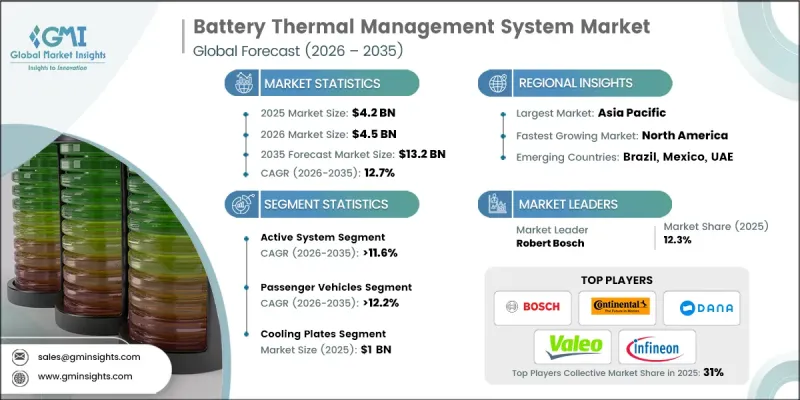
Expansion within the battery thermal management system industry is supported by the growing adoption of electric vehicles, increasing demand for advanced battery storage technologies, strict safety standards for battery operation, and the rapid development of renewable energy infrastructure. Automotive manufacturers, battery developers, and energy storage providers are investing heavily in advanced thermal management solutions to improve battery performance, extend operational lifespan, and ensure safe functionality. The rapid expansion of electric mobility, large-scale battery storage installations, and high-capacity battery packs is further strengthening demand for efficient thermal management technologies. As battery capacity increases and power density rises, maintaining stable operating temperatures becomes critical for preventing degradation and ensuring reliable energy output. Consequently, advanced battery thermal management systems are becoming essential components in modern energy storage and electric mobility ecosystems.
| Market Scope | |
|---|---|
| Start Year | 2025 |
| Forecast Year | 2026-2035 |
| Start Value | $4.2 Billion |
| Forecast Value | $13.2 Billion |
| CAGR | 12.7% |
The growing need to maintain temperature stability in high-performance battery systems is encouraging the deployment of more advanced thermal management technologies across multiple industries. Manufacturers and system integrators are increasingly focusing on solutions that enable efficient heat dissipation, reduce overheating risks, and enhance energy efficiency. Modern battery thermal management systems incorporate features such as real-time temperature monitoring, intelligent cooling mechanisms, and advanced materials designed to regulate thermal conditions. Recent technological developments, including improved cooling architectures, intelligent monitoring platforms, and integrated battery control technologies, are reshaping conventional battery management approaches while enhancing operational safety and reliability.
The active system segment held a 47% share in 2025, and it is expected to grow at a CAGR of 11.6% between 2026 and 2035. This segment plays a vital role in actively maintaining optimal battery temperatures, which directly influences battery safety, efficiency, and operational lifespan. With the increasing use of high-capacity lithium-ion and next-generation battery technologies in electric mobility and energy storage systems, active cooling approaches have become essential for maintaining consistent performance. These systems provide continuous temperature regulation and improve energy efficiency, which is critical for ensuring stable battery operation across various applications worldwide.
The passenger vehicles segment held 76% share in 2025, and it is estimated to grow at a CAGR of 12.2% during 2026-2035. The strong performance of this segment is largely attributed to the increasing production and adoption of electric and hybrid passenger vehicles globally. Consumers and manufacturers are prioritizing improved battery efficiency, longer battery lifespan, enhanced thermal stability, and consistent vehicle performance. As a result, advanced battery thermal management technologies are being widely integrated into passenger vehicles to maintain optimal battery operating conditions and support reliable vehicle operation. Increasing standardization of integrated battery thermal management systems across different vehicle categories is further strengthening the leadership of this segment across global markets.
China Battery Thermal Management System Market held a 55% share, generating USD 1,108.8 million in 2025. The country plays a significant role in the battery thermal management system industry due to its strong electric vehicle manufacturing ecosystem and well-established battery supply chain infrastructure. The presence of major automotive manufacturers and battery suppliers has accelerated the development and deployment of advanced thermal management solutions within the region. Close collaboration between automotive companies and technology providers continues to support improvements in battery safety, operational efficiency, and long-term performance while ensuring compliance with strict energy efficiency and safety regulations.
Major companies operating in the Global Battery Thermal Management System Market include Robert Bosch, Continental, BorgWarner, Denso, Valeo, Dana, MAHLE, Hanon Systems, Infineon Technologies, and Hitachi Astemo. Companies participating in the Global Battery Thermal Management System Market are implementing a range of strategic initiatives to strengthen their competitive position and expand their market presence. Leading manufacturers are investing significantly in research and development to introduce advanced thermal management technologies that improve energy efficiency and battery performance. Many companies are also forming strategic partnerships with automotive manufacturers and energy storage providers to accelerate the development of integrated battery solutions. Expanding production capacity and strengthening global supply chains are key priorities to meet growing demand from the electric mobility sector. Additionally, organizations are focusing on integrating intelligent monitoring systems and advanced cooling technologies into their product portfolios. Continuous innovation, strategic collaborations, and the development of next-generation battery management technologies are helping companies reinforce their foothold in the global battery thermal management system market.
Table of Contents
Chapter 1 Methodology & Scope
- 1.1 Market scope and definition
- 1.2 Research design
- 1.2.1 Research approach
- 1.2.2 Data collection methods
- 1.3 Data mining sources
- 1.3.1 Global
- 1.3.2 Regional/Country
- 1.4 Base estimates and calculations
- 1.4.1 Base year calculation
- 1.4.2 Key trends for market estimation
- 1.5 Primary research and validation
- 1.5.1 Primary sources
- 1.6 Forecast
- 1.7 Research assumptions and limitations
Chapter 2 Executive Summary
- 2.1 Industry 360° synopsis, 2022 - 2035
- 2.2 Key market trends
- 2.2.1 Regional
- 2.2.2 Cooling method
- 2.2.3 Component
- 2.2.4 Vehicle
- 2.2.5 Battery
- 2.2.6 Propulsion
- 2.3 TAM Analysis, 2026-2035
- 2.4 CXO perspectives: Strategic imperatives
- 2.4.1 Executive decision points
- 2.4.2 Critical success factors
- 2.5 Future outlook and strategic recommendations
Chapter 3 Industry Insights
- 3.1 Industry ecosystem analysis
- 3.1.1 Supplier Landscape
- 3.1.2 Profit Margin
- 3.1.3 Cost structure
- 3.1.4 Value addition at each stage
- 3.1.5 Factor affecting the value chain
- 3.1.6 Disruptions
- 3.2 Industry impact forces
- 3.2.1 Growth drivers
- 3.2.1.1 Rising EV Adoption
- 3.2.1.2 High-Capacity Battery Packs
- 3.2.1.3 Regulatory & Safety Standards
- 3.2.1.4 Technological Advancements
- 3.2.2 Industry pitfalls and challenges
- 3.2.2.1 High Initial Cost
- 3.2.2.2 Integration Complexity
- 3.2.3 Market opportunities
- 3.2.3.1 Commercial EV & Fleet Electrification
- 3.2.3.2 Energy Storage & Renewable Integration
- 3.2.3.3 Next-Generation Battery Technologies
- 3.2.3.4 Integration with AI and IoT
- 3.2.1 Growth drivers
- 3.3 Growth potential analysis
- 3.4 Regulatory landscape
- 3.4.1 North America
- 3.4.1.1 U.S.: EPA, CARB, NHTSA Standards
- 3.4.1.2 Canada: Transport Canada, CMVSS 305
- 3.4.2 Europe
- 3.4.2.1 Germany: BMDV, Euro 6/7
- 3.4.2.2 France: Ministry of Transport, Euro 6/7
- 3.4.2.3 UK: Department for Transport, Euro 6/7
- 3.4.2.4 Italy: Ministry of Infrastructure & Transport, EV Battery Compliance
- 3.4.3 Asia Pacific
- 3.4.3.1 China: MIIT, China 6/7 Standards
- 3.4.3.2 Japan: MLIT, JIS Regulations
- 3.4.3.3 South Korea: MOLIT, KS Emission Standards
- 3.4.3.4 India: MoRTH, BS6 Norms
- 3.4.4 Latin America
- 3.4.4.1 Brazil: DENATRAN, CONAMA Standards
- 3.4.4.2 Mexico: Ministry of Communications & Transport
- 3.4.5 Middle East and Africa
- 3.4.5.1 UAE: RTA, ESMA Regulations
- 3.4.5.2 Saudi Arabia: Ministry of Transport, SASO
- 3.4.1 North America
- 3.5 Porter's analysis
- 3.6 PESTEL analysis
- 3.7 Technology and Innovation Landscape
- 3.7.1 Current technological trends
- 3.7.2 Emerging technologies
- 3.8 Pricing analysis (Driven by Primary Research)
- 3.8.1 Historical Price Trend Analysis
- 3.8.2 Pricing Strategy by Player Type (Premium / Value / Cost-Plus)
- 3.8.3 Regional Price Variation Analysis
- 3.9 Cost breakdown analysis
- 3.10 Patent landscape (Driven by Primary Research)
- 3.11 Impact of Artificial Intelligence (AI)
- 3.11.1 AI-driven disruption of existing business models
- 3.11.2 Predictive maintenance & fleet battery management AI
- 3.11.3 Automated BTMS design optimization
- 3.11.4 Supply chain AI for component demand forecasting
- 3.11.5 GenAI use cases & adoption roadmap by segment
- 3.11.5.1 Thermal module design generation
- 3.11.5.2 Battery performance optimization
- 3.11.5.3 Customer service chatbots & technical support
- 3.11.5.4 Marketing content creation
- 3.11.6 Risks, limitations & regulatory considerations
- 3.11.6.1 Data privacy in IoT-enabled BTMS
- 3.11.6.2 AI algorithm transparency requirements
- 3.11.6.3 Liability in AI-driven product failures
- 3.12 Sustainability and Environmental Aspects
- 3.12.1 Sustainable practices
- 3.12.2 Waste reduction strategies
- 3.12.3 Energy efficiency in production
- 3.12.4 Eco-friendly initiatives
- 3.12.5 Carbon footprint considerations
- 3.13 Use case scenarios
Chapter 4 Competitive Landscape, 2025
- 4.1 Introduction
- 4.2 Company market share analysis
- 4.2.1 North America
- 4.2.2 Europe
- 4.2.3 Asia Pacific
- 4.2.4 Latin America
- 4.2.5 Middle East & Africa
- 4.3 Competitive analysis of major market players
- 4.4 Competitive positioning matrix
- 4.5 Strategic outlook matrix
- 4.6 Key developments
- 4.6.1 Mergers & acquisitions
- 4.6.2 Partnerships & collaborations
- 4.6.3 New product launches
- 4.6.4 Expansion plans and funding
Chapter 5 Market Estimates & Forecast, By Cooling Method, 2022 - 2035 ($Bn, Units)
- 5.1 Key trends
- 5.2 Active system
- 5.2.1 Liquid Cooling Systems
- 5.2.2 Refrigerant-Based Cooling Systems
- 5.2.3 Thermoelectric Cooling Systems
- 5.3 Passive system
- 5.3.1 Air Cooling Systems
- 5.3.2 Heat Sink-Based Systems
- 5.3.3 Natural Convection Systems
- 5.4 Hybrid system
- 5.4.1 Active Liquid + Passive PCM Integration
- 5.4.2 Air + Liquid Hybrid Systems
- 5.4.3 Multi-Mode Adaptive Systems
Chapter 6 Market Estimates & Forecast, By Component, 2022 - 2035 ($Bn, Units)
- 6.1 Key trends
- 6.2 Cooling Plates
- 6.3 Heat Exchangers
- 6.4 Pumps & Compressors
- 6.5 Fans & Blowers
- 6.6 Thermal Sensors
- 6.7 Thermal Interface Materials
- 6.8 Others
Chapter 7 Market Estimates & Forecast, By Vehicle, 2022 - 2035 ($Bn, Units)
- 7.1 Key trends
- 7.2 Passenger vehicles
- 7.2.1 Hatchbacks
- 7.2.2 Sedans
- 7.2.3 SUV
- 7.3 Commercial vehicles
- 7.3.1 Light commercial vehicles (LCV)
- 7.3.2 Medium commercial vehicles (MCV)
- 7.3.3 Heavy commercial vehicles (HCV)
Chapter 8 Market Estimates & Forecast, By Battery, 2022 - 2035 ($Bn, Units)
- 8.1 Key trends
- 8.2 Lithium-ion battery
- 8.3 Nickel-Metal Hydride (NiMH) battery
- 8.4 Lead-acid battery
- 8.5 Solid-state battery
Chapter 9 Market Estimates & Forecast, By Propulsion, 2022 - 2035 ($Bn, Units)
- 9.1 Key trends
- 9.2 Battery Electric Vehicles (BEVs)
- 9.3 Plug-in Hybrid Electric Vehicles (PHEVs)
- 9.4 Hybrid Electric Vehicles (HEVs)
Chapter 10 Market Estimates & Forecast, By Battery Capacity, 2022 - 2035 ($Bn, Units)
- 10.1 Key trends
- 10.2 <100 KWH
- 10.3 100-200 KWH
- 10.4 200-500 KWH
- 10.5 >500 KWH
Chapter 11 Market Estimates & Forecast, By Region, 2022 - 2035 ($Bn, Units)
- 11.1 Key trends
- 11.2 North America
- 11.2.1 US
- 11.2.2 Canada
- 11.3 Europe
- 11.3.1 UK
- 11.3.2 Germany
- 11.3.3 France
- 11.3.4 Italy
- 11.3.5 Spain
- 11.3.6 Belgium
- 11.3.7 Netherlands
- 11.3.8 Sweden
- 11.4 Asia Pacific
- 11.4.1 China
- 11.4.2 India
- 11.4.3 Japan
- 11.4.4 Australia
- 11.4.5 Singapore
- 11.4.6 South Korea
- 11.4.7 Vietnam
- 11.4.8 Indonesia
- 11.5 Latin America
- 11.5.1 Brazil
- 11.5.2 Mexico
- 11.5.3 Argentina
- 11.6 MEA
- 11.6.1 UAE
- 11.6.2 South Africa
- 11.6.3 Saudi Arabia
Chapter 12 Company Profiles
- 12.1 Global Player
- 12.1.1 BorgWarner
- 12.1.2 Continental
- 12.1.3 Dana
- 12.1.4 Denso
- 12.1.5 Hanon Systems
- 12.1.6 Hitachi Astemo
- 12.1.7 Infineon Technologies
- 12.1.8 MAHLE
- 12.1.9 Robert Bosch
- 12.1.10 Valeo
- 12.2 Regional Player
- 12.2.1 Aisin Seiki
- 12.2.2 Borgers
- 12.2.3 Calsonic Kansei (KKC)
- 12.2.4 GKN Automotive
- 12.2.5 Inalfa Roof Systems
- 12.2.6 Magna International
- 12.2.7 Modine Manufacturing
- 12.2.8 Nidec
- 12.2.9 Thermo King
- 12.2.10 Webasto

