PUBLISHER: Global Market Insights Inc. | PRODUCT CODE: 1998689

PUBLISHER: Global Market Insights Inc. | PRODUCT CODE: 1998689
Duodenoscopes Market Opportunity, Growth Drivers, Industry Trend Analysis, and Forecast 2026 - 2035
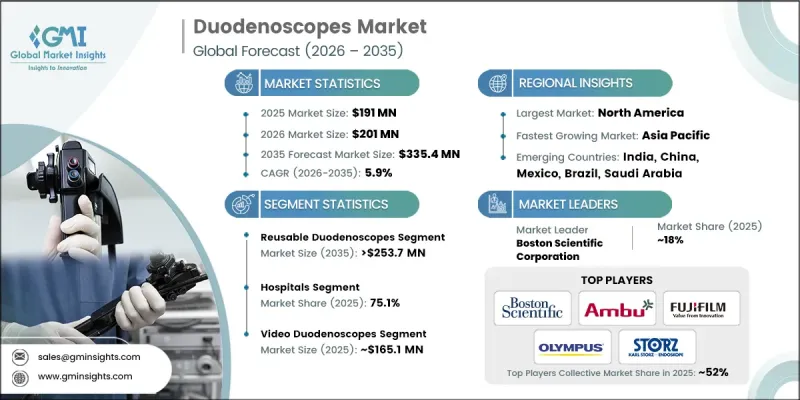
The Global Duodenoscopes Market was valued at USD 191 million in 2025 and is estimated to grow at a CAGR of 5.9% to reach USD 335.4 million by 2035.
Growth across the duodenoscope industry is supported by the rising demand for minimally invasive medical procedures, the growing prevalence of digestive system disorders, and expanding therapeutic applications of endoscopic technologies. Duodenoscopes are specialized flexible medical instruments designed to evaluate and treat conditions affecting the upper section of the small intestine. These devices are widely used in procedures that allow physicians to diagnose and manage disorders related to the digestive tract and associated organs. Increasing awareness regarding digestive health and the expansion of early screening initiatives are encouraging patients to undergo diagnostic examinations. In addition, improved access to healthcare coverage in many developed regions allows patients to utilize advanced diagnostic technologies more easily. The global aging population is also more susceptible to digestive and hepatopancreatic conditions, which continues to increase the need for specialized diagnostic equipment. Furthermore, the growing use of duodenoscopes for therapeutic interventions has expanded their clinical significance. Continuous technological improvements in imaging capabilities, safety mechanisms, and device ergonomics are also enhancing procedure outcomes and increasing adoption across healthcare facilities.
| Market Scope | |
|---|---|
| Start Year | 2025 |
| Forecast Year | 2026-2035 |
| Start Value | $191 Million |
| Forecast Value | $335.4 Million |
| CAGR | 5.9% |
The reusable duodenoscopes segment is expected to grow at a CAGR of 5.6% and is projected to reach USD 253.7 million by 2035. Reusable devices remain widely utilized in healthcare facilities with high procedural volumes because the initial investment can be offset through repeated usage over time. Medical institutions operating with constrained budgets often rely on reusable models due to their cost efficiency. Modern reusable duodenoscope designs incorporate detachable components that simplify cleaning processes and help reduce contamination risks. In addition, reusable devices equipped with high-definition visualization technologies and advanced imaging capabilities continue to play a crucial role in complex diagnostic and therapeutic procedures.
The video duodenoscopes segment generated USD 165.1 million in 2025. Video-based duodenoscopes provide enhanced visualization of the digestive tract, enabling clinicians to perform more accurate examinations and interventions. Advanced imaging technologies allow healthcare professionals to assess anatomical structures in real time, supporting improved clinical decision-making during procedures. High-quality visualization capabilities also contribute to the increased adoption of minimally invasive endoscopic procedures. Furthermore, innovations in imaging technologies and intelligent diagnostic tools are improving the precision and reliability of video duodenoscope systems. Newer device designs are also lighter and more ergonomic, which supports longer procedures and improves usability for medical professionals.
U.S. Duodenoscopes Market generated USD 74.5 million in 2025. The strong demand in the United States is supported by the high occurrence of digestive system disorders that require specialized diagnostic and therapeutic procedures. Healthcare providers in the country are increasingly adopting advanced endoscopic technologies to improve diagnostic accuracy and treatment outcomes. Continuous innovation in imaging technologies and the integration of advanced visualization capabilities are further supporting the demand for modern duodenoscope systems across hospitals and specialized medical centers.
Key companies operating in the Global Duodenoscopes Market include Olympus Corporation, Boston Scientific Corporation, Fujifilm Holdings Corporation, PENTAX MEDICAL, Ambu, Ottomed Endoscopy, SonoScape, and STORZ. Companies in the Global Duodenoscopes Market are implementing several strategic initiatives to strengthen their competitive position and expand market reach. Leading manufacturers are investing significantly in research and development to introduce advanced endoscopic technologies that improve imaging quality, safety features, and overall device performance. Many organizations are focusing on developing innovative designs that enhance infection control and simplify device reprocessing. Strategic partnerships with healthcare institutions and medical technology providers are also helping companies accelerate product adoption and expand clinical applications. In addition, manufacturers are increasing their global distribution networks and strengthening service support for healthcare facilities. Continuous product innovation, regulatory approvals in multiple regions, and the introduction of next-generation endoscopic imaging technologies are enabling companies to reinforce their presence in the duodenoscopes market.
Table of Contents
Chapter 1 Research Methodology
- 1.1 Research approach
- 1.2 Quality commitments
- 1.2.1 GMI AI policy & data integrity commitment
- 1.2.1.1 Source consistency protocol
- 1.2.1 GMI AI policy & data integrity commitment
- 1.3 Research trail & confidence scoring
- 1.3.1 Research trail components
- 1.3.2 Scoring components
- 1.4 Data collection
- 1.4.1 Partial list of primary sources
- 1.5 Data mining sources
- 1.5.1 Paid sources
- 1.5.1.1 Sources, by region
- 1.5.1 Paid sources
- 1.6 Base estimates and calculations
- 1.6.1 Base year calculation for any one approach
- 1.7 Forecast model
- 1.7.1 Quantified market impact analysis
- 1.7.1.1 Mathematical impact of growth parameters on forecast
- 1.7.1 Quantified market impact analysis
- 1.8 Research transparency addendum
- 1.8.1 Source attribution framework
- 1.8.2 Quality assurance metrics
- 1.8.3 Our commitment to trust
Chapter 2 Executive Summary
- 2.1 Industry 360° synopsis
- 2.2 Key Market Trends
- 2.2.1 Regional trends
- 2.2.2 Product type trends
- 2.2.3 Category trends
- 2.2.4 Sales channel trends
- 2.2.5 End use trends
- 2.3 CXO perspectives: Strategic imperatives
Chapter 3 Industry Insights
- 3.1 Industry ecosystem analysis
- 3.2 Industry impact forces
- 3.2.1 Growth drivers
- 3.2.1.1 Increasing prevalence of gastrointestinal diseases
- 3.2.1.2 Technological advancements in devices
- 3.2.1.3 Rising awareness and diagnosis rates
- 3.2.2 Industry pitfalls and challenges
- 3.2.2.1 High cost and stringent regulatory requirements
- 3.2.3 Market opportunities
- 3.2.3.1 Surge in integrated AI and data analytics
- 3.2.1 Growth drivers
- 3.3 Growth potential analysis
- 3.4 Regulatory landscape
- 3.5 Pipeline analysis
- 3.6 Pricing analysis, 2025 (Driven by primary research)
- 3.7 Reimbursement scenario
- 3.8 Consumer insights (Driven by primary research)
- 3.9 Technology landscape
- 3.9.1 Current technologies
- 3.9.2 Emerging technologies
- 3.10 Gap analysis
- 3.11 Impact of AI and generative AI on the market
- 3.12 Porter's analysis
- 3.13 PESTEL analysis
Chapter 4 Competitive Landscape, 2025
- 4.1 Introduction
- 4.2 Company matrix analysis
- 4.3 Company market share analysis
- 4.3.1 Global
- 4.3.2 North America
- 4.3.3 Europe
- 4.3.4 Asia Pacific
- 4.3.5 LAMEA
- 4.4 Competitive positioning matrix
- 4.5 Competitive analysis of major market players
- 4.6 Key developments
- 4.6.1 Mergers & acquisitions
- 4.6.2 Partnerships & collaborations
- 4.6.3 New product type launches
- 4.6.4 Expansion plans
Chapter 5 Market Estimates and Forecast, By Product Type, 2022 - 2035 ($ Mn)
- 5.1 Key trends
- 5.2 Reusable duodenoscopes
- 5.3 Single-use duodenoscopes
Chapter 6 Market Estimates and Forecast, By Category, 2022 - 2035 ($ Mn)
- 6.1 Key trends
- 6.2 Video duodenoscopes
- 6.3 Fiber optic duodenoscopes
Chapter 7 Market Estimates and Forecast, By Sales Channel, 2022 - 2035 ($ Mn)
- 7.1 Key trends
- 7.2 Direct sales
- 7.3 Distributors
Chapter 8 Market Estimates and Forecast, By End Use, 2022 - 2035 ($ Mn)
- 8.1 Key trends
- 8.2 Hospitals
- 8.3 Ambulatory surgical centers
- 8.4 Other end users
Chapter 9 Market Estimates and Forecast, By Region, 2022 - 2035 ($ Mn)
- 9.1 Key trends
- 9.2 North America
- 9.2.1 U.S.
- 9.2.2 Canada
- 9.3 Europe
- 9.3.1 Germany
- 9.3.2 UK
- 9.3.3 France
- 9.3.4 Spain
- 9.3.5 Italy
- 9.3.6 Netherlands
- 9.4 Asia Pacific
- 9.4.1 China
- 9.4.2 Japan
- 9.4.3 India
- 9.4.4 Australia
- 9.4.5 South Korea
- 9.5 Latin America
- 9.5.1 Brazil
- 9.5.2 Mexico
- 9.5.3 Argentina
- 9.6 Middle East and Africa
- 9.6.1 South Africa
- 9.6.2 Saudi Arabia
- 9.6.3 UAE
Chapter 10 Company Profiles
- 10.1 Ambu
- 10.2 Boston Scientific Corporation
- 10.3 Fujifilm Holdings Corporation
- 10.4 Olympus Corporation
- 10.5 Ottomed Endoscopy
- 10.6 PENTAX MEDICAL
- 10.7 SonoScape
- 10.8 STORZ

