
PUBLISHER: Global Market Insights Inc. | PRODUCT CODE: 1998698

PUBLISHER: Global Market Insights Inc. | PRODUCT CODE: 1998698
Automotive Control Cables Market Opportunity, Growth Drivers, Industry Trend Analysis, and Forecast 2026 - 2035
The Global Automotive Control Cables Market was valued at USD 5.1 billion in 2025 and is estimated to grow at a CAGR of 4.1% to reach USD 7.6 billion by 2035.
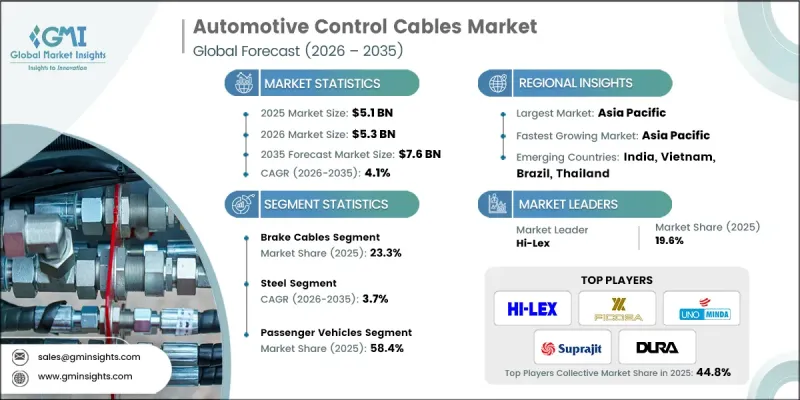
Despite the increasing shift toward vehicle electrification, the demand for automotive control cables remains stable because various mechanical systems still require cable-based mechanisms for operational functionality. Even in vehicles powered by electric drivetrains, several internal mechanical operations continue to rely on control cable systems to enable consistent movement and functionality. In addition to new vehicle production, the global aging vehicle fleet is playing a significant role in sustaining demand for replacement components. The average age of vehicles in circulation worldwide surpassed twelve years in 2023, which has contributed to higher wear rates for mechanical components such as control cables. As vehicles remain in service for longer periods, maintenance and replacement activities have become increasingly important across both developed and developing automotive markets. Consequently, replacement parts account for roughly forty percent of total automotive control cable sales in mature markets, reinforcing the importance of the aftermarket segment alongside original equipment manufacturing demand within the global automotive control cables market.
| Market Scope | |
|---|---|
| Start Year | 2025 |
| Forecast Year | 2026-2035 |
| Start Value | $5.1 Billion |
| Forecast Value | $7.6 Billion |
| CAGR | 4.1% |
Although the automotive industry is gradually adopting advanced electronic transmission technologies and digital control systems, manual transmission vehicles continue to maintain a meaningful share of global vehicle production. In 2024, vehicles equipped with manual transmissions accounted for nearly thirty percent of total global production. This continued presence supports consistent demand for clutch and gear control cables across passenger vehicles and light-duty vehicle categories. While advancements in vehicle electronics and automated systems are influencing component design, these developments are not expected to significantly reduce the overall volume of control cables required within the automotive sector.
The brake cables segment held 23.3% share in 2025 and is expected to grow at a CAGR of 5% from 2026 to 2035. Brake cable systems remain a fundamental component in vehicle safety mechanisms, which supports their continued importance across passenger and commercial vehicle categories worldwide. Regulatory frameworks focused on vehicle safety standards contribute to consistent demand for reliable braking systems that require durable control cables. In addition to original equipment demand, brake cables experience frequent wear due to regular vehicle operation, which increases the need for replacement parts throughout the lifespan of vehicles. As a result, brake cable systems contribute significantly to the overall volume of control cables sold across both OEM and aftermarket segments within the automotive control cables market.
Based on material type, the steel segment held a 44.6% share in 2025 and is projected to grow at a CAGR of 3.7% between 2026 and 2035. Steel cables remain widely preferred for automotive applications that require strong tensile performance and high load-bearing capacity to maintain reliable mechanical operation. These characteristics are particularly important in vehicle systems where durability and consistent performance are required over extended operating cycles. Steel-based cables also demonstrate strong resistance to mechanical stress and environmental conditions, making them suitable for long-term use in various vehicle platforms. Due to their established reliability and performance characteristics, automotive manufacturers continue to rely on steel control cables for large-scale vehicle production across multiple automotive segments.
China Automotive Control Cables Market held 53% share, generating USD 1.4 billion in 2025. The country represents a critical hub for automotive manufacturing due to its extensive vehicle production capacity and large installed vehicle base. High production volumes across passenger vehicles, commercial vehicles, and two-wheeler segments contribute to sustained demand for original equipment control cable systems. The continuous expansion of the vehicle population also creates substantial demand for aftermarket replacement components. Vehicles operating in densely populated urban and semi-urban environments often experience frequent start-and-stop driving conditions, which can accelerate wear in mechanical cable systems. As a result, replacement demand remains strong, reinforcing China's position as one of the most significant markets for automotive control cable production and consumption within the Asia Pacific region.
Major companies operating in the Global Automotive Control Cables Market include Atsumitec, Chuo Spring, Dura Automotive Systems, Ficosa International, Grand Rapids Controls, Hi-Lex, Kuster, Minda, Suprajit Engineering, and TSC. Companies competing in the Automotive Control Cables Market are adopting a range of strategic initiatives to strengthen their competitive positions and expand global market presence. Manufacturers are focusing on product innovation by developing advanced cable systems that offer improved durability, flexibility, and performance across diverse vehicle applications. Many companies are also investing in expanding production facilities and strengthening supply chain capabilities to support growing demand from automotive manufacturers worldwide. Strategic collaborations with vehicle manufacturers are helping suppliers integrate control cable systems into next-generation vehicle platforms. In addition, companies are expanding their aftermarket distribution networks to capture the growing demand for replacement components as the global vehicle fleet ages.
Table of Contents
Chapter 1 Methodology
- 1.1 Research approach
- 1.2 Quality Commitments
- 1.2.1 GMI AI policy & data integrity commitment
- 1.2.1.1 Source consistency protocol
- 1.2.1 GMI AI policy & data integrity commitment
- 1.3 Research Trail & Confidence Scoring
- 1.3.1 Research Trail Components
- 1.3.2 Scoring Components
- 1.4 Data Collection
- 1.4.1 Partial list of primary sources
- 1.5 Data mining sources
- 1.5.1 Paid sources
- 1.5.1.1 Sources, by region
- 1.5.1 Paid sources
- 1.6 Base estimates and calculations
- 1.6.1 Base year calculation for any one approach
- 1.7 Forecast model
- 1.7.1 Quantified market impact analysis
- 1.7.1.1 Mathematical impact of growth parameters on forecast
- 1.7.1 Quantified market impact analysis
- 1.8 Research transparency addendum
- 1.8.1 Source attribution framework
- 1.8.2 Quality assurance metrics
- 1.8.3 Our commitment to trust
Chapter 2 Executive Summary
- 2.1 Industry 360° synopsis, 2022 - 2035
- 2.2 Key market trends
- 2.2.1 Regional
- 2.2.2 Cable
- 2.2.3 Material
- 2.2.4 Vehicle
- 2.2.5 Application
- 2.2.6 Sales Channel
- 2.3 TAM Analysis, 2026-2035
- 2.4 CXO perspectives: Strategic imperatives
- 2.4.1 Executive decision points
- 2.4.2 Critical success factors
- 2.5 Future outlook and strategic recommendations
Chapter 3 Industry Insights
- 3.1 Industry ecosystem analysis
- 3.1.1 Supplier landscape
- 3.1.2 Profit margin analysis
- 3.1.3 Cost structure
- 3.1.4 Value addition at each stage
- 3.1.5 Factor affecting the value chain
- 3.1.6 Disruptions
- 3.2 Industry impact forces
- 3.2.1 Growth drivers
- 3.2.1.1 Rising global vehicle parc
- 3.2.1.2 Sustained demand for mechanical systems
- 3.2.1.3 Increasing average vehicle age
- 3.2.1.4 Growth in emerging automotive markets
- 3.2.2 Industry pitfalls and challenges
- 3.2.2.1 Shift toward electronic actuation systems
- 3.2.2.2 Price sensitivity in aftermarket
- 3.2.3 Market opportunities
- 3.2.3.1 Rising electric vehicle production
- 3.2.3.2 Expansion of organized aftermarket
- 3.2.3.3 Localization of component manufacturing
- 3.2.1 Growth drivers
- 3.3 Growth potential analysis
- 3.4 Regulatory landscape
- 3.4.1 North America
- 3.4.1.1 United States automotive safety and mechanical control component regulations
- 3.4.1.2 Federal motor vehicle safety standards related to braking and control systems
- 3.4.1.3 Vehicle durability and performance compliance requirements
- 3.4.1.4 Canada automotive component safety and quality regulations
- 3.4.2 Europe
- 3.4.2.1 European Union automotive safety and component compliance framework
- 3.4.2.2 ECE regulations for braking and mechanical control systems
- 3.4.2.3 Country level automotive component certification requirements
- 3.4.2.4 Environmental and material compliance rules for automotive cables
- 3.4.3 Asia Pacific
- 3.4.3.1 China automotive component standards and quality regulations
- 3.4.3.2 India automotive safety and component homologation standards
- 3.4.3.3 Japan vehicle safety and mechanical control system guidelines
- 3.4.3.4 South Korea automotive component quality and durability standards
- 3.4.3.5 ASEAN regional automotive component regulatory frameworks
- 3.4.4 Latin America
- 3.4.4.1 Brazil automotive safety and component compliance regulations
- 3.4.4.2 Argentina vehicle component quality requirements
- 3.4.4.3 Mexico automotive manufacturing and safety standards
- 3.4.4.4 Regional automotive component regulatory frameworks
- 3.4.5 Middle East & Africa
- 3.4.5.1 UAE automotive safety and vehicle component regulations
- 3.4.5.2 Saudi Arabia vehicle safety and mechanical system compliance
- 3.4.5.3 South Africa automotive component standards and road safety requirements
- 3.4.5.4 Regional automotive regulatory frameworks
- 3.4.1 North America
- 3.5 Porter's analysis
- 3.6 PESTEL analysis
- 3.7 Technology and innovation landscape
- 3.7.1 Current technological trends
- 3.7.2 Emerging technologies
- 3.8 Price trends
- 3.8.1 By region
- 3.8.2 By product
- 3.9 Production statistics
- 3.9.1 Production hubs
- 3.9.2 Consumption hubs
- 3.9.3 Export and import
- 3.10 Cost breakdown analysis
- 3.11 Patent analysis
- 3.12 Sustainability and environmental aspects
- 3.12.1 Sustainable practices
- 3.12.2 Waste reduction strategies
- 3.12.3 Energy efficiency in production
- 3.12.4 Eco-friendly Initiatives
- 3.12.5 Carbon footprint considerations
- 3.13 Drive by Wire Technology Substitution Threat
- 3.13.1 Electronic Throttle Control Penetration
- 3.13.2 Electronic Parking Brake Adoption Rates
- 3.13.3 Shift by Wire Transmission Systems
- 3.13.4 Cost Benefit Analysis Mechanical versus Electronic Systems
- 3.14 Geographic Manufacturing Cluster Analysis
- 3.14.1 Major Manufacturing Hubs by Region
- 3.14.2 Proximity to OEM Facility Requirements
- 3.14.3 Regional Production Capacity Distribution
- 3.14.4 Manufacturing Consolidation versus Distributed Models
- 3.15 Patent Monetization and IP Value Creation
- 3.15.1 Licensing Revenue Opportunities
- 3.15.2 Patent Portfolio Valuation
- 3.15.3 Cross Licensing Agreements
- 3.15.4 Defensive Patent Strategies
Chapter 4 Competitive Landscape, 2025
- 4.1 Introduction
- 4.2 Company market share analysis
- 4.2.1 North America
- 4.2.2 Europe
- 4.2.3 Asia Pacific
- 4.2.4 LATAM
- 4.2.5 MEA
- 4.3 Competitive analysis of major market players
- 4.4 Competitive positioning matrix
- 4.5 Strategic outlook matrix
- 4.6 Key developments
- 4.6.1 Mergers & acquisitions
- 4.6.2 Partnerships & collaborations
- 4.6.3 New Product Launches
- 4.6.4 Expansion Plans and funding
Chapter 5 Market Estimates & Forecast, By Cable, 2022 - 2035 (USD Mn, Units)
- 5.1 Key trends
- 5.2 Clutch cables
- 5.3 Accelerator cables
- 5.4 Brake cables
- 5.5 Gear shift cables
- 5.6 Handbrake cables
- 5.7 Throttle cables
- 5.8 Others
Chapter 6 Market Estimates & Forecast, By Material, 2022 - 2035 (USD Mn, Units)
- 6.1 Key trends
- 6.2 Steel
- 6.3 PVC (Polyvinyl Chloride)
- 6.4 Nylon
- 6.5 Rubber coated
- 6.6 Others
Chapter 7 Market Estimates & Forecast, By Vehicle, 2022 - 2035 (USD Mn, Units)
- 7.1 Key trends
- 7.2 Passenger vehicles
- 7.2.1 Hatchback
- 7.2.2 Sedan
- 7.2.3 SUV
- 7.3 Commercial vehicles
- 7.3.1 Light Commercial Vehicles (LCV)
- 7.3.2 Medium Commercial Vehicles (MCV)
- 7.3.3 Heavy Commercial Vehicles (HCV)
- 7.4 Two-wheelers
Chapter 8 Market Estimates & Forecast, By Application, 2022 - 2035 (USD Mn, Units)
- 8.1 Key trends
- 8.2 Engine control
- 8.3 Transmission control
- 8.4 Braking system
- 8.5 HVAC system
- 8.6 Others
Chapter 9 Market Estimates & Forecast, By Sales Channel, 2022 - 2035 (USD Mn, Units)
- 9.1 Key trends
- 9.2 OEM
- 9.3 Aftermarket
Chapter 10 Market Estimates & Forecast, By Region, 2022 - 2035 (USD Mn, Units)
- 10.1 Key trends
- 10.2 North America
- 10.2.1 US
- 10.2.2 Canada
- 10.3 Europe
- 10.3.1 Germany
- 10.3.2 UK
- 10.3.3 France
- 10.3.4 Italy
- 10.3.5 Spain
- 10.3.6 Russia
- 10.3.7 Norway
- 10.3.8 Netherlands
- 10.3.9 Sweden
- 10.4 Asia Pacific
- 10.4.1 China
- 10.4.2 India
- 10.4.3 Japan
- 10.4.4 Australia
- 10.4.5 South Korea
- 10.4.6 Singapore
- 10.4.7 Thailand
- 10.4.8 Indonesia
- 10.4.9 Vietnam
- 10.5 Latin America
- 10.5.1 Brazil
- 10.5.2 Mexico
- 10.5.3 Argentina
- 10.6 MEA
- 10.6.1 South Africa
- 10.6.2 Saudi Arabia
- 10.6.3 UAE
- 10.6.4 Turkey
Chapter 11 Company Profiles
- 11.1 Global Players
- 11.1.1 Atsumitec
- 11.1.2 Cofle
- 11.1.3 Dura Automotive Systems
- 11.1.4 Ficosa International
- 11.1.5 Hi-Lex
- 11.1.6 Kuster
- 11.1.7 Kyung Chang Industrial
- 11.1.8 Nippon Cable System
- 11.1.9 Sila
- 11.1.10 Suprajit Engineering
- 11.2 Regional Players
- 11.2.1 Cable Manufacturing & Assembly
- 11.2.2 Cablecraft Motion Controls
- 11.2.3 Chuo Spring
- 11.2.4 GEMO
- 11.2.5 Grand Rapids Controls
- 11.2.6 Minda
- 11.2.7 Tata AutoComp Systems
- 11.2.8 Thai Steel Cable
- 11.2.9 WR Controls
- 11.3 Emerging Players / Disruptors
- 11.3.1 Acey Engineering
- 11.3.2 Kalpa Industries
- 11.3.3 KALTROL
- 11.3.4 Premier Auto Cables
- 11.3.5 Remsons Industries
- 11.3.6 Silco Automotive Solutions

