PUBLISHER: Global Market Insights Inc. | PRODUCT CODE: 1998706

PUBLISHER: Global Market Insights Inc. | PRODUCT CODE: 1998706
Aerospace Titanium Market Opportunity, Growth Drivers, Industry Trend Analysis, and Forecast 2026 - 2035
The Global Aerospace Titanium Market was valued at USD 3.1 billion in 2025 and is estimated to grow at a CAGR of 8.6% to reach USD 7.2 billion by 2035.
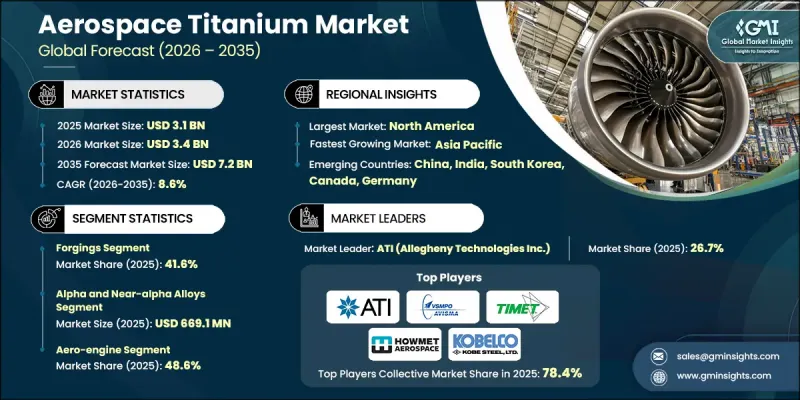
Market expansion is driven by increasing aircraft production worldwide and the growing adoption of titanium in aerospace manufacturing due to its exceptional strength-to-weight ratio. Titanium materials are widely utilized in aerospace applications because they offer durability, corrosion resistance, and structural reliability while maintaining lightweight performance. The market is also benefiting from the expansion of military aviation initiatives and increasing investments in next-generation aircraft development programs. In addition, the integration of additive manufacturing technologies for complex titanium components is transforming the aerospace production landscape by enabling precise fabrication and reducing material waste. Growing global interest in space exploration and satellite development programs is further contributing to the rising demand for advanced titanium materials. These factors collectively strengthen the market outlook as aerospace manufacturers seek materials capable of supporting high-performance aircraft structures while improving operational efficiency and reducing overall aircraft weight.
| Market Scope | |
|---|---|
| Start Year | 2025 |
| Forecast Year | 2026-2035 |
| Start Value | $3.1 Billion |
| Forecast Value | $7.2 Billion |
| CAGR | 8.6% |
Increasing aircraft production rates globally are significantly influencing the aerospace titanium market as commercial aircraft manufacturers expand manufacturing capacities to address existing delivery backlogs. Titanium materials are increasingly incorporated into aircraft structures to enhance performance and structural reliability while maintaining weight efficiency. The use of recycled titanium in certified aerospace manufacturing processes is also gradually increasing as manufacturers focus on improving sustainability and reducing material costs. The expansion of titanium recycling practices helps reduce reliance on primary raw materials, supports environmentally responsible manufacturing practices, and contributes to improved supply chain efficiency within the aerospace sector.
The forgings segment accounted for 41.6% share in 2025. Titanium forgings are widely preferred in aerospace manufacturing because they deliver superior mechanical strength, structural consistency, and long-term durability for critical components subjected to demanding operating conditions. Their ability to tolerate high stress, fatigue loads, and temperature fluctuations makes them essential for aerospace structures requiring high reliability. Titanium forgings remain a key material solution for various structural and mechanical applications in the aerospace industry. Sustained demand from both commercial aviation programs and defense-related aircraft production continues to drive consistent utilization of titanium forgings across global aerospace supply chains.
The alpha and near-alpha titanium alloys segment generated USD 669.1 million in 2025. These alloys are widely used in aerospace engineering because they provide excellent resistance to high temperatures, corrosion, and fatigue stress. Their mechanical stability and strong performance under demanding operating environments make them highly suitable for critical aerospace components. In addition, these alloys demonstrate strong machinability and compatibility with modern aerospace manufacturing technologies, supporting their widespread adoption across commercial aviation and defense aircraft programs. Their reliability and material efficiency continue to position alpha and near-alpha titanium alloys as important materials within the broader aerospace titanium market.
North America Aerospace Titanium Market accounted for 45% share in 2025. Market growth in this region is supported by increasing aircraft production activities, continuous defense modernization programs, and rising demand for advanced lightweight materials in aviation manufacturing. Aerospace manufacturers and Tier-1 suppliers across the region are expanding the use of advanced titanium alloys, titanium forgings, and additive manufacturing technologies to enhance aircraft performance and efficiency. Governments and aerospace organizations are investing in advanced manufacturing facilities and strengthening supply chains to support higher production rates. These investments are helping the region maintain a strong position in the global aerospace titanium market while supporting future aerospace manufacturing expansion.
Major companies operating in the Global Aerospace Titanium Market include Carpenter Technology Corporation, Allegheny Technologies Inc. (ATI), Kobe Steel, Ltd., Nippon Steel Corporation, Titanium Metals Corporation (TIMET), PJSC VSMPO-AVISMA Corporation, Howmet, Aubert & Duval, Acnis International, Dynamic Metals Ltd., Plymouth Tube Company USA, Gould Alloys, Supra Alloys, AEM Metal, and Shaanxi Dongyu Titanium Industry Co., Ltd. Companies operating in the aerospace titanium market are adopting multiple strategic initiatives to strengthen their competitive position and expand their global presence. Industry participants are investing heavily in research and development to improve titanium alloy performance and develop advanced manufacturing techniques such as additive manufacturing and precision forging. Strategic collaborations with aerospace manufacturers and supply chain partners are helping companies secure long-term supply agreements and expand production capabilities. Firms are also focusing on sustainability initiatives by increasing the use of recycled titanium and implementing efficient material recovery systems.
Table of Contents
Chapter 1 Methodology and Scope
- 1.1 Market scope and definition
- 1.2 Research design
- 1.2.1 Research approach
- 1.2.2 Data collection methods
- 1.3 Data mining sources
- 1.3.1 Global
- 1.3.2 Regional/Country
- 1.4 Base estimates and calculations
- 1.4.1 Base year calculation
- 1.4.2 Key trends for market estimation
- 1.5 Primary research and validation
- 1.5.1 Primary sources
- 1.6 Forecast model
- 1.7 Research assumptions and limitations
Chapter 2 Executive Summary
- 2.1 Industry 360° synopsis, 2022 - 2035
- 2.2 Key market trends
- 2.2.1 Physical form trends
- 2.2.2 Alloy type trends
- 2.2.3 Application trends
- 2.2.4 End-use industry trends
- 2.2.5 Regional trends
- 2.3 TAM Analysis, 2026-2035
- 2.4 CXO perspectives: Strategic imperatives
- 2.4.1 Executive decision points
- 2.4.2 critical success factors
- 2.5 Future outlook and strategic recommendations
Chapter 3 Industry Insights
- 3.1 Industry ecosystem analysis
- 3.1.1 Supplier Landscape
- 3.1.2 Profit Margin
- 3.1.3 Cost structure
- 3.1.4 Value addition at each stage
- 3.1.5 Factor affecting the value chain
- 3.1.6 Disruptions
- 3.2 Industry impact forces
- 3.2.1 Growth drivers
- 3.2.1.1 Rising global aircraft production rates
- 3.2.1.2 Titanium’s superior strength-to-weight ratio
- 3.2.1.3 Growth in defense aviation programs
- 3.2.1.4 Adoption of additive manufacturing for complex parts
- 3.2.1.5 Expansion of space exploration missions
- 3.2.2 Industry pitfalls and challenges
- 3.2.2.1 Supply-chain volatility and dependency
- 3.2.2.2 Stringent aerospace certification hurdles
- 3.2.3 Market opportunities
- 3.2.3.1 Hypersonic & reusable systems boost premium titanium use
- 3.2.3.2 High performance alloy innovation and recycling
- 3.2.1 Growth drivers
- 3.3 Growth potential analysis
- 3.4 Regulatory landscape
- 3.4.1 North America
- 3.4.2 Europe
- 3.4.3 Asia Pacific
- 3.4.4 Latin America
- 3.4.5 Middle East & Africa
- 3.5 Porter's analysis
- 3.6 PESTEL analysis
- 3.7 Technology and Innovation landscape
- 3.7.1 Current technological trends
- 3.7.2 Emerging technologies
- 3.8 Price trends
- 3.8.1 By region
- 3.8.2 By product
- 3.9 Pricing Strategies
- 3.10 Emerging Business Models
- 3.11 Compliance Requirements
- 3.12 Patent and IP analysis
- 3.13 Geopolitical and trade dynamics
Chapter 4 Competitive Landscape, 2025
- 4.1 Introduction
- 4.2 Company market share analysis
- 4.2.1 By region
- 4.2.1.1 North America
- 4.2.1.2 Europe
- 4.2.1.3 Asia Pacific
- 4.2.1.4 Latin America
- 4.2.1.5 Middle East & Africa
- 4.2.2 Market concentration analysis
- 4.2.1 By region
- 4.3 Competitive benchmarking of key players
- 4.3.1 Financial performance comparison
- 4.3.1.1 Revenue
- 4.3.1.2 Profit margin
- 4.3.1.3 R&D
- 4.3.2 Product portfolio comparison
- 4.3.2.1 Product range breadth
- 4.3.2.2 Technology
- 4.3.2.3 Innovation
- 4.3.3 Geographic presence comparison
- 4.3.3.1 Global footprint analysis
- 4.3.3.2 Service network coverage
- 4.3.3.3 Market penetration by region
- 4.3.4 Competitive positioning matrix
- 4.3.4.1 Leaders
- 4.3.4.2 Challengers
- 4.3.4.3 Followers
- 4.3.4.4 Niche players
- 4.3.5 Strategic outlook matrix
- 4.3.1 Financial performance comparison
- 4.4 Key developments
- 4.4.1 Mergers and acquisitions
- 4.4.2 Partnerships and collaborations
- 4.4.3 Technological advancements
- 4.4.4 Expansion and investment strategies
- 4.4.5 Digital transformation initiatives
- 4.5 Emerging/ startup competitors landscape
Chapter 5 Market Estimates and Forecast, By Physical Form, 2022 - 2035 (USD Million)
- 5.1 Key trends
- 5.2 Forgings
- 5.3 Plate
- 5.4 Sheet & strip
- 5.5 Bar & billet
- 5.6 Tubes & extrusions
- 5.7 Others (wire, casting, flash-welded rings, specialty forms / extrusions)
Chapter 6 Market Estimates and Forecast, By Alloy Type, 2022 - 2035 (USD Million)
- 6.1 Key trends
- 6.2 Commercially pure (CP) titanium (Grades: 1-4, 7, 11, 16, 17, 26, 27)
- 6.3 Alpha & near-alpha alloys
- 6.3.1 Ti-5Al-2.5Sn
- 6.3.2 Ti-6242 (Ti-6Al-2Sn-4Zr-2Mo)
- 6.4 Alpha-beta alloys
- 6.4.1 Ti-6Al-4V
- 6.4.2 Ti-6Al-4V ELI
- 6.4.3 Other alpha-beta alloys (Ti-3Al-2.5V, Ti-6Al-7Nb, Ti-6-22-22)
- 6.5 Beta & metastable beta alloys (Ti-10V-2Fe-3Al, Ti-15V-3Al-3Cr-3Sn, Ti-17, Beta-21S)
- 6.6 Titanium aluminides (gamma-TiAl)
Chapter 7 Market Estimates and Forecast, By Application, 2022 - 2035 (USD Million)
- 7.1 Key trends
- 7.2 Aero-engine applications
- 7.2.1 Rotating components (fan blades, compressor blades, discs, rotors)
- 7.2.2 Static engine components (casings, frames, vanes)
- 7.2.3 Engine nacelles & thrust reversers
- 7.3 Airframe structural applications
- 7.3.1 Primary structures (wing forgings, bulkheads, frames)
- 7.3.2 Attachment & interface components
- 7.3.3 Landing systems (landing gear, struts, actuators)
- 7.4 Fasteners, springs & hydraulic systems
- 7.5 Space & launch vehicle applications
- 7.5.1 Pressure vessels & COPV liners
- 7.5.2 Cryogenic systems (LOX, LH2, LCH4 hardware)
- 7.5.3 Rocket & satellite structures
Chapter 8 Market Estimates and Forecast, By End-use Industry, 2022 - 2035 (USD Million)
- 8.1 Key trends
- 8.2 Commercial
- 8.3 Government and defense
Chapter 9 Market Estimates and Forecast, By Region, 2022 - 2035 (USD Million)
- 9.1 Key trends
- 9.2 North America
- 9.2.1 U.S.
- 9.2.2 Canada
- 9.3 Europe
- 9.3.1 Germany
- 9.3.2 UK
- 9.3.3 France
- 9.3.4 Spain
- 9.3.5 Italy
- 9.3.6 Russia
- 9.4 Asia Pacific
- 9.4.1 China
- 9.4.2 India
- 9.4.3 Japan
- 9.4.4 Australia
- 9.4.5 South Korea
- 9.5 Latin America
- 9.5.1 Brazil
- 9.5.2 Mexico
- 9.5.3 Argentina
- 9.6 Middle East and Africa
- 9.6.1 South Africa
- 9.6.2 Saudi Arabia
- 9.6.3 UAE
Chapter 10 Company Profiles
- 10.1 Global Key Players
- 10.1.1 PJSC VSMPO AVISMA Corporation
- 10.1.2 Titanium Metals Corporation (TIMET)
- 10.1.3 Kobe Steel, Ltd.
- 10.1.4 Howmet
- 10.2 Regional key players
- 10.2.1 North America
- 10.2.1.1 ATI (Allegheny Technologies Inc.)
- 10.2.1.2 Plymouth Tube Company USA
- 10.2.1.3 Carpenter Technology Corporation
- 10.2.2 Asia Pacific
- 10.2.2.1 Shaanxi Dongyu Titanium Industry Co., Ltd.
- 10.2.2.2 Nippon Steel Corporation
- 10.2.3 Europe
- 10.2.3.1 Aubert & Duval
- 10.2.3.2 Supra Alloys
- 10.2.3.3 AEM Metal
- 10.2.1 North America
- 10.3 Niche Players/Disruptors
- 10.3.1 Dynamic Metals Ltd.
- 10.3.2 Acnis International
- 10.3.3 Gould Alloys

