
PUBLISHER: Global Market Insights Inc. | PRODUCT CODE: 1998707

PUBLISHER: Global Market Insights Inc. | PRODUCT CODE: 1998707
Women Health Devices Market Opportunity, Growth Drivers, Industry Trend Analysis, and Forecast 2026 - 2035
The Global Women Health Devices Market was valued at USD 150.4 billion in 2025 and is estimated to grow at a CAGR of 10.2% to reach USD 389.8 billion by 2035.
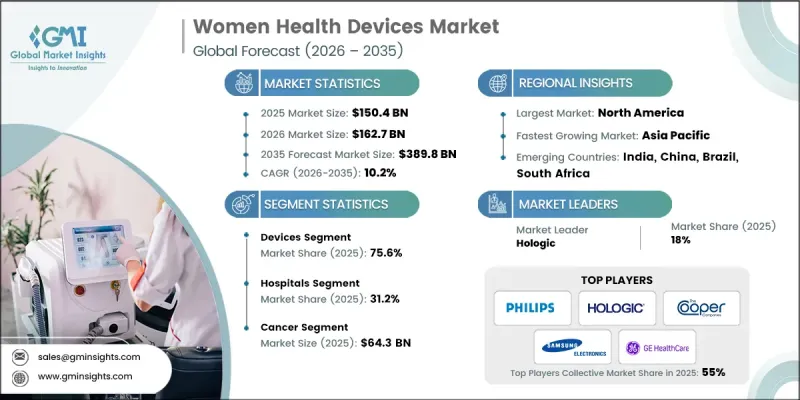
Growth in the women health devices market is fueled by the increasing incidence of health conditions that disproportionately affect women, along with a broader shift toward proactive and preventive healthcare practices. Healthcare providers and consumers are placing greater emphasis on early diagnosis, routine monitoring, and long-term disease management, which is accelerating the adoption of specialized medical technologies. Continuous progress in digital health, smart monitoring tools, and diagnostic imaging equipment is also contributing to market expansion. Modern devices designed for reproductive health, hormonal monitoring, maternal care, and long-term wellness are becoming more accessible across both clinical environments and home-care settings. In addition, improved awareness regarding reproductive health, screening programs, and wellness management is encouraging more women to utilize medical technologies tailored to their specific health needs. The expanding elderly female population is another important growth factor, as aging increases susceptibility to long-term medical conditions that require ongoing monitoring and treatment. Overall, the women health devices market represents a dedicated segment of the medical device industry focused on technologies developed to address diagnostic, therapeutic, and wellness requirements that are unique to women.
| Market Scope | |
|---|---|
| Start Year | 2025 |
| Forecast Year | 2026-2035 |
| Start Value | $150.4 Billion |
| Forecast Value | $389.8 Billion |
| CAGR | 10.2% |
The devices segment generated USD 113.7 billion in 2025 and accounted for 75.6% share. This category includes contraceptive devices, fertility monitoring devices, menstrual health products, breast health devices, pelvic health devices, maternal health products, general health monitoring devices, medical devices used in gynecological conditions, and other specialized technologies. Expansion of this segment is supported by increasing awareness among women about the importance of preventive care and routine health tracking. The availability of dedicated devices that allow individuals to monitor and manage health conditions more effectively is encouraging wider adoption. Continuous improvements in device accuracy, ease of use, and portability are also supporting demand across hospitals, clinics, and home-care environments.
Based on end use, the hospitals segment held 31.2% share in 2025. Hospitals remain a key setting for diagnosis, treatment, and surgical management of a wide range of women-specific health conditions, which contributes significantly to device demand. High patient inflow, the presence of specialized departments, and the availability of advanced treatment infrastructure continue to support the use of sophisticated medical technologies within hospital environments. These facilities rely on integrated diagnostic systems, monitoring equipment, and therapeutic devices to manage complex healthcare requirements associated with obstetric and gynecological care. In addition, hospitals operate under strict regulatory and quality-assurance standards that require the adoption of approved medical technologies designed to improve patient outcomes and ensure safety. The growing number of procedures and clinical interventions related to women's health is therefore reinforcing the demand for advanced devices within hospital settings.
North America Women Health Devices Market accounted for 32.1% share in 2025. The region continues to demonstrate strong market leadership due to its well-established healthcare infrastructure, high levels of healthcare expenditure, and a strong focus on women's health awareness initiatives. The availability of advanced diagnostic technologies, specialized healthcare facilities, and supportive regulatory frameworks further contributes to regional growth. Healthcare providers across the region are increasingly integrating innovative medical technologies into routine care to improve disease detection, monitoring, and treatment outcomes. In addition, continued investments in research, clinical development, and digital healthcare platforms are accelerating the adoption of next-generation medical devices tailored for women's health. These factors collectively position North America as a key contributor to the ongoing expansion of the women health devices market over the forecast period.
Several major companies are actively participating in the Global Women Health Devices Market, including Allengers, Ava Women, Caldera Medical, Carestream Health, Garmin Ltd., GE Healthcare Technologies, HeraMED, Hologic, Koninklijke Philips N.V., Mankind Pharma Limited, Pregnabit, Samsung Electronics, and The Cooper Companies. Companies operating in the Global Women Health Devices Market are adopting multiple strategic initiatives to strengthen their competitive position and expand global presence. Leading players are focusing heavily on research and development to introduce technologically advanced products with improved accuracy, connectivity, and patient usability. Strategic collaborations with healthcare providers, technology firms, and research institutions are also being pursued to accelerate innovation and expand product capabilities. Many companies are investing in digital health integration, including connected devices and data-driven healthcare platforms that enhance patient monitoring and personalized care. Geographic expansion through partnerships, distribution agreements, and regional manufacturing facilities is another key approach used to reach emerging markets.
Table of Contents
Chapter 1 Methodology and Scope
- 1.1 Market scope and definition
- 1.2 Research design
- 1.2.1 Research approach
- 1.2.2 Data collection methods
- 1.3 Data mining sources
- 1.3.1 Global
- 1.3.2 Regional/Country
- 1.4 Base estimates and calculations
- 1.4.1 Base year calculation
- 1.4.2 Key trends for market estimation
- 1.5 Primary research and validation
- 1.5.1 Primary sources
- 1.6 Forecast model
- 1.7 Research assumptions and limitations
Chapter 2 Executive Summary
- 2.1 Industry 360° synopsis
- 2.2 Key market trends
- 2.2.1 Regional trends
- 2.2.2 Product trends
- 2.2.3 Application trends
- 2.2.4 End use trends
- 2.3 CXO perspectives: Strategic imperatives
Chapter 3 Industry Insights
- 3.1 Industry ecosystem analysis
- 3.2 Industry impact forces
- 3.2.1 Growth drivers
- 3.2.1.1 Increasing disease burden among women
- 3.2.1.2 Rising elderly female population
- 3.2.1.3 Technological advancements in healthcare
- 3.2.1.4 Increasing awareness regarding women’s health in developing countries
- 3.2.2 Industry pitfalls and challenges
- 3.2.2.1 High cost of devices and procedures
- 3.2.2.2 Stringent regulatory guidelines for new devices
- 3.2.3 Market opportunities
- 3.2.3.1 Growing demand for home-based and remote monitoring solutions for women’s health
- 3.2.3.2 Rising adoption of wearable devices for menstrual and hormonal health tracking
- 3.2.1 Growth drivers
- 3.3 Growth potential analysis
- 3.4 Regulatory landscape
- 3.4.1 North America
- 3.4.2 Europe
- 3.4.3 Asia Pacific
- 3.5 Technological advancements
- 3.5.1 Current technological trends
- 3.5.2 Emerging technologies
- 3.6 Pricing analysis, 2024
- 3.7 Future market trends
- 3.8 Impact of AI and generative AI on the market
- 3.9 Porter's analysis
- 3.10 PESTEL analysis
Chapter 4 Competitive Landscape, 2024
- 4.1 Introduction
- 4.2 Company market share analysis
- 4.3 Company matrix analysis
- 4.4 Competitive analysis of major market players
- 4.5 Competitive positioning matrix
- 4.6 Key developments
- 4.6.1 Mergers and acquisitions
- 4.6.2 Partnerships and collaborations
- 4.6.3 New product launches
- 4.6.4 Expansion plans
Chapter 5 Market Estimates and Forecast, By Product, 2022 - 2035 ($ Mn)
- 5.1 Key trends
- 5.2 Devices
- 5.2.1 Contraceptive devices
- 5.2.2 Fertility monitoring devices
- 5.2.3 Menstrual health products
- 5.2.4 Breast health devices
- 5.2.5 Pelvic health devices
- 5.2.6 Maternal health products
- 5.2.7 General health monitoring devices
- 5.2.8 Medical devices for gynecological conditions
- 5.2.9 Other devices
- 5.3 Consumables
Chapter 6 Market Estimates and Forecast, By Application, 2022 - 2035 ($ Mn)
- 6.1 Key trends
- 6.2 Cancer
- 6.3 Osteoporosis
- 6.4 Infectious disease
- 6.5 Uterine fibroids
- 6.6 Pregnancy
- 6.7 Female sterilization
- 6.8 Menstrual disorders
- 6.9 Other applications
Chapter 7 Market Estimates and Forecast, By End Use, 2022 - 2035 ($ Mn)
- 7.1 Key trends
- 7.2 Hospitals
- 7.3 Obstetrics and gynecology clinics
- 7.4 Diagnostic laboratories
- 7.5 Ambulatory surgical centers
- 7.6 Other end users
Chapter 8 Market Estimates and Forecast, By Region, 2022 - 2035 ($ Mn)
- 8.1 Key trends
- 8.2 North America
- 8.2.1 U.S.
- 8.2.2 Canada
- 8.3 Europe
- 8.3.1 Germany
- 8.3.2 UK
- 8.3.3 France
- 8.3.4 Spain
- 8.3.5 Italy
- 8.3.6 Netherlands
- 8.4 Asia Pacific
- 8.4.1 China
- 8.4.2 India
- 8.4.3 Japan
- 8.4.4 Australia
- 8.4.5 South Korea
- 8.5 Latin America
- 8.5.1 Brazil
- 8.5.2 Mexico
- 8.5.3 Argentina
- 8.6 Middle East and Africa
- 8.6.1 Saudi Arabia
- 8.6.2 South Africa
- 8.6.3 UAE
Chapter 9 Company Profiles
- 9.1 Allengers
- 9.2 Ava Women
- 9.3 Caldera Medical
- 9.4 Carestream Health
- 9.5 Garmin Ltd.
- 9.6 GE Healthcare Technologies
- 9.7 HeraMED
- 9.8 Hologic
- 9.9 Koninklijke Philips N.V.
- 9.10 Mankind Pharma Limited
- 9.11 Pregnabit
- 9.12 Samsung Electronics
- 9.13 The Cooper Companies

