
PUBLISHER: Global Market Insights Inc. | PRODUCT CODE: 1998709

PUBLISHER: Global Market Insights Inc. | PRODUCT CODE: 1998709
Quenching Fluids and Salts Market Opportunity, Growth Drivers, Industry Trend Analysis, and Forecast 2026 - 2035
The Global Quenching Fluids & Salts Market was valued at USD 2.1 billion in 2025 and is estimated to grow at a CAGR of 5.2% to reach USD 3.6 billion by 2035.
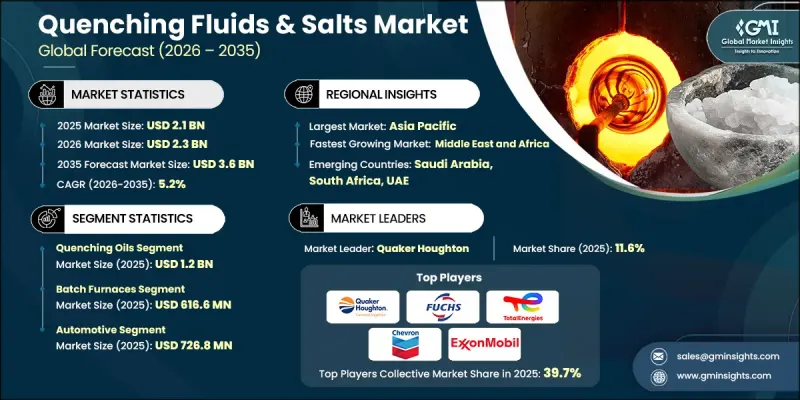
Quenching fluids and salts play a central role in heat treatment processes by rapidly cooling heated metals so that they achieve desired mechanical characteristics such as improved hardness and structural strength. These materials enable controlled cooling that directly influences the microstructure, durability, and dimensional stability of treated metals. Over time, heat treatment operations have increasingly transitioned toward technologically advanced quenching systems designed to improve efficiency and consistency in industrial production. Modern quenching technologies emphasize improved cooling control, operational safety, and enhanced process reliability. Manufacturers are introducing innovative formulations that support more precise thermal management and minimize operational challenges associated with rapid cooling processes. The market is also witnessing the development of environmentally considerate quenching solutions designed to meet evolving sustainability standards. In addition, growing integration of automation and digital process monitoring within heat treatment systems is helping facilities achieve better temperature regulation, repeatability, and productivity. These developments collectively strengthen the role of quenching fluids and salts in supporting the performance and reliability of heat-treated components used across multiple manufacturing environments.
| Market Scope | |
|---|---|
| Start Year | 2025 |
| Forecast Year | 2026-2035 |
| Start Value | $2.1 Billion |
| Forecast Value | $3.6 Billion |
| CAGR | 5.2% |
The quenching oils segment generated USD 1.2 billion in 2025. Quenching oils remain widely used in heat treatment operations because they provide reliable cooling characteristics and consistent metallurgical performance. Their ability to deliver controlled cooling makes them suitable for a wide range of heat treatment systems and metallurgical requirements. Industry trends indicate rising interest in optimized oil formulations designed to provide faster or more balanced cooling behavior for large-scale manufacturing environments. Manufacturers are increasingly focusing on advanced formulations that offer improved thermal stability, reduced evaporation, and lower emissions during operation. These developments are supporting safer industrial environments while also extending fluid life and maintaining process consistency.
The batch furnaces segment accounted for USD 616.6 million in 2025. These furnace systems are widely utilized in heat treatment facilities due to their operational flexibility and ability to process varied component sizes and production volumes. Manufacturers rely on these systems for efficient thermal processing while maintaining precise control over quenching operations. The equipment segment is evolving as industries prioritize improved production efficiency, optimized energy utilization, and compatibility with multiple quenching media. Technological advancements in furnace design are enabling better thermal uniformity, improved automation capabilities, and enhanced process reliability. Equipment suppliers are also focusing on solutions that support streamlined production workflows and consistent processing outcomes. As industrial facilities continue to modernize their heat treatment infrastructure, furnace technologies that deliver operational flexibility and stable quenching performance are expected to maintain strong demand.
United States Quenching Fluids & Salts Market reached USD 459.6 million in 2025. Market growth in the country is supported by the presence of a well-established manufacturing ecosystem that requires high-quality heat-treated components for demanding performance applications. Industrial sectors across the region continue to invest in advanced materials processing technologies to improve product reliability and durability. Meanwhile, Canada is steadily adopting modern quenching technologies as part of broader industrial modernization initiatives. Manufacturers across the region are emphasizing improved production efficiency and enhanced quality control in metal processing operations. Increasing adoption of digital manufacturing practices and automated heat treatment systems is helping companies optimize quenching processes, reduce operational errors, and control production costs more effectively. These factors collectively contribute to the continued expansion of the quenching fluids & salts market across North America.
Major companies operating in the Global Quenching Fluids & Salts Market include BP Castrol, Croda International Plc, CONDAT, Idemitsu Kosan Co., Ltd., Exxon Mobil Corporation, Petrofer Chemie, Chemtool Incorporated, FUCHS Petrolub SE, Quaker Houghton, TotalEnergies SE, Chevron Corporation, Hubbard-Hall, Park Thermal International, Metal Heat Treatment Solutions, and Savannah River Nuclear Solutions. Companies in the quenching fluids & salts market are focusing on multiple strategic initiatives to strengthen their competitive position and expand their global presence. Product innovation remains a key priority, with manufacturers investing in research and development to create advanced quenching solutions that deliver improved thermal performance, longer service life, and enhanced environmental compatibility. Strategic collaborations with equipment manufacturers and heat treatment service providers are also helping companies integrate their fluids into advanced thermal processing systems. In addition, firms are expanding production capabilities and distribution networks to serve growing industrial demand across emerging manufacturing regions.
Table of Contents
Chapter 1 Methodology & Scope
- 1.1 Market scope and definition
- 1.2 Research design
- 1.2.1 Research approach
- 1.2.2 Data collection methods
- 1.3 Data mining sources
- 1.3.1 Global
- 1.3.2 Regional/Country
- 1.4 Base estimates and calculations
- 1.4.1 Base year calculation
- 1.4.2 Key trends for market estimation
- 1.5 Primary research and validation
- 1.5.1 Primary sources
- 1.6 Forecast model
- 1.7 Research assumptions and limitations
Chapter 2 Executive Summary
- 2.1 Industry 360° synopsis
- 2.2 Key market trends
- 2.2.1 Product Type
- 2.2.2 Furnace/Equipment Type
- 2.2.3 End User Industry
- 2.2.4 Regional
- 2.3 TAM Analysis, 2026-2035
- 2.4 CXO perspectives: Strategic imperatives
- 2.4.1 Executive decision points
- 2.4.2 Critical success factors
- 2.5 Future outlook and strategic recommendations
Chapter 3 Industry Insights
- 3.1 Industry ecosystem analysis
- 3.1.1 Supplier landscape
- 3.1.2 Profit margin
- 3.1.3 Value addition at each stage
- 3.1.4 Factor affecting the value chain
- 3.1.5 Disruptions
- 3.2 Industry impact forces
- 3.2.1 Growth drivers
- 3.2.1.1 Growth of automotive and manufacturing industries
- 3.2.1.2 Rising demand for high-performance materials
- 3.2.1.3 Technological advancements in heat treatment processes
- 3.2.2 Industry pitfalls and challenges
- 3.2.2.1 Environmental and regulatory challenges
- 3.2.2.2 Risk of metallurgical defects
- 3.2.3 Market opportunities
- 3.2.3.1 Increasing adoption of polymer-based quenchants
- 3.2.3.2 Rising demand from infrastructure and energy projects
- 3.2.3.3 Demand for customized and application-specific solutions
- 3.2.1 Growth drivers
- 3.3 Growth potential analysis
- 3.4 Regulatory landscape
- 3.4.1 North America
- 3.4.2 Europe
- 3.4.3 Asia Pacific
- 3.4.4 Latin America
- 3.4.5 Middle East & Africa
- 3.5 Porter's analysis
- 3.6 PESTEL analysis
- 3.7 Technology and innovation landscape
- 3.7.1 Current technological trends
- 3.7.2 Emerging technologies
- 3.8 Price trends
- 3.8.1 By region
- 3.8.2 By product type
- 3.9 Future market trends
- 3.10 Patent landscape
- 3.11 Trade statistics (HS code)
- 3.11.1 Major importing countries
- 3.11.2 Major exporting countries
- 3.12 Sustainability and environmental aspects
- 3.12.1 Sustainable practices
- 3.12.2 Waste reduction strategies
- 3.12.3 Energy efficiency in production
- 3.12.4 Eco-friendly initiatives
- 3.13 Carbon footprint consideration
Chapter 4 Competitive Landscape, 2025
- 4.1 Introduction
- 4.2 Company market share analysis
- 4.2.1 By region
- 4.2.1.1 North America
- 4.2.1.2 Europe
- 4.2.1.3 Asia Pacific
- 4.2.1.4 LATAM
- 4.2.1.5 MEA
- 4.2.1 By region
- 4.3 Company matrix analysis
- 4.4 Competitive analysis of major market players
- 4.5 Competitive positioning matrix
- 4.6 Key developments
- 4.6.1 Mergers & acquisitions
- 4.6.2 Partnerships & collaborations
- 4.6.3 New product launches
- 4.6.4 Expansion plans
Chapter 5 Market Estimates and Forecast, By Product Type, 2022-2035 (USD Billion) (Kilo Tons)
- 5.1 Key trends
- 5.2 Quenching oils
- 5.2.1 Fast/accelerated quenching oils
- 5.2.2 Medium-speed quenching oils
- 5.2.3 Slow-speed quenching oils
- 5.2.4 Marquench/martempering
- 5.2.5 Vacuum quenching oils
- 5.2.6 Synthetic quenching oils
- 5.2.7 Others
- 5.3 Quenching salts
- 5.3.1 Nitrate-based salts
- 5.3.2 Nitrite-based salts
- 5.3.3 Chloride-based salts
- 5.3.4 Cyanide-based salts
- 5.3.5 Fluoride-based salts
- 5.3.6 Others
- 5.4 Polymer quenchants
- 5.4.1 PAG-based (polyalkylene glycol)
- 5.4.2 PVP-based (polyvinylpyrrolidone)
- 5.4.3 Others
Chapter 6 Market Estimates and Forecast, By Furnace/Equipment Type, 2022-2035 (USD Billion) (Kilo Tons)
- 6.1 Key trends
- 6.2 Batch furnaces
- 6.3 Continuous furnaces
- 6.4 Vacuum furnaces
- 6.5 Induction heating systems
- 6.6 Salt bath furnaces
- 6.7 Sealed quench furnaces
- 6.8 Others
Chapter 7 Market Estimates and Forecast, By End User Industry, 2022-2035 (USD Billion) (Kilo Tons)
- 7.1 Key trends
- 7.2 Automotive
- 7.3 Aerospace and defense
- 7.4 Construction equipment and heavy machinery
- 7.5 Tool and die manufacturing
- 7.6 Bearing manufacturing
- 7.7 Energy and power generation
- 7.8 Medical devices
- 7.9 Oil and gas
- 7.10 Rail and transportation
- 7.11 Mining
- 7.12 Others
Chapter 8 Market Estimates and Forecast, By Region, 2022-2035 (USD Billion) (Kilo Tons)
- 8.1 Key trends
- 8.2 North America
- 8.2.1 U.S.
- 8.2.2 Canada
- 8.2.3 Mexico
- 8.3 Europe
- 8.3.1 Germany
- 8.3.2 UK
- 8.3.3 France
- 8.3.4 Spain
- 8.3.5 Italy
- 8.3.6 Rest of Europe
- 8.4 Asia Pacific
- 8.4.1 China
- 8.4.2 India
- 8.4.3 Japan
- 8.4.4 Australia
- 8.4.5 South Korea
- 8.4.6 Rest of Asia Pacific
- 8.5 Latin America
- 8.5.1 Brazil
- 8.5.2 Mexico
- 8.5.3 Argentina
- 8.5.4 Rest of Latin America
- 8.6 Middle East and Africa
- 8.6.1 Saudi Arabia
- 8.6.2 South Africa
- 8.6.3 UAE
- 8.6.4 Rest of Middle East and Africa
Chapter 9 Company Profiles
- 9.1 BP Castrol
- 9.2 Chemtool Incorporated
- 9.3 Chevron Corporation
- 9.4 CONDAT
- 9.5 Croda International Plc
- 9.6 Exxon Mobil Corporation
- 9.7 FUCHS Petrolub SE
- 9.8 Hubbard-Hall
- 9.9 Idemitsu Kosan Co., Ltd.
- 9.10 Metal Heat Treatment Solutions
- 9.11 Park Thermal International
- 9.12 Petrofer Chemie
- 9.13 Quaker Houghton
- 9.14 Savannah River Nuclear Solutions
- 9.15 TotalEnergies SE

