PUBLISHER: Global Market Insights Inc. | PRODUCT CODE: 1998717

PUBLISHER: Global Market Insights Inc. | PRODUCT CODE: 1998717
Dental Sterilization Market Opportunity, Growth Drivers, Industry Trend Analysis, and Forecast 2026 - 2035
The Global Dental Sterilization Market was valued at USD 1.7 billion in 2025 and is estimated to grow at a CAGR of 7.9% to reach USD 3.6 billion by 2035.
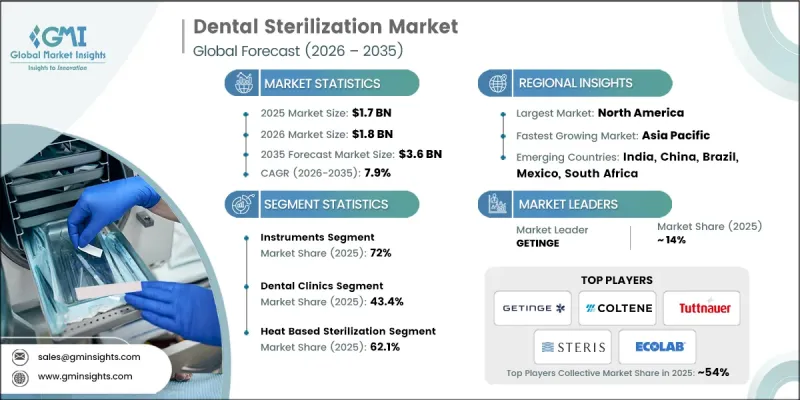
Rising numbers of dental procedures worldwide, along with strict infection prevention standards within healthcare environments, are major factors supporting this growth. Dental sterilization refers to the complete elimination of microorganisms, including bacteria, viruses, fungi, and spores, from instruments and equipment used in dental treatments. Maintaining sterile instruments is essential to prevent the spread of infections and ensure safe clinical environments. Increasing awareness regarding the risks of cross-contamination is encouraging dental clinics and hospitals to adopt advanced sterilization solutions. In addition, continuous technological improvements in sterilization equipment are improving operational efficiency and reliability within dental practices. The growing demand for dental treatments, improvements in oral healthcare infrastructure, and expanding investments in dental services are collectively driving the need for modern sterilization technologies across dental clinics, hospitals, and specialized treatment centers around the world.
| Market Scope | |
|---|---|
| Start Year | 2025 |
| Forecast Year | 2026-2035 |
| Start Value | $1.7 Billion |
| Forecast Value | $3.6 Billion |
| CAGR | 7.9% |
The demand for dental sterilization equipment is also supported by the rising prevalence of oral health conditions and the growing number of complex dental procedures performed globally. As dental clinics handle higher patient volumes, maintaining strict hygiene standards has become a critical operational priority. Sterilization processes ensure that reusable dental instruments remain free from harmful microorganisms before being used on patients. Modern sterilization technologies are helping clinics improve workflow efficiency while maintaining high safety standards. Innovations such as faster sterilization cycles, advanced low-temperature systems, and automated cleaning equipment are helping reduce equipment turnaround times and enhance clinical productivity. In addition, the growing focus on environmentally sustainable healthcare practices has encouraged the development of sterilization solutions that minimize chemical usage and energy consumption. The expansion of dental tourism and the increasing presence of organized dental service networks are also contributing to the rising demand for efficient sterilization infrastructure across global dental healthcare systems.
The consumables and accessories segment generated USD 485.7 million in 2025 and is projected to grow at a CAGR of 8.4% between 2026 and 2035. This segment continues to expand as dental practices rely heavily on disposable sterilization materials and accessories to ensure safe instrument handling and infection prevention. Sterilization packaging materials, monitoring indicators, and related supplies are used frequently within dental clinics as part of routine sterilization protocols. Continuous sterilization cycles also create ongoing demand for maintenance components and replacement items that support the performance and longevity of sterilization systems. As dental practices place greater emphasis on maintaining high hygiene standards, the consistent consumption of these products is expected to support sustained growth within the consumables and accessories segment of the dental sterilization market.
The heat-based sterilization segment accounted for 62.1% share in 2025 and is expected to reach USD 2.2 billion during 2026-2035. Heat-driven sterilization techniques are widely recognized for their ability to eliminate a broad spectrum of microorganisms from dental equipment. These systems are commonly used to sterilize instruments that require reliable microbial decontamination prior to clinical use. Their proven effectiveness and reliability have made them the preferred method for sterilizing many dental instruments used in routine procedures. Compliance with established infection control protocols within healthcare environments has encouraged dental clinics and hospitals to invest in advanced heat-based sterilization equipment. The consistent need to maintain safe treatment environments and meet regulatory hygiene standards continues to support the widespread adoption of these systems across dental healthcare facilities worldwide.
North America Dental Sterilization Market accounted for 43.3% share in 2025. The region's leadership is largely supported by its well-established dental healthcare infrastructure and strong emphasis on infection control within clinical environments. Dental practices across the region operate under comprehensive regulatory frameworks designed to ensure patient safety and hygiene standards. As a result, clinics and hospitals are required to implement effective sterilization protocols for reusable dental instruments. Compliance with these standards has encouraged healthcare providers to invest in advanced sterilization equipment and monitoring systems. In addition, the region has demonstrated early adoption of modern sterilization technologies that improve efficiency and workflow within dental clinics. Innovations in automated sterilization systems, rapid processing technologies, and digital monitoring tools are helping dental professionals maintain high hygiene standards while improving operational productivity, further supporting growth in the regional dental sterilization market.
Prominent companies operating in the Global Dental Sterilization Market include GETINGE, A-dec, Belimed, CODYSON, COLTENE, DURR DENTAL, ECOLAB, HuFriedy Group, MELAG, Midmark Corporation, PLANMECA, SciCan, STERIS, Tuttnauer, and W&H. Companies participating in the Global Dental Sterilization Market are focusing on multiple strategies to strengthen their competitive positions and expand their global presence. Many manufacturers are investing in research and development to introduce technologically advanced sterilization systems that deliver improved efficiency, faster processing cycles, and enhanced safety features. Firms are also expanding their product portfolios to include automated sterilization solutions, digital monitoring tools, and environmentally sustainable technologies that reduce energy consumption and chemical use. Strategic collaborations with dental clinics, hospitals, and healthcare distributors are helping companies broaden their market reach and improve customer access to sterilization equipment. In addition, companies are strengthening their service networks by providing maintenance support, training programs, and technical assistance to ensure reliable system performance and long-term customer relationships.
Table of Contents
Chapter 1 Research Methodology
- 1.1 Research approach
- 1.2 Quality commitments
- 1.2.1 GMI AI policy & data integrity commitment
- 1.2.1.1 Source consistency protocol
- 1.2.1 GMI AI policy & data integrity commitment
- 1.3 Research trail & confidence scoring
- 1.3.1 Research trail components
- 1.3.2 Scoring components
- 1.4 Data collection
- 1.4.1 Partial list of primary sources
- 1.5 Data mining sources
- 1.5.1 Paid sources
- 1.5.1.1 Sources, by region
- 1.5.1 Paid sources
- 1.6 Base estimates and calculations
- 1.6.1 Base year calculation for any one approach
- 1.7 Forecast model
- 1.7.1 Quantified market impact analysis
- 1.7.1.1 Mathematical impact of growth parameters on forecast
- 1.7.1 Quantified market impact analysis
- 1.8 Research transparency addendum
- 1.8.1 Source attribution framework
- 1.8.2 Quality assurance metrics
- 1.8.3 Our commitment to trust
Chapter 2 Executive Summary
- 2.1 Industry 360° synopsis
- 2.2 Key market trends
- 2.2.1 Regional trends
- 2.2.2 Product type trends
- 2.2.3 Sterilization method trends
- 2.2.4 End use trends
- 2.3 CXO perspectives: Strategic imperatives
Chapter 3 Industry Insights
- 3.1 Industry ecosystem analysis
- 3.2 Industry impact forces
- 3.2.1 Growth drivers
- 3.2.1.1 Increasing prevalence of dental disorders
- 3.2.1.2 Growth in dental procedures & cosmetic dentistry
- 3.2.1.3 Technological advancements in sterilization equipment
- 3.2.1.4 Rising awareness about cross-contamination risks
- 3.2.2 Industry pitfalls and challenges
- 3.2.2.1 High cost associated with advanced equipment
- 3.2.2.2 Risk of material damage due to sterilization
- 3.2.3 Market opportunities
- 3.2.3.1 Development of portable/compact sterilization devices
- 3.2.3.2 Integration of IoT and digital sterilization tracking
- 3.2.1 Growth drivers
- 3.3 Growth potential analysis
- 3.4 Regulatory landscape (Driven by primary research)
- 3.4.1 North America
- 3.4.2 Europe
- 3.4.3 Asia Pacific
- 3.5 Technology landscape
- 3.5.1 Current technological trends
- 3.5.2 Emerging technologies
- 3.6 Reimbursement scenario (Driven by primary research)
- 3.7 Future market trends
- 3.8 Pricing analysis, 2025 (Driven by primary research)
- 3.9 Value chain analysis
- 3.10 Porter's analysis
- 3.11 PESTEL analysis
- 3.12 Customer insights (Driven by primary research)
- 3.13 Start-up scenarios
- 3.14 Impact of AI and generative AI on the market
- 3.15 Investment landscape
- 3.16 New product development landscape
- 3.17 Gap analysis
Chapter 4 Competitive Landscape, 2025
- 4.1 Introduction
- 4.2 Company matrix analysis
- 4.3 Company market share analysis (Driven by primary research)
- 4.3.1 Global
- 4.3.2 North America
- 4.3.3 Europe
- 4.3.4 Asia Pacific
- 4.4 Competitive positioning matrix
- 4.5 Competitive analysis of major market players
- 4.6 Key developments
- 4.6.1 Mergers & acquisitions
- 4.6.2 Partnerships & collaborations
- 4.6.3 New product launches
- 4.6.4 Expansion plans
Chapter 5 Market Estimates and Forecast, By Product Type, 2022 - 2035 ($ Mn)
- 5.1 Key trends
- 5.2 Instruments
- 5.2.1 Sterilization equipment
- 5.2.1.1 High-temperature sterilizers
- 5.2.1.2 Low-temperature sterilizers
- 5.2.2 Cleaning and disinfectant equipment
- 5.2.2.1 Washer disinfectants
- 5.2.2.2 Ultrasonic cleaners
- 5.2.3 Packaging equipment
- 5.2.1 Sterilization equipment
- 5.3 Consumables and accessories
- 5.3.1 Instrument disinfectants
- 5.3.2 Surface disinfectants
- 5.3.3 Sterilization packaging accessories
- 5.3.4 Sterilization indicators
- 5.3.5 Lubrication and cleaning solutions
Chapter 6 Market Estimates and Forecast, By Sterilization Method, 2022 - 2035 ($ Mn)
- 6.1 Key trends
- 6.2 Heat based sterilization
- 6.3 Chemical based sterilization
- 6.4 Gas sterilization
- 6.5 Radiation sterilization
Chapter 7 Market Estimates and Forecast, By End Use, 2022 - 2035 ($ Mn)
- 7.1 Key trends
- 7.2 Dental clinics
- 7.3 Dental laboratories
- 7.4 Hospitals
- 7.5 Other end users
Chapter 8 Market Estimates and Forecast, By Region, 2022 - 2035 ($ Mn)
- 8.1 Key trends
- 8.2 North America
- 8.2.1 U.S.
- 8.2.2 Canada
- 8.3 Europe
- 8.3.1 Germany
- 8.3.2 UK
- 8.3.3 France
- 8.3.4 Spain
- 8.3.5 Italy
- 8.3.6 Netherlands
- 8.4 Asia Pacific
- 8.4.1 China
- 8.4.2 Japan
- 8.4.3 India
- 8.4.4 Australia
- 8.4.5 South Korea
- 8.5 Latin America
- 8.5.1 Brazil
- 8.5.2 Mexico
- 8.5.3 Argentina
- 8.6 Middle East and Africa
- 8.6.1 South Africa
- 8.6.2 Saudi Arabia
- 8.6.3 UAE
Chapter 9 Company Profiles
- 9.1 GETINGE
- 9.2 A-dec
- 9.3 Belimed
- 9.4 CODYSON
- 9.5 COLTENE
- 9.6 DURR DENTAL
- 9.7 ECOLAB
- 9.8 HuFriedy Group
- 9.9 MELAG
- 9.10 midmark
- 9.11 PLANMECA
- 9.12 SciCan
- 9.13 STERIS
- 9.14 Tuttnauer
- 9.15 W&H

