
PUBLISHER: Global Market Insights Inc. | PRODUCT CODE: 1998719

PUBLISHER: Global Market Insights Inc. | PRODUCT CODE: 1998719
DNA Data Storage Market Opportunity, Growth Drivers, Industry Trend Analysis, and Forecast 2026 - 2035
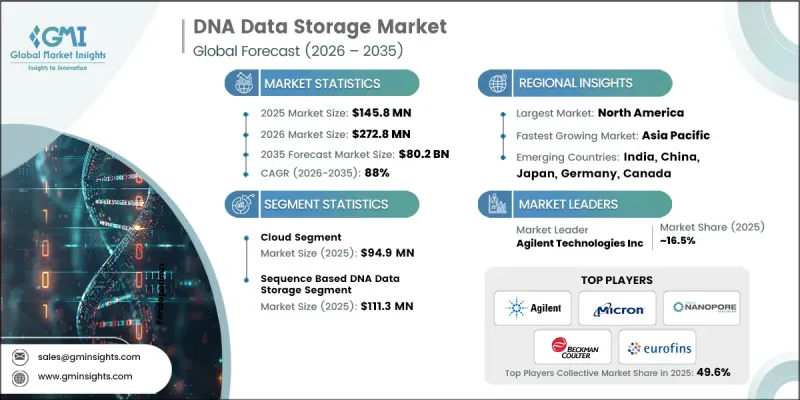
The Global DNA Data Storage Market was valued at USD 145.8 million in 2025 and is estimated to grow at a CAGR of 88% to reach USD 80.2 billion by 2035.
The rapid growth is fueled by the skyrocketing need for high-density data storage, the massive increase in global digital data generation, and breakthroughs in DNA synthesis and sequencing technologies. Organizations in healthcare, biotechnology, and research are increasingly adopting DNA-based storage to ensure long-term preservation of critical information. Traditional storage media are struggling to cope with exponentially growing data volumes, while DNA offers unmatched molecular density, durability, and scalability. Governments and standards bodies are actively supporting DNA as a next-generation archival medium, recognizing its potential to transform long-term data preservation. The surge of AI, IoT, scientific research, and online services is creating unprecedented data loads, pushing enterprises and academic institutions to explore DNA-based storage for its reliability, longevity, and compact footprint.
| Market Scope | |
|---|---|
| Start Year | 2025 |
| Forecast Year | 2026-2035 |
| Start Value | $145.8 Million |
| Forecast Value | $80.2 Billion |
| CAGR | 88% |
The cloud segment generated USD 94.9 million in 2025, offering global scalability and remote storage capabilities. Cloud-based DNA storage allows enterprises to manage large datasets without local hardware limitations while enabling secure, centralized access, real-time collaboration, and seamless integration with existing IT infrastructure. Its convenience and minimal upfront investment make it a preferred solution for managing genomic, scientific, and multimedia data. Manufacturers are focusing on delivering encrypted, scalable, multi-tenant cloud solutions with API integration to attract research organizations and enterprises requiring high-capacity archival systems.
The sequence-based DNA storage segment generated USD 111.3 million in 2025, driven by its alignment with existing sequencing technologies and bioinformatics workflows. This approach ensures reliable encoding, decoding, and retrieval of large digital datasets. Its integration with genomic research and long-term archival needs makes it particularly attractive for healthcare, biotechnology, and academic institutions. Manufacturers are emphasizing error-correction optimization, automation, and read/write accuracy improvements to appeal to large-scale research and archival clients.
North America DNA Data Storage Market held a 35.2% share in 2025. The region leads due to its advanced research facilities, substantial investments in biotech and IT, and strong government and private R&D funding. The U.S. hosts key technology companies and academic consortia focused on DNA synthesis, sequencing, and error-reduction techniques, accelerating market adoption. High digital data generation across healthcare, finance, and defense further drives demand for dense archival solutions. Collaborative projects among universities, national laboratories, and private enterprises are accelerating prototype deployments, standardization, and commercialization of DNA storage, establishing North America as the hub for innovation and early adoption.
Key players operating in the Global DNA Data Storage Market include Microsoft, Twist Bioscience, Thermo Fisher Scientific, Inc, Illumina, Inc, Agilent Technologies, Inc, Beckman Coulter, Inc., Oxford Nanopore Technologies Plc., Catalog, Helixworks Technologies, Ltd., Evonetix, BGI Group Guangdong ICP, Quantum Corporation, Iridia Inc., Molecular Assemblies, and Eurofins Scientific. Companies in the DNA data storage market are focusing on strategies to strengthen their position by expanding R&D efforts to enhance synthesis accuracy, error correction, and data retrieval efficiency. Strategic partnerships with research institutions and tech firms allow for accelerated product development and access to large-scale projects. Investment in cloud-based platforms and scalable infrastructure ensures broader adoption by enterprises requiring high-density, secure storage. Companies are also exploring automation, AI integration, and standardized workflows to optimize performance and reduce operational costs.
Table of Contents
Chapter 1 Methodology and Scope
- 1.1 Market scope and definition
- 1.2 Research design
- 1.2.1 Research approach
- 1.2.2 Data collection methods
- 1.3 Data mining sources
- 1.3.1 Global
- 1.3.2 Regional/Country
- 1.4 Base estimates and calculations
- 1.4.1 Base year calculation
- 1.4.2 Key trends for market estimation
- 1.5 Primary research and validation
- 1.5.1 Primary sources
- 1.6 Forecast model
- 1.7 Research assumptions and limitations
Chapter 2 Executive Summary
- 2.1 Industry 360° synopsis
- 2.2 Key market trends
- 2.2.1 Type trends
- 2.2.2 Technology trends
- 2.2.3 End-use industry trends
- 2.2.4 Regional trends
- 2.3 TAM Analysis, 2026 - 2035 (USD Million)
- 2.4 CXO perspectives: Strategic imperatives
- 2.4.1 Executive decision points
- 2.4.2 Critical success factors
- 2.5 Future outlook and strategic recommendations
Chapter 3 Industry Insights
- 3.1 Industry ecosystem analysis
- 3.1.1 Supplier landscape
- 3.1.2 Profit margin
- 3.1.3 Cost structure
- 3.1.4 Value addition at each stage
- 3.1.5 Factor affecting the value chain
- 3.1.6 Disruptions
- 3.2 Industry impact forces
- 3.2.1 Growth drivers
- 3.2.1.1 Increasing demand for high-density data storage
- 3.2.1.2 Rising digital data generation globally
- 3.2.1.3 Advancements in DNA synthesis and sequencing technologies
- 3.2.1.4 Long-term data preservation needs
- 3.2.1.5 Growing adoption in healthcare and biotechnology sectors
- 3.2.2 Pitfalls and challenges
- 3.2.2.1 High cost of DNA synthesis and sequencing
- 3.2.2.2 Regulatory and standardization uncertainties
- 3.2.1 Growth drivers
- 3.3 Growth potential analysis
- 3.4 Regulatory landscape
- 3.4.1 North America
- 3.4.2 Europe
- 3.4.3 Asia Pacific
- 3.4.4 Latin America
- 3.4.5 Middle East & Africa
- 3.5 Porter's analysis
- 3.6 PESTEL analysis
- 3.7 Technology and Innovation landscape
- 3.7.1 Current technological trends
- 3.7.2 Emerging technologies
- 3.8 Emerging Business Models
- 3.9 Compliance Requirements
- 3.10 Supply Chain Resilience
- 3.11 Geopolitical Analysis
Chapter 4 Competitive Landscape, 2025
- 4.1 Introduction
- 4.2 Company market share analysis
- 4.2.1 By region
- 4.2.1.1 North America
- 4.2.1.2 Europe
- 4.2.1.3 Asia Pacific
- 4.2.1.4 Latin America
- 4.2.1.5 Middle East & Africa
- 4.2.2 Market concentration analysis
- 4.2.1 By region
- 4.3 Competitive benchmarking of key players
- 4.3.1 Product portfolio comparison
- 4.3.1.1 Product range breadth
- 4.3.1.2 Technology
- 4.3.1.3 Innovation
- 4.3.2 Geographic presence comparison
- 4.3.2.1 Global footprint analysis
- 4.3.2.2 Service network coverage
- 4.3.2.3 Market penetration by region
- 4.3.3 Competitive positioning matrix
- 4.3.3.1 Leaders
- 4.3.3.2 Challengers
- 4.3.3.3 Followers
- 4.3.3.4 Niche players
- 4.3.4 Strategic outlook matrix
- 4.3.1 Product portfolio comparison
- 4.4 Key developments, 2022-2025
- 4.4.1 Mergers and acquisitions
- 4.4.2 Partnerships and collaborations
- 4.4.3 Technological advancements
- 4.4.4 Expansion and investment strategies
- 4.4.5 Sustainability initiatives
- 4.4.6 Digital transformation initiatives
- 4.5 Emerging/ startup competitors landscape
Chapter 5 Market Estimates and Forecast, By Type, 2022 - 2035 (USD Million)
- 5.1 Key trends
- 5.2 Cloud
- 5.3 On-premises
Chapter 6 Market Estimates and Forecast, By Technology, 2022 - 2035 (USD Million)
- 6.1 Key Trends
- 6.2 Sequence based DNA data storage
- 6.3 Structure based DNA data storage
Chapter 7 Market Estimates and Forecast, By End-Use Industry, 2022 - 2035 (USD Million)
- 7.1 Key Trends
- 7.2 Biotechnology and healthcare
- 7.3 Banking & finance
- 7.4 Government and defense
- 7.5 Media and entertainment
- 7.6 Others
- 7.6.1 Environmental sciences
- 7.6.2 Academic and research institutions
Chapter 8 Market Estimates and Forecast, By Region, 2022 - 2035 (USD Million)
- 8.1 Key trends
- 8.2 North America
- 8.2.1 U.S.
- 8.2.2 Canada
- 8.3 Europe
- 8.3.1 Germany
- 8.3.2 UK
- 8.3.3 France
- 8.3.4 Spain
- 8.3.5 Italy
- 8.4 Asia Pacific
- 8.4.1 China
- 8.4.2 India
- 8.4.3 Japan
- 8.4.4 Australia
- 8.4.5 South Korea
- 8.5 Latin America
- 8.5.1 Brazil
- 8.5.2 Mexico
- 8.5.3 Argentina
- 8.6 Middle East and Africa
- 8.6.1 Saudi Arabia
- 8.6.2 South Africa
- 8.6.3 UAE
Chapter 9 Company Profiles
- 9.1 Global Key Players
- 9.1.1 Thermo Fisher Scientific, Inc
- 9.1.2 Microsoft
- 9.1.3 Agilent Technologies, Inc
- 9.1.4 Illumina, Inc
- 9.1.5 Eurofins Scientific
- 9.2 Regional Key Players
- 9.2.1 North America
- 9.2.1.1 Beckman Coulter, Inc.
- 9.2.1.2 Twist Bioscience
- 9.2.1.3 Micron Technology, Inc.
- 9.2.1.4 Quantum Corporation
- 9.2.2 Europe
- 9.2.2.1 Oxford Nanopore Technologies Plc.
- 9.2.2.2 Evonetix
- 9.2.3 Asia Pacific
- 9.2.3.1 BGI Group Guangdong ICP
- 9.2.1 North America
- 9.3 Niche / Disruptors
- 9.3.1 Iridia Inc.
- 9.3.2 Catalog
- 9.3.3 Helixworks Technologies, Ltd.
- 9.3.4 Molecular Assemblies

