PUBLISHER: Global Market Insights Inc. | PRODUCT CODE: 1998721

PUBLISHER: Global Market Insights Inc. | PRODUCT CODE: 1998721
Autonomous Vehicle Development Platform Market Opportunity, Growth Drivers, Industry Trend Analysis, and Forecast 2026 - 2035
The Global Autonomous Vehicle Development Platform Market was valued at USD 46.8 billion in 2025 and is estimated to grow at a CAGR of 22.7% to reach USD 380.3 billion by 2035.
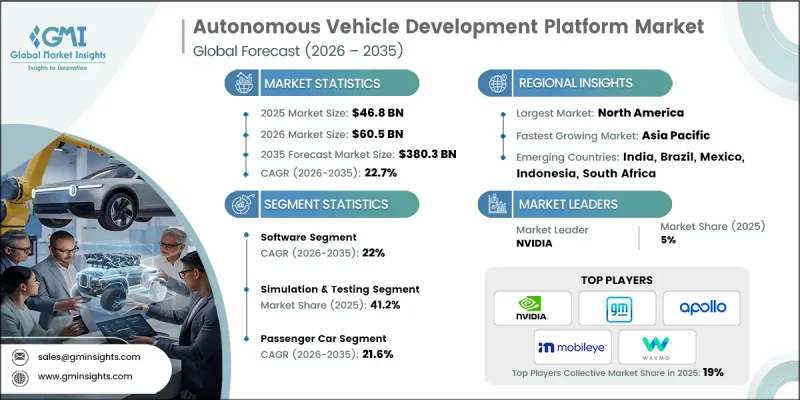
Market expansion is fueled by advances in machine learning and artificial intelligence, which enhance autonomous vehicle perception, decision-making, and route planning, enabling navigation in complex environments. Increasing integration of advanced driver assistance systems (ADAS) and incremental autonomous features in OEM vehicles is driving demand for comprehensive development, testing, and validation platforms. Major automakers and technology firms are investing heavily to accelerate innovation and enhance platform capabilities, facilitating faster commercial deployment. Cloud-based simulation environments are gaining traction as they enable large-scale testing, collaborative workflows across distributed teams, and cost reductions compared with physical test vehicles. AI-powered simulation further refines edge-case scenario modeling, improving algorithm accuracy while minimizing expensive real-world trials. The market is defined by continual software innovation, scalable cloud platforms, and strategic investments in AI-driven autonomous functionality.
| Market Scope | |
|---|---|
| Start Year | 2025 |
| Forecast Year | 2026-2035 |
| Start Value | $46.8 Billion |
| Forecast Value | $380.3 Billion |
| CAGR | 22.7% |
The software segment accounted for 72% share in 2025 and is expected to grow at a CAGR of 22% through 2035. Autonomous vehicle development software includes sensor simulation, perception modeling, mapping, localization, and decision-making frameworks, allowing virtual validation under diverse driving conditions. These platforms support data collection, annotation, and the training and testing of machine learning models, improving object detection, path planning, and vehicle control systems.
The passenger car segment held 62% share in 2025 and is expected to grow at a CAGR of 21.6% from 2026 to 2035. Passenger vehicles are rapidly incorporating Level 2+ and Conditional Level 3 autonomy, driving demand for development platforms. OEMs rely on simulation, sensor fusion software, and AI-based validation tools to accelerate feature deployment, comply with regulations, pass safety tests, and integrate connected vehicle systems with over-the-air updates. Platforms emphasize AI personalization, predictive decision-making, and advanced perception systems through large-scale data training and digital twin testing, improving urban driving performance.
U.S. Autonomous Vehicle Development Platform Market generated USD 13.1 billion in 2025. The country leads globally in AV platform development due to its concentration of AI, cloud, and simulation expertise. Collaboration between universities, research institutions, and OEMs strengthens machine learning, perception, and decision-making frameworks. Venture capital investment supports innovation in start-ups and platform technologies, further reinforcing U.S. leadership.
Key players in the Global Autonomous Vehicle Development Platform Market include NVIDIA, Waymo (Alphabet), Tesla, GM / Cruise, Mobileye (Intel), Mercedes-Benz, Toyota, Baidu (Apollo), Microsoft, and Qualcomm. Companies in the Autonomous Vehicle Development Platform Market are focusing on several strategies to strengthen their market position. Key approaches include heavy investment in AI and machine learning to enhance perception and decision-making capabilities. Firms are developing scalable cloud-based simulation environments for faster and cost-effective validation of autonomous systems. Strategic partnerships with OEMs, technology providers, and research institutions enable collaboration on advanced sensor fusion, mapping, and digital twin technologies. Companies are also expanding globally to tap into emerging markets and adopting modular, adaptable platforms to meet varying vehicle types and autonomy levels.
Table of Contents
Chapter 1 Methodology
- 1.1 Research approach
- 1.2 Quality commitments
- 1.3 GMI AI policy & data integrity commitment
- 1.4 Research trail & confidence scoring
- 1.4.1 Research trail components
- 1.4.2 Scoring components
- 1.5 Data collection
- 1.5.1 Partial list of primary sources
- 1.6 Data mining sources
- 1.6.1 Paid sources
- 1.7 Base estimates and calculations
- 1.7.1 Base year calculation
- 1.8 Forecast model
- 1.9 Research transparency addendum
Chapter 2 Executive Summary
- 2.1 Industry 360° synopsis
- 2.2 Key market trends
- 2.2.1 Regional
- 2.2.2 Component
- 2.2.3 Functionality
- 2.2.4 End use
- 2.2.5 Vehicle
- 2.2.6 Deployment mode
- 2.3 TAM analysis, 2026-2035
- 2.4 CXO perspectives: Strategic imperatives
Chapter 3 Industry Insights
- 3.1 Industry ecosystem analysis
- 3.1.1 Supplier landscape
- 3.1.2 Profit margin
- 3.1.3 Cost structure
- 3.1.4 Value addition at each stage
- 3.1.5 Factor affecting the value chain
- 3.1.6 Disruptions
- 3.2 Industry impact forces
- 3.2.1 Growth drivers
- 3.2.1.1 Advanced AI and machine learning integration
- 3.2.1.2 Increasing adoption of ADAS and autonomous technologies
- 3.2.1.3 Growing investment from OEMs and tech companies
- 3.2.1.4 Expansion of cloud computing and simulation infrastructure
- 3.2.2 Industry pitfalls and challenges
- 3.2.2.1 High development and R&D costs
- 3.2.2.2 Regulatory uncertainty and compliance challenges
- 3.2.3 Market opportunities
- 3.2.3.1 Rising demand for Level 4-5 autonomous vehicles
- 3.2.3.2 Integration of digital twin and simulation technologies
- 3.2.3.3 Partnerships between tech companies and automakers
- 3.2.3.4 Emerging markets adoption
- 3.2.1 Growth drivers
- 3.3 Growth potential analysis
- 3.4 Regulatory landscape
- 3.4.1 North America
- 3.4.1.1 National Highway Traffic Safety Administration (NHTSA)
- 3.4.1.2 Transport Canada Motor Vehicle Safety Standards (CMVSS)
- 3.4.2 Europe
- 3.4.2.1 European Whole Vehicle Type Approval (WVTA)
- 3.4.2.2 ECE Regulation 124 (R124)
- 3.4.3 Asia Pacific
- 3.4.3.1 Japan Automotive Standards Organization (JASO)
- 3.4.3.2 AIS (Automotive Industry Standards) - India
- 3.4.4 Latin America
- 3.4.4.1 Brazilian National Traffic Council (CONTRAN) - Resolution 242
- 3.4.4.2 Mexican NOM Standards (Normas Oficiales Mexicanas)
- 3.4.5 Middle East & Africa
- 3.4.5.1 Emirates Authority for Standardization and Metrology (ESMA)
- 3.4.5.2 South African Bureau of Standards (SABS)
- 3.4.1 North America
- 3.5 Porter's analysis
- 3.6 PESTEL analysis
- 3.7 Technology and innovation landscape
- 3.7.1 Current technological trends
- 3.7.2 Emerging technologies
- 3.8 Pricing analysis (Driven by Primary Research)
- 3.8.1 Historical price trend analysis
- 3.8.2 Pricing strategy by player type (premium / value / cost-plus)
- 3.9 Cost breakdown analysis
- 3.10 Patent analysis (Driven by Primary Research)
- 3.11 Sustainability and environmental aspects
- 3.11.1 Sustainable practices
- 3.11.2 Waste reduction strategies
- 3.11.3 Energy efficiency in production
- 3.11.4 Eco-friendly initiatives
- 3.11.5 Carbon footprint considerations
- 3.12 Impact of AI & Generative AI on the Market
- 3.12.1 AI-driven disruption of existing business models
- 3.12.2 Gen AI use cases & adoption roadmap by segment
- 3.12.3 Risks, limitations & regulatory considerations
- 3.13 Infrastructure & deployment landscape (Driven by primary research)
- 3.13.1 Deployment penetration by region & buyer segment
- 3.13.2 Scalability constraints & infrastructure investment trends
- 3.14 Forecast assumptions & scenario analysis (Driven by primary research)
- 3.14.1 Base Case - key macro & industry variables driving CAGR
- 3.14.2 Optimistic Scenarios - Favorable macro and industry tailwinds
- 3.14.3 Pessimistic Scenario - Macroeconomic slowdown or industry headwinds
Chapter 4 Competitive Landscape, 2025
- 4.1 Introduction
- 4.2 Company market share analysis
- 4.2.1 North America
- 4.2.2 Europe
- 4.2.3 Asia Pacific
- 4.2.4 LATAM
- 4.2.5 MEA
- 4.3 Competitive analysis of major market players
- 4.4 Competitive positioning matrix
- 4.5 Key developments
- 4.5.1 Mergers & acquisitions
- 4.5.2 Partnerships & collaborations
- 4.5.3 New product launches
- 4.5.4 Expansion plans and funding
- 4.6 Company tier benchmarking
- 4.6.1 Tier classification criteria & qualifying thresholds
- 4.6.2 Tier positioning matrix by revenue, geography & innovation
Chapter 5 Market Estimates & Forecast, By Component, 2022 - 2035 ($Mn)
- 5.1 Key trends
- 5.2 Software
- 5.2.1 Simulation & testing software
- 5.2.2 Sensor fusion & perception software
- 5.2.3 Machine learning & AI frameworks
- 5.2.4 Data management & annotation software
- 5.2.5 Mapping & localization software
- 5.2.6 Control & decision-making software
- 5.3 Services
- 5.3.1 Professional services
- 5.3.2 Managed services
Chapter 6 Market Estimates & Forecast, By Functionality, 2022 - 2035 ($Mn)
- 6.1 Key trends
- 6.2 Sensor simulation
- 6.3 Data collection & analysis
- 6.4 Simulation & testing
Chapter 7 Market Estimates & Forecast, By End Use, 2022 - 2035 ($Mn)
- 7.1 Key trends
- 7.2 Automotive manufacturers
- 7.3 Technology companies
- 7.4 Research institutions & universities
- 7.5 Government & defense
- 7.6 Others
Chapter 8 Market Estimates & Forecast, By Vehicle, 2022 - 2035 ($Mn)
- 8.1 Key trends
- 8.2 Passenger cars
- 8.2.1 Hatchback
- 8.2.2 SUV
- 8.2.3 Sedan
- 8.3 Commercial vehicle
- 8.3.1 LCV
- 8.3.2 MCV
- 8.3.3 HCV
Chapter 9 Market Estimates & Forecast, By Deployment Mode, 2022 - 2035 ($Mn)
- 9.1 Key trends
- 9.2 On-premises platforms
- 9.3 Cloud-based platforms
- 9.4 Hybrid deployment
Chapter 10 Market Estimates & Forecast, By Region, 2022 - 2035 ($Mn)
- 10.1 Key trends
- 10.2 North America
- 10.2.1 US
- 10.2.2 Canada
- 10.3 Europe
- 10.3.1 Germany
- 10.3.2 UK
- 10.3.3 France
- 10.3.4 Italy
- 10.3.5 Spain
- 10.3.6 Nordics
- 10.3.7 Russia
- 10.3.8 Poland
- 10.3.9 Romania
- 10.4 Asia Pacific
- 10.4.1 China
- 10.4.2 India
- 10.4.3 Japan
- 10.4.4 South Korea
- 10.4.5 ANZ
- 10.4.6 Vietnam
- 10.4.7 Indonesia
- 10.4.8 Philippines
- 10.5 Latin America
- 10.5.1 Brazil
- 10.5.2 Mexico
- 10.5.3 Argentina
- 10.6 MEA
- 10.6.1 South Africa
- 10.6.2 Saudi Arabia
- 10.6.3 UAE
Chapter 11 Company Profiles
- 11.1 Global companies
- 11.1.1 Baidu (Apollo)
- 11.1.2 GM
- 11.1.3 Mercedes-Benz
- 11.1.4 Microsoft
- 11.1.5 Mobileye (Intel)
- 11.1.6 NVIDIA
- 11.1.7 Qualcomm
- 11.1.8 Tesla
- 11.1.9 Toyota
- 11.1.10 Waymo (Alphabet)
- 11.2 Regional players
- 11.2.1 Ansys
- 11.2.2 Aurora Innovation
- 11.2.3 dSPACE
- 11.2.4 Momenta
- 11.2.5 Pony.ai
- 11.3 Emerging players
- 11.3.1 Applied Intuition
- 11.3.2 CARLA Simulator (Open-Source Community)
- 11.3.3 Cognata
- 11.3.4 Foretellix
- 11.3.5 Parallel Domain
- 11.3.6 Scale AI

