
PUBLISHER: Global Market Insights Inc. | PRODUCT CODE: 1998730

PUBLISHER: Global Market Insights Inc. | PRODUCT CODE: 1998730
Food Bleaching Agent Market Opportunity, Growth Drivers, Industry Trend Analysis, and Forecast 2026 - 2035
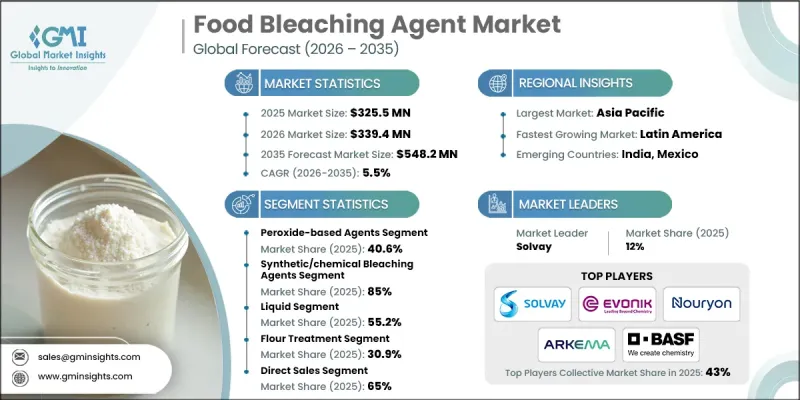
The Global Food Bleaching Agent Market was valued at USD 325.5 million in 2025 and is estimated to grow at a CAGR of 5.5% to reach USD 548.2 million by 2035.
Food bleaching agents play a crucial role in modern food manufacturing, as they help maintain product appearance while enhancing texture and improving overall processing efficiency. These agents assist producers in achieving uniform raw material characteristics, allowing manufacturers to maintain consistency across large-scale production batches. Over time, the value proposition of whitening agents has expanded beyond basic color modification to include enhanced functionality during complex manufacturing processes. Market development is also being influenced by continuous innovation in chemical and naturally derived formulations designed to meet evolving regulatory frameworks and changing consumer expectations. Shifting consumption patterns are encouraging food manufacturers to focus on packaged food products that maintain visual quality and reliable processing performance. At the same time, consumers are increasingly seeking food products that align with perceptions of improved quality and minimal processing. As a result, industry participants are gradually exploring alternative formulations derived from natural or plant-based sources, particularly in regions where regulatory oversight and consumer scrutiny regarding food ingredients are especially strong.
| Market Scope | |
|---|---|
| Start Year | 2025 |
| Forecast Year | 2026-2035 |
| Start Value | $325.5 Million |
| Forecast Value | $548.2 Million |
| CAGR | 5.5% |
The peroxide-based bleaching agents segment accounted for 40.6% share in 2025 and is anticipated to grow at a CAGR of 6.1% through 2035. These agents remain widely adopted across the food processing industry due to their strong oxidative properties and dependable operational performance. Their chemical stability allows them to function effectively within high-capacity production environments, making them suitable for industrial processing systems that require consistent and reliable ingredient treatment. The capability of peroxide-based agents to support stable processing conditions continues to reinforce their position as a preferred solution within the global food bleaching agent market.
The synthetic or chemical bleaching agents segment held 85% share and is expected to grow at a CAGR of 5.1% between 2026 and 2035. These agents continue to dominate the industry because they provide high reactivity and consistent outcomes that align well with the requirements of large-scale food manufacturing. Their predictable chemical performance enables producers to achieve uniform product appearance and stable processing conditions across multiple product categories. In addition, synthetic bleaching agents remain essential in industrial environments where rapid color correction, strong oxidative action, and dependable processing reliability are required to maintain consistent production timelines and standardized product quality.
North America Food Bleaching Agent Market held 47.4% share in 2025. The region has developed into a strategically important market due to its highly developed food manufacturing infrastructure and strict food safety standards that emphasize consistent product quality. The presence of advanced production technologies and well-established processing facilities enables companies in the region to adopt technologically advanced bleaching formulations more rapidly. Strong manufacturing capabilities also support large-scale food production activities, further strengthening regional demand for efficient and reliable food bleaching agents.
Key companies operating in the Global Food Bleaching Agent Market include BASF SE, Solvay, Evonik Industries AG, AkzoNobel N.V., Arkema S.A., Nouryon, Aditya Birla Chemicals, Kemira Oyj, Clariant AG, Imerys S.A., Kemin Industries, and DSM-Firmenich. Companies in the Food Bleaching Agent Market are strengthening their competitive positions through continuous product innovation and strategic expansion initiatives. Leading manufacturers are investing in research and development to introduce improved bleaching formulations that meet evolving food safety regulations while maintaining strong processing performance. Firms are also focusing on developing naturally derived and environmentally responsible ingredients to address shifting consumer expectations and regulatory pressures. Strategic partnerships with food processing companies and ingredient suppliers are helping manufacturers expand their application capabilities and market reach. In addition, companies are expanding their global production networks and strengthening distribution channels to ensure a stable supply for large-scale food manufacturers.
Table of Contents
Chapter 1 Methodology & Scope
- 1.1 Market scope and definition
- 1.2 Research design
- 1.2.1 Research approach
- 1.2.2 Data collection methods
- 1.3 Data mining sources
- 1.3.1 Global
- 1.3.2 Regional/Country
- 1.4 Base estimates and calculations
- 1.4.1 Base year calculation
- 1.4.2 Key trends for market estimation
- 1.5 Primary research and validation
- 1.5.1 Primary sources
- 1.6 Forecast model
- 1.7 Research assumptions and limitations
Chapter 2 Executive Summary
- 2.1 Industry 360° synopsis
- 2.2 Key market trends
- 2.2.1 Regional
- 2.2.2 Agent Type
- 2.2.3 Source
- 2.2.4 Form
- 2.2.5 Application
- 2.2.6 Distribution Channel
- 2.3 TAM Analysis, 2026-2035
- 2.4 CXO perspectives: Strategic imperatives
- 2.4.1 Executive decision points
- 2.4.2 Critical success factors
- 2.5 Future Outlook and Strategic Recommendations
Chapter 3 Industry Insights
- 3.1 Industry ecosystem analysis
- 3.1.1 Supplier landscape
- 3.1.2 Profit margin
- 3.1.3 Value addition at each stage
- 3.1.4 Factor affecting the value chain
- 3.1.5 Disruptions
- 3.2 Industry impact forces
- 3.2.1 Growth drivers
- 3.2.1.1 Rising demand for processed and packaged food products requiring visual enhancement
- 3.2.1.2 Increasing adoption of bleaching agents in bakery and confectionery applications
- 3.2.1.3 Technological advancements in natural and synthetic food bleaching agents
- 3.2.2 Industry pitfalls and challenges
- 3.2.2.1 Growing consumer preference for clean-label and natural ingredients
- 3.2.2.2 Potential health concerns related to synthetic bleaching agents affecting market growth
- 3.2.3 Market opportunities
- 3.2.3.1 Development of natural & plant-based alternatives
- 3.2.3.2 Enzymatic bleaching technology commercialization
- 3.2.1 Growth drivers
- 3.3 Growth potential analysis
- 3.4 Regulatory landscape
- 3.4.1 North America
- 3.4.2 Europe
- 3.4.3 Asia Pacific
- 3.4.4 Latin America
- 3.4.5 Middle East & Africa
- 3.5 Porter's analysis
- 3.6 PESTEL analysis
- 3.7 Price trends
- 3.7.1 By region
- 3.7.2 By agent type
- 3.8 Future market trends
- 3.9 Technology and Innovation landscape
- 3.9.1 Current technological trends
- 3.9.2 Emerging technologies
- 3.10 Patent Landscape
- 3.11 Trade statistics (HS code)
- 3.11.1 Major importing countries
- 3.11.2 Major exporting countries
- 3.12 Sustainability and environmental aspects
- 3.12.1 Sustainable practices
- 3.12.2 Waste reduction strategies
- 3.12.3 Energy efficiency in production
- 3.12.4 Eco-friendly initiatives
- 3.13 Carbon footprint consideration
Chapter 4 Competitive Landscape, 2025
- 4.1 Introduction
- 4.2 Company market share analysis
- 4.2.1 By region
- 4.2.1.1 North America
- 4.2.1.2 Europe
- 4.2.1.3 Asia Pacific
- 4.2.1.4 LATAM
- 4.2.1.5 MEA
- 4.2.1 By region
- 4.3 Company matrix analysis
- 4.4 Competitive analysis of major market players
- 4.5 Competitive positioning matrix
- 4.6 Key developments
- 4.6.1 Mergers & acquisitions
- 4.6.2 Partnerships & collaborations
- 4.6.3 New Product Launches
- 4.6.4 Expansion Plans
Chapter 5 Market Estimates and Forecast, By Agent Type, 2022-2035 (USD Million) (Kilo Tons)
- 5.1 Key trends
- 5.2 Peroxide-based agents
- 5.3 Chlorine-based agents
- 5.4 Physical adsorption agents
- 5.5 Sulfite-based agents
- 5.6 Enzymatic bleaching agents
- 5.7 Natural & plant-based alternatives
- 5.8 Peracid-based agents
- 5.9 Other chemical agents
Chapter 6 Market Estimates and Forecast, By Source, 2022-2035 (USD Million) (Kilo Tons)
- 6.1 Key trends
- 6.2 Synthetic/chemical bleaching agents
- 6.3 Natural/plant-based bleaching agents
- 6.4 Mineral-based bleaching agents
Chapter 7 Market Estimates and Forecast, By Form, 2022-2035 (USD Million) (Kilo Tons)
- 7.1 Key trends
- 7.2 Liquid
- 7.3 Powder
- 7.4 Granular
Chapter 8 Market Estimates and Forecast, By Application, 2022-2035 (USD Million) (Kilo Tons)
- 8.1 Key trends
- 8.2 Flour Treatment
- 8.3 Edible Oils & Fats
- 8.4 Bakery & Confectionery Products
- 8.5 Dairy Products
- 8.6 Starch & Sugar Products
- 8.7 Beverages
- 8.8 Aseptic Packaging
- 8.9 Meat & Poultry Processing
- 8.10 Egg Products
- 8.11 Spices & Herbs
- 8.12 Others
Chapter 9 Market Estimates and Forecast, By Distribution Channel, 2022-2035 (USD Million) (Kilo Tons)
- 9.1 Key trends
- 9.2 Direct Sales
- 9.3 Distributors & Wholesalers
- 9.4 Online Channels
Chapter 10 Market Estimates and Forecast, By Region, 2022-2035 (USD Million) (Kilo Tons)
- 10.1 Key trends
- 10.2 North America
- 10.2.1 U.S.
- 10.2.2 Canada
- 10.3 Europe
- 10.3.1 Germany
- 10.3.2 UK
- 10.3.3 France
- 10.3.4 Spain
- 10.3.5 Italy
- 10.3.6 Rest of Europe
- 10.4 Asia Pacific
- 10.4.1 China
- 10.4.2 India
- 10.4.3 Japan
- 10.4.4 Australia
- 10.4.5 South Korea
- 10.4.6 Rest of Asia Pacific
- 10.5 Latin America
- 10.5.1 Brazil
- 10.5.2 Mexico
- 10.5.3 Argentina
- 10.5.4 Rest of Latin America
- 10.6 Middle East and Africa
- 10.6.1 Saudi Arabia
- 10.6.2 South Africa
- 10.6.3 UAE
- 10.6.4 Rest of Middle East and Africa
Chapter 11 Company Profiles
- 11.1 Solvay
- 11.2 Evonik Industries AG
- 11.3 BASF SE
- 11.4 AkzoNobel N.V.
- 11.5 Arkema S.A.
- 11.6 Nouryon
- 11.7 Aditya Birla Chemicals
- 11.8 Kemira Oyj
- 11.9 Clariant AG
- 11.10 Imerys S.A.
- 11.11 Kemin Industries
- 11.12 DSM-Firmenich

