
PUBLISHER: Global Market Insights Inc. | PRODUCT CODE: 1998735

PUBLISHER: Global Market Insights Inc. | PRODUCT CODE: 1998735
Food Antimicrobials Market Opportunity, Growth Drivers, Industry Trend Analysis, and Forecast 2026 - 2035
The Global Food Antimicrobials Market was valued at USD 3 billion in 2025 and is estimated to grow at a CAGR of 5.4% to reach USD 5.2 billion by 2035.
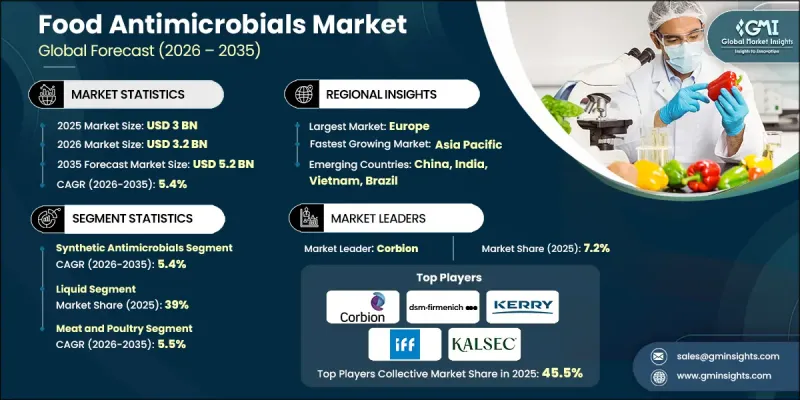
Food antimicrobials include a broad range of natural and synthetic compounds designed to suppress the growth of microorganisms that can compromise food quality and safety. Their role has become increasingly important as food production and distribution systems grow more sophisticated and globalized. Demand is rising as manufacturers seek solutions that support longer shelf life while maintaining freshness, safety, and consistent product quality. At the same time, consumers are showing greater interest in ingredients perceived as healthier and more transparent, which is encouraging the development of clean-label antimicrobial formulations. Food antimicrobials are widely incorporated into numerous food categories where microbial stability is critical throughout storage, transportation, and retail distribution. Growing consumption of packaged and convenience foods is further accelerating adoption, as producers require reliable preservation technologies that protect product integrity without negatively affecting flavor, texture, or nutritional value. Continuous research in preservation technologies is also improving antimicrobial effectiveness and expanding their compatibility with diverse food formulations, strengthening their importance in modern food manufacturing.
| Market Scope | |
|---|---|
| Start Year | 2025 |
| Forecast Year | 2026-2035 |
| Start Value | $3 Billion |
| Forecast Value | $5.2 Billion |
| CAGR | 5.4% |
The synthetic antimicrobials segment held 39.7% share and is projected to grow at a CAGR of 5.4% through 2035. These solutions remain widely used in food processing due to their affordability, reliable functionality, and consistent antimicrobial performance under various production conditions. Synthetic compounds have established regulatory acceptance across many international markets, which supports their large-scale use in commercial food production. Their predictable activity and stability help manufacturers maintain consistent preservation outcomes while ensuring minimal influence on product characteristics when applied at appropriate levels.
The liquid antimicrobials segment held 39% share in 2025 and is anticipated to grow at a CAGR of 5.6% through 2035. These solutions are favored because they integrate easily into food processing systems and allow uniform distribution throughout product formulations. Their high solubility and dispersion efficiency enable accurate dosing and thorough blending, which helps maintain consistent antimicrobial effectiveness across entire production batches. Liquid antimicrobials also support streamlined processing operations because they can be incorporated efficiently into liquid or semi-liquid food matrices.
United States Food Antimicrobials Market held 84.8% share in 2025 and is projected to reach USD 1.3 billion by 2035, supported by strict regulatory frameworks governing food safety as well as strong consumer awareness regarding product quality and hygiene standards. The highly developed food manufacturing sector in the United States creates sustained demand for antimicrobial solutions that ensure stability and safety throughout production, packaging, and distribution stages.
Key companies operating in the Global Food Antimicrobials Market include Celanese, Corbion, DSM-Firmenich, Eastman, Galactic, International Flavors & Fragrances, Jungbunzlauer, Kalsec, Kerry Group, Mitsubishi Chemical, and Novonesis. Companies active in the Global Food Antimicrobials Market are strengthening their competitive position through several strategic initiatives focused on innovation, partnerships, and global expansion. Many manufacturers are increasing investments in research and development to create advanced antimicrobial formulations that align with evolving consumer preferences and regulatory standards. Businesses are also prioritizing the development of clean-label and naturally derived preservation solutions to address growing demand for transparent ingredient profiles. Strategic collaborations with food manufacturers and ingredient suppliers are helping companies expand product adoption and strengthen distribution networks. In addition, firms are enhancing production capabilities and optimizing supply chains to support rising global demand.
Table of Contents
Chapter 1 Methodology & Scope
- 1.1 Market scope and definition
- 1.2 Research design
- 1.2.1 Research approach
- 1.2.2 Data collection methods
- 1.3 Data mining sources
- 1.3.1 Global
- 1.3.2 Regional/Country
- 1.4 Base estimates and calculations
- 1.4.1 Base year calculation
- 1.4.2 Key trends for market estimation
- 1.5 Primary research and validation
- 1.5.1 Primary sources
- 1.6 Forecast model
- 1.7 Research assumptions and limitations
Chapter 2 Executive Summary
- 2.1 Industry 360° synopsis
- 2.2 Key market trends
- 2.2.1 Type
- 2.2.2 Form
- 2.2.3 Application
- 2.2.4 Regional
- 2.3 TAM Analysis, 2026-2035
- 2.4 CXO perspectives: Strategic imperatives
Chapter 3 Industry Insights
- 3.1 Industry ecosystem analysis
- 3.1.1 Supplier landscape
- 3.1.2 Profit margin
- 3.1.3 Value addition at each stage
- 3.1.4 Factor affecting the value chain
- 3.1.5 Disruptions
- 3.2 Industry impact forces
- 3.2.1 Growth drivers
- 3.2.2 Industry pitfalls and challenges
- 3.2.3 Market opportunities
- 3.3 Growth potential analysis
- 3.4 Regulatory landscape
- 3.4.1 North America
- 3.4.2 Europe
- 3.4.3 Asia Pacific
- 3.4.4 Latin America
- 3.4.5 Middle East & Africa
- 3.5 Porter's analysis
- 3.6 PESTEL analysis
- 3.7 Price trends
- 3.7.1 By region
- 3.7.2 By type
- 3.8 Future market trends
- 3.9 Technology and Innovation landscape
- 3.9.1 Current technological trends
- 3.9.2 Emerging technologies
- 3.10 Patent Landscape
- 3.11 Trade statistics (HS code)
( Note: the trade statistics will be provided for key countries only)
- 3.11.1 Major importing countries
- 3.11.2 Major exporting countries
- 3.12 Sustainability and environmental aspects
- 3.12.1 Sustainable practices
- 3.12.2 Waste reduction strategies
- 3.12.3 Energy efficiency in production
- 3.12.4 Eco-friendly initiatives
- 3.13 Carbon footprint consideration
Chapter 4 Competitive Landscape, 2025
- 4.1 Introduction
- 4.2 Company market share analysis
- 4.2.1 By region
- 4.2.1.1 North America
- 4.2.1.2 Europe
- 4.2.1.3 Asia Pacific
- 4.2.1.4 LATAM
- 4.2.1.5 MEA
- 4.2.1 By region
- 4.3 Competitive analysis of major market players
- 4.4 Competitive positioning matrix
- 4.5 Key developments
- 4.5.1 Mergers & acquisitions
- 4.5.2 Partnerships & collaborations
- 4.5.3 New Product Launches
- 4.5.4 Expansion Plans
Chapter 5 Market Estimates and Forecast, By Type, 2022-2035 (USD Billion) (Kilo Tons)
- 5.1 Key trends
- 5.2 Natural antimicrobials
- 5.2.1 Organic acids
- 5.2.2 Bacteriocins
- 5.2.3 Essential oils & active compounds
- 5.2.4 Plant extracts & polyphenols
- 5.2.5 Enzymes
- 5.2.6 Chitosan & derivatives
- 5.2.7 Antimicrobial peptides
- 5.2.8 Microbial biopreservatives
- 5.2.9 Others
- 5.3 Nature-identical antimicrobials
- 5.3.1 Vanillin
- 5.3.2 Linalool
- 5.3.3 Coumarin
- 5.3.4 Others
- 5.4 Synthetic antimicrobials
- 5.4.1 Benzoates
- 5.4.2 Sorbates
- 5.4.3 Nitrites & nitrates
- 5.4.4 Sulfites
- 5.4.5 Propionates
- 5.4.6 Synthetic antioxidants (BHA, BHT, TBHQ, Propyl Gallate)
- 5.4.7 Others
Chapter 6 Market Estimates and Forecast, By Form, 2022-2035 (USD Billion) (Kilo Tons)
- 6.1 Key trends
- 6.2 Liquid
- 6.3 Powder
- 6.4 Others
Chapter 7 Market Estimates and Forecast, By Application, 2022-2035 (USD Billion) (Kilo Tons)
- 7.1 Key trends
- 7.2 Meat & poultry
- 7.2.1 Fresh meat products
- 7.2.2 Processed & cured meat
- 7.2.3 Poultry products
- 7.2.4 Ready-to-eat (RTE) meat products
- 7.2.5 Others
- 7.3 Bakery & confectionery
- 7.3.1 Bread & baked goods
- 7.3.2 Cakes & pastries
- 7.3.3 Confectionery products
- 7.3.4 Others
- 7.4 Dairy & frozen desserts
- 7.4.1 Fluid milk
- 7.4.2 Cheese products
- 7.4.3 Yogurt & fermented dairy
- 7.4.4 Ice cream & frozen desserts
- 7.4.5 Butter & cream
- 7.4.6 Others
- 7.5 Beverages
- 7.5.1 Fruit juices & nectars
- 7.5.2 Soft drinks & carbonated beverages
- 7.5.3 Alcoholic beverages
- 7.5.4 Others
- 7.6 Snacks
- 7.6.1 Savory snacks
- 7.6.2 Roasted nuts & peanut butter
- 7.6.3 Others
- 7.7 Others
Chapter 8 Market Estimates and Forecast, By Region, 2022-2035 (USD Billion) (Kilo Tons)
- 8.1 Key trends
- 8.2 North America
- 8.2.1 U.S.
- 8.2.2 Canada
- 8.3 Europe
- 8.3.1 Germany
- 8.3.2 UK
- 8.3.3 France
- 8.3.4 Spain
- 8.3.5 Italy
- 8.3.6 Rest of Europe
- 8.4 Asia Pacific
- 8.4.1 China
- 8.4.2 India
- 8.4.3 Japan
- 8.4.4 Australia
- 8.4.5 South Korea
- 8.4.6 Rest of Asia Pacific
- 8.5 Latin America
- 8.5.1 Brazil
- 8.5.2 Mexico
- 8.5.3 Argentina
- 8.5.4 Rest of Latin America
- 8.6 Middle East and Africa
- 8.6.1 Saudi Arabia
- 8.6.2 South Africa
- 8.6.3 UAE
- 8.6.4 Rest of Middle East and Africa
Chapter 9 Company Profiles
- 9.1 Celanese
- 9.2 Corbion
- 9.3 DSM-Firmenich
- 9.4 Eastman
- 9.5 Galactic
- 9.6 International Flavors & Fragrances
- 9.7 Jungbunzlauer
- 9.8 Kalsec
- 9.9 Kerry Group
- 9.10 Mitsubishi Chemical
- 9.11 Novonesis

