PUBLISHER: Global Market Insights Inc. | PRODUCT CODE: 1998737

PUBLISHER: Global Market Insights Inc. | PRODUCT CODE: 1998737
Automotive Traction Motor Market Opportunity, Growth Drivers, Industry Trend Analysis, and Forecast 2026 - 2035
The Global Automotive Traction Motor Market was valued at USD 30.7 billion in 2025 and is estimated to grow at a CAGR of 13% to reach USD 104.2 billion by 2035.
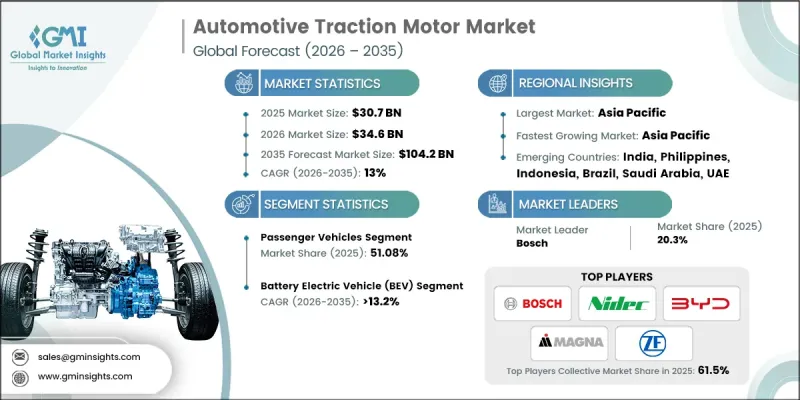
The rapid electrification of the automotive industry is transforming the traction motor from a secondary drivetrain element into a central component responsible for vehicle performance and energy efficiency. As global mobility transitions toward electrified transportation, traction motors have become essential for delivering power, optimizing energy usage, and supporting compliance with evolving environmental regulations. These motors are now widely integrated across various electrified vehicle platforms, including fully electric vehicles, hybrid vehicles, and electrified commercial fleets. Rising electric vehicle production, expanding vehicle model offerings, and increasingly strict emission reduction policies are collectively driving strong demand for advanced motor technologies. Automotive manufacturers are focusing on enhancing motor efficiency, improving torque output, reducing overall system weight, and ensuring stable thermal performance. At the same time, the integration of traction motors with power electronics and battery systems is encouraging a more comprehensive approach to vehicle architecture design. Technological advancements in motor materials and configurations are also influencing competition within the market as manufacturers continue to develop solutions that improve energy efficiency, reduce production costs, and enhance long-term vehicle performance.
| Market Scope | |
|---|---|
| Start Year | 2025 |
| Forecast Year | 2026-2035 |
| Start Value | $30.7 Billion |
| Forecast Value | $104.2 Billion |
| CAGR | 13% |
The passenger cars segment accounted for 51.08% share in 2025 and is projected to grow at a CAGR of 12.3% through 2035. The strong position of this segment is primarily supported by the accelerating adoption of electric passenger vehicles worldwide and the increasing availability of electrified models across different price categories. Automotive manufacturers are prioritizing the electrification of various passenger vehicle categories, which has significantly increased the installation of traction motors in modern vehicles. In addition, the transition toward dedicated electric vehicle platforms and the growing adoption of multi-motor configurations in premium passenger vehicles are increasing the number of motors used per vehicle, further strengthening the market share of the passenger car segment.
The battery electric vehicle segment held a 67.2% share in 2025 and is expected to grow at a CAGR of 13.2% between 2026 and 2035. This strong dominance is largely attributed to the complete reliance of battery electric vehicles on electric propulsion systems for mobility. Unlike hybrid vehicles that combine internal combustion engines with electric powertrains, battery electric vehicles operate entirely using electric motors, which directly increases traction motor demand per vehicle. In addition, many high-performance electric vehicles utilize multiple motor configurations to enhance power output and vehicle control. Global initiatives promoting zero-emission mobility, declining battery costs, and the continuous expansion of charging infrastructure are further accelerating the production and adoption of battery electric vehicles, thereby increasing demand for traction motor technologies.
China Automotive Traction Motor Market generated USD 10.4 billion in 2025 and held 64.21% share. The country maintains a strong position in the regional market due to its leadership in global electric vehicle manufacturing and its strong support for vehicle electrification. China has developed a comprehensive ecosystem that includes large-scale electric vehicle production, integrated supply chains, and strong manufacturing capabilities for batteries and power electronics. Government initiatives aimed at promoting new energy vehicles and expanding electric mobility infrastructure continue to encourage the adoption of electrified passenger vehicles and commercial transportation solutions. These factors are contributing to substantial demand for advanced traction motor systems designed to deliver efficient and reliable electric propulsion.
Key companies operating in the Global Automotive Traction Motor Market include Bosch, Denso, ZF Friedrichshafen, Continental, Magna, Valeo, Hitachi, Mitsubishi Electric, Aisin, and General Motors. Companies competing in the Automotive Traction Motor Market are implementing a variety of strategies to strengthen their competitive position and expand global market share. Leading manufacturers are investing heavily in research and development to improve motor efficiency, increase power density, and enhance thermal management capabilities. Many companies are also focusing on developing advanced motor architectures that reduce reliance on expensive raw materials while improving performance and durability. Strategic collaborations with automotive manufacturers and technology partners are helping companies accelerate innovation and integrate traction motors more effectively with electric powertrain systems. Additionally, organizations are expanding manufacturing facilities, strengthening supply chains, and increasing production capacity to meet the rapidly growing demand for electric vehicles. Continuous technological advancement, platform integration, and global expansion remain essential strategies for maintaining competitiveness in the automotive traction motor market.
Table of Contents
Chapter 1 Methodology
- 1.1 Research approach
- 1.2 Quality Commitments
- 1.2.1 GMI AI policy & data integrity commitment
- 1.2.1.1 Source consistency protocol
- 1.2.1 GMI AI policy & data integrity commitment
- 1.3 Research Trail & Confidence Scoring
- 1.3.1 Research Trail Components
- 1.3.2 Scoring Components
- 1.4 Data Collection
- 1.4.1 Partial list of primary sources
- 1.5 Data mining sources
- 1.5.1 Paid sources
- 1.5.1.1 Sources, by region
- 1.5.1 Paid sources
- 1.6 Base estimates and calculations
- 1.6.1 Base year calculation for any one approach
- 1.7 Forecast
- 1.7.1 Quantified market impact analysis
- 1.7.1.1 Mathematical impact of growth parameters on forecast
- 1.7.1 Quantified market impact analysis
- 1.8 Research transparency addendum
- 1.8.1 Source attribution framework
- 1.8.2 Quality assurance metrics
- 1.8.3 Our commitment to trust
Chapter 2 Executive Summary
- 2.1 Industry 360° synopsis, 2022 - 2035
- 2.2 Key market trends
- 2.2.1 Regional
- 2.2.2 Vehicle
- 2.2.3 Electric Drivetrain
- 2.2.4 Motor
- 2.2.5 Power Output
- 2.3 TAM Analysis, 2026-2035
- 2.4 CXO perspectives: Strategic imperatives
Chapter 3 Industry Insights
- 3.1 Industry ecosystem analysis
- 3.1.1 Supplier landscape
- 3.1.2 Profit margin analysis
- 3.1.3 Cost structure
- 3.1.4 Value addition at each stage
- 3.1.5 Factor affecting the value chain
- 3.1.6 Disruptions
- 3.2 Industry impact forces
- 3.2.1 Growth drivers
- 3.2.1.1 Rise in global electric vehicle production
- 3.2.1.2 Increase in stringent emission and fuel efficiency regulations
- 3.2.1.3 Surge in electrification of public transport and logistics fleets
- 3.2.1.4 Rise in consumer demand for high-performance EVs
- 3.2.1.5 Increase in investments toward localized EV manufacturing ecosystems
- 3.2.2 Industry pitfalls and challenges
- 3.2.2.1 Fluctuation in rare-earth material prices
- 3.2.2.2 High initial R&D and capital investment requirements
- 3.2.3 Market opportunities
- 3.2.3.1 Growth in EV adoption across emerging economies
- 3.2.3.2 Rise in electrification of two- and three-wheelers
- 3.2.3.3 Increase in government-backed electric bus deployment programs
- 3.2.3.4 Surge in demand for premium and performance EV segments
- 3.2.1 Growth drivers
- 3.3 Growth potential analysis
- 3.4 Regulatory guidline
- 3.4.1 North America
- 3.4.1.1 U.S.: EV Tax Credits, EPA Emission Standards & DOE Electric Drive Efficiency Programs
- 3.4.1.2 Canada: Zero-Emission Vehicle (ZEV) Mandate & Transport Canada Safety Standards
- 3.4.2 Europe
- 3.4.2.1 Germany: EU CO Fleet Emission Targets & End-of-Life Vehicle (ELV) Directive
- 3.4.2.2 UK: Zero Emission Vehicle (ZEV) Mandate & Type Approval Regulations
- 3.4.2.3 France: Energy Transition Law & EV Industrial Strategy
- 3.4.2.4 Italy: National Energy & Climate Plan (PNIEC) Alignment
- 3.4.3 Asia Pacific
- 3.4.3.1 China: NEV Mandate & Dual Credit Policy
- 3.4.3.2 India: FAME II & PLI Scheme for Auto Components
- 3.4.3.3 Japan: Green Growth Strategy & JEVS Standards
- 3.4.3.4 Australia: National Electric Vehicle Strategy
- 3.4.4 Latin America
- 3.4.4.1 Brazil: Rota 2030 Program
- 3.4.4.2 Mexico: USMCA Localization Requirements
- 3.4.4.3 Argentina: National Sustainable Mobility Policies
- 3.4.5 MEA
- 3.4.5.1 UAE: Net Zero 2050 Strategy & EV Infrastructure Expansion
- 3.4.5.2 Saudi Arabia: Vision 2030 & EV Localization Strategy
- 3.4.5.3 South Africa: Green Transport Strategy
- 3.4.1 North America
- 3.5 Porter's analysis
- 3.6 PESTEL analysis
- 3.7 Technology and Innovation landscape
- 3.7.1 Current technological trends
- 3.7.2 Emerging technologies
- 3.8 Patent analysis (Driven by Primary Research)
- 3.9 Pricing Analysis (Driven by Primary Research)
- 3.9.1 Historical Price Trend Analysis
- 3.9.2 Pricing Strategy by Player Type
- 3.10 Cost breakdown analysis
- 3.11 Sustainability and environmental impact analysis
- 3.11.1 Sustainable practices
- 3.11.2 Waste reduction strategies
- 3.11.3 Energy efficiency in production
- 3.11.4 Eco-friendly initiatives
- 3.11.5 Carbon footprint considerations
- 3.12 Future outlook & opportunities
- 3.13 Trade statistics (Driven by Paid Database)
- 3.13.1 Production hubs
- 3.13.2 Consumption hubs
- 3.13.3 Export and import
- 3.14 Key Trade corridors & tariff impact
- 3.14.1 US-china trade dynamics
- 3.14.2 EU internal market trade
- 3.14.3 Asia-pacific regional trade
- 3.15 Impact of AI & Generative AI on the Market
- 3.15.1 AI-Driven disruption of existing business models
- 3.15.2 GenAI use cases & adoption roadmap by segment
- 3.15.3 Risks, limitations & regulatory considerations
- 3.16 Investment & funding analysis
- 3.16.1 Private equity & venture capital activity
- 3.16.2 M&a trends & strategic consolidations
- 3.16.3 Government funding & R&D grants
- 3.17 Forecast assumptions & scenario analysis (Driven by Primary Research)
- 3.17.1 Base Case - key macro & industry variables driving CAGR
- 3.17.2 Optimistic Scenarios - Favorable Macro and Industry Tailwinds
- 3.17.3 Pessimistic Scenario - Macroeconomic slowdown or industry headwinds
Chapter 4 Competitive Landscape, 2025
- 4.1 Introduction
- 4.2 Company market share analysis
- 4.2.1 North America
- 4.2.2 Europe
- 4.2.3 Asia-Pacific
- 4.2.4 Latin America
- 4.2.5 Middle East & Africa
- 4.3 Competitive analysis of major market players
- 4.4 Competitive positioning matrix
- 4.5 Company Tier Benchmarking
- 4.5.1 Tier Classification Criteria & Qualifying Thresholds
- 4.5.2 Tier Positioning Matrix by Revenue, Geography & Innovation
- 4.6 Key developments
- 4.6.1 Mergers & acquisitions
- 4.6.2 Partnerships & collaborations
- 4.6.3 New product launches
- 4.6.4 Expansion plans and funding
Chapter 5 Market Estimates & Forecast, By Vehicle, 2022 - 2035 ($Bn, Units)
- 5.1 Key trends
- 5.2 Passenger vehicles
- 5.2.1 Hatchback
- 5.2.2 Sedan
- 5.2.3 SUVs
- 5.3 Commercial vehicles
- 5.3.1 Light Commercial Vehicles (LCV)
- 5.3.2 Medium Commercial Vehicles (MCV)
- 5.3.3 Heavy Commercial Vehicles (HCV)
- 5.4 Two-wheelers
- 5.5 Off-road vehicles
Chapter 6 Market Estimates & Forecast, By Electric Drivetrain, 2022 - 2035 ($Bn, Units)
- 6.1 Key trends
- 6.2 Battery Electric Vehicle (BEV)
- 6.3 Hybrid Electric Vehicle (HEV)
- 6.4 Plug-in Hybrid Electric Vehicle (PHEV)
Chapter 7 Market Estimates & Forecast, By Motor, 2022 - 2035 ($Bn, Units)
- 7.1 Key trends
- 7.2 PMSM
- 7.3 AC Induction
- 7.4 Others
Chapter 8 Market Estimates & Forecast, By Power Output, 2022 - 2035 ($Bn, Units)
- 8.1 Key trends
- 8.2 Less than 200 KW
- 8.3 200-400 KW
- 8.4 Above 400 KW
Chapter 9 Market Estimates & Forecast, By Region, 2022 - 2035 ($Bn, Units)
- 9.1 Key trends
- 9.2 North America
- 9.2.1 US
- 9.2.2 Canada
- 9.3 Europe
- 9.3.1 Germany
- 9.3.2 UK
- 9.3.3 France
- 9.3.4 Italy
- 9.3.5 Spain
- 9.3.6 Russia
- 9.3.7 Netherlands
- 9.3.8 Belgium
- 9.4 Asia Pacific
- 9.4.1 China
- 9.4.2 India
- 9.4.3 Japan
- 9.4.4 Australia
- 9.4.5 South Korea
- 9.4.6 Philippines
- 9.4.7 Indonesia
- 9.5 Latin America
- 9.5.1 Brazil
- 9.5.2 Mexico
- 9.5.3 Argentina
- 9.6 MEA
- 9.6.1 South Africa
- 9.6.2 Saudi Arabia
- 9.6.3 UAE
Chapter 10 Company Profiles
- 10.1 Global Players
- 10.1.1 Aisin
- 10.1.2 BorgWarner
- 10.1.3 Bosch
- 10.1.4 BYD
- 10.1.5 DENSO
- 10.1.6 Nidec
- 10.1.7 Tesla
- 10.1.8 Valeo
- 10.1.9 Vitesco Technologies
- 10.1.10 ZF Friedrichshafen
- 10.2 Regional Players
- 10.2.1 General Motors
- 10.2.2 Hitachi Astemo
- 10.2.3 Huawei Digital Power
- 10.2.4 Hyundai Mobis
- 10.2.5 Inovance Automotive
- 10.2.6 Jing-Jin Electric
- 10.2.7 Magna International
- 10.2.8 MAHLE
- 10.2.9 Mitsubishi Electric
- 10.2.10 Schaeffler Group
- 10.3 Emerging players
- 10.3.1 Equipmake
- 10.3.2 LG Magna e-Powertrain
- 10.3.3 Lucid Motors
- 10.3.4 Rivian
- 10.3.5 YASA (Mercedes-Benz)

