PUBLISHER: Global Market Insights Inc. | PRODUCT CODE: 1998742

PUBLISHER: Global Market Insights Inc. | PRODUCT CODE: 1998742
Automatic Pill Dispenser Market Opportunity, Growth Drivers, Industry Trend Analysis, and Forecast 2026 - 2035
The Global Automatic Pill Dispenser Market was valued at USD 3.4 billion in 2025 and is estimated to grow at a CAGR of 6.7% to reach USD 6.7 billion by 2035.
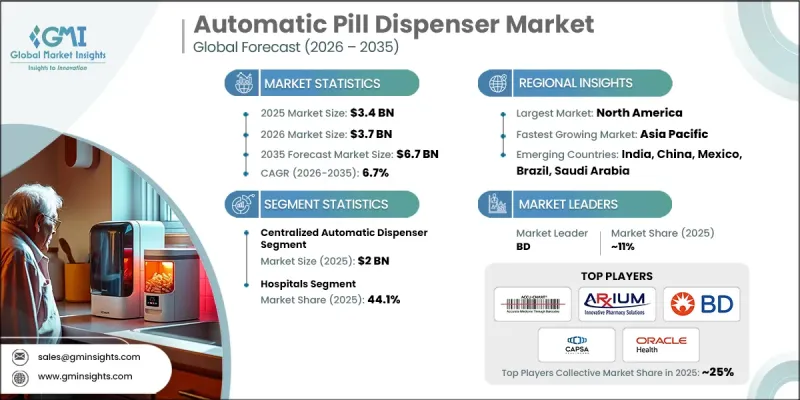
Growth in the automatic pill dispenser market is driven by the increasing prevalence of dementia and other neurodegenerative conditions, a rapidly expanding aging population, and the growing volume of prescription medications worldwide. Automatic pill dispensers are designed to assist individuals in organizing and dispensing medications in a timely and accurate manner, improving adherence to prescribed treatment schedules. These devices are particularly valuable for individuals managing multiple medications or those experiencing cognitive challenges that may affect their ability to maintain consistent medication routines. Rising awareness regarding the importance of medication adherence is encouraging healthcare systems and support organizations to promote solutions that help patients follow treatment plans correctly. Caregivers also benefit from automated medication management tools that reduce the complexity of supervising daily dosing schedules. At the same time, the expanding adoption of telehealth services and remote patient monitoring technologies is strengthening the role of automated medication management devices in modern healthcare. The growing preference for home-based healthcare services, supported by the increasing cost of institutional care and the desire for more comfortable care environments, is further boosting the demand for user-friendly automated medical devices such as automatic pill dispensers.
| Market Scope | |
|---|---|
| Start Year | 2025 |
| Forecast Year | 2026-2035 |
| Start Value | $3.4 Billion |
| Forecast Value | $6.7 Billion |
| CAGR | 6.7% |
The centralized automatic dispenser segment generated USD 2 billion in 2025. These systems are widely utilized within large healthcare institutions where efficient medication storage, dispensing, and tracking are essential for operational performance. Centralized dispensing technologies support accurate medication distribution while helping healthcare providers maintain better control over pharmaceutical inventories. Medication dispensing errors remain a significant concern within healthcare environments, and automated centralized systems help minimize these risks by delivering precise and consistent medication handling. In addition to improving accuracy, these systems help healthcare institutions comply with regulatory standards by maintaining detailed digital records of medication distribution, which supports documentation and reporting requirements.
The hospitals segment held 44.1% share in 2025 and is projected to reach USD 2.8 billion during 2026-2035. Hospitals manage substantial volumes of medications each day, which increases the need for highly reliable dispensing systems that reduce the likelihood of medication-related errors. Automated dispensing technologies enhance accuracy in medication administration and help reduce the risk of adverse drug events, ultimately supporting improved patient outcomes. The growing number of patient admissions, supported by demographic shifts and the rising prevalence of chronic diseases, is increasing the demand for efficient medication management systems within hospital environments. Additionally, automatic pill dispensers connected with hospital inventory management systems allow healthcare providers to monitor pharmaceutical supplies more effectively. Real-time tracking capabilities help prevent medication shortages while minimizing waste through improved stock management.
United States Automatic Pill Dispenser Market reached USD 1.2 billion in 2025. Expansion of the home healthcare sector in the United States is a major factor supporting this growth, as many individuals increasingly prefer receiving care within their homes rather than in institutional settings. Automated medication dispensing systems allow elderly individuals and patients with chronic conditions to manage prescriptions independently while reducing reliance on continuous caregiver supervision. Government healthcare policies are also supporting the adoption of technologies that promote medication adherence and improve patient safety. Reimbursement support for home healthcare solutions further strengthens the adoption of automated medication management technologies within residential care environments.
Key companies participating in the Global Automatic Pill Dispenser Market include Omnicell, MedMinder, ARxIUM, BD, ScriptPro, CAPSA HEALTHCARE, McKesson, InstyMeds, swisslog healthcare, Medipense, Hero Health, ACCU-CHART, PharmaCell, and Oracle Health. Companies operating in the Automatic Pill Dispenser Market are implementing several strategic initiatives to strengthen their competitive positioning and expand market reach. Product innovation remains a major focus, with manufacturers investing in advanced dispensing technologies that integrate digital monitoring, connectivity, and smart alerts to improve medication adherence. Many companies are also forming strategic partnerships with healthcare providers, pharmacies, and technology firms to enhance product integration within healthcare systems. Expansion of distribution networks and manufacturing capacity is helping companies meet growing global demand for automated medication management devices. Additionally, organizations are increasingly incorporating remote monitoring features and telehealth compatibility into their products to support evolving healthcare delivery models.
Table of Contents
Chapter 1 Research Methodology
- 1.1 Research approach
- 1.2 Quality commitments
- 1.2.1 GMI AI policy & data integrity commitment
- 1.2.1.1 Source consistency protocol
- 1.2.1 GMI AI policy & data integrity commitment
- 1.3 Research trail & confidence scoring
- 1.3.1 Research trail components
- 1.3.2 Scoring components
- 1.4 Data collection
- 1.4.1 Partial list of primary sources
- 1.5 Data mining sources
- 1.5.1 Paid sources
- 1.5.1.1 Sources, by region
- 1.5.1 Paid sources
- 1.6 Base estimates and calculations
- 1.6.1 Base year calculation for any one approach
- 1.7 Forecast model
- 1.7.1 Quantified market impact analysis
- 1.7.1.1 Mathematical impact of growth parameters on forecast
- 1.7.1 Quantified market impact analysis
- 1.8 Research transparency addendum
- 1.8.1 Source attribution framework
- 1.8.2 Quality assurance metrics
- 1.8.3 Our commitment to trust
Chapter 2 Executive Summary
- 2.1 Industry 360° synopsis
- 2.2 Key market trends
- 2.2.1 Regional trends
- 2.2.2 Product trends
- 2.2.3 End use trends
- 2.3 CXO perspectives: Strategic imperatives
Chapter 3 Industry Insights
- 3.1 Industry ecosystem analysis
- 3.2 Industry impact forces
- 3.2.1 Growth drivers
- 3.2.1.1 Rising dementia & neurodegenerative disorders
- 3.2.1.2 Surging aging population & higher medication usage
- 3.2.1.3 Technological advancements
- 3.2.1.4 Adoption of telehealth & remote patient monitoring
- 3.2.2 Industry pitfalls and challenges
- 3.2.2.1 High cost of the device
- 3.2.3 Market opportunities
- 3.2.3.1 Rise of advanced smart & AI-enabled pill dispensers
- 3.2.1 Growth drivers
- 3.3 Growth potential analysis
- 3.4 Regulatory landscape
- 3.4.1 North America
- 3.4.2 Europe
- 3.4.3 Asia Pacific
- 3.5 Technology landscape (Driven by Primary Research)
- 3.5.1 Current technological trends
- 3.5.2 Emerging technologies
- 3.6 Future market trends
- 3.7 Patent analysis
- 3.8 Pricing analysis, 2025 (Driven by Primary Research)
- 3.9 Customer insights (Driven by Primary Research)
- 3.10 Porter's analysis
- 3.11 Impact of AI and generative AI on the market
- 3.12 PESTEL analysis
- 3.13 Gap analysis
Chapter 4 Competitive Landscape, 2025
- 4.1 Introduction
- 4.2 Company matrix analysis
- 4.3 Company market share analysis
- 4.3.1 Global
- 4.3.2 North America
- 4.3.3 Europe
- 4.3.4 Asia Pacific
- 4.4 Competitive positioning matrix
- 4.5 Competitive analysis of major market players
- 4.6 Key developments
- 4.6.1 Mergers & acquisitions
- 4.6.2 Partnerships & collaborations
- 4.6.3 New product type launches
- 4.6.4 Expansion plans
Chapter 5 Market Estimates and Forecast, By Product, 2022 - 2035 ($ Mn)
- 5.1 Key trends
- 5.2 Centralized automatic dispenser
- 5.2.1 Robotic
- 5.2.2 Carousels
- 5.3 Decentralized automatic dispenser
- 5.3.1 Ward based automated dispensing system
- 5.3.2 Pharmacy based automated dispensing system
- 5.3.3 Automatic unit dose dispensing system
Chapter 6 Market Estimates and Forecast, By End Use, 2022 - 2035 ($ Mn)
- 6.1 Key trends
- 6.2 Hospitals
- 6.3 Senior care facilities
- 6.4 Pharmacies
- 6.5 Other end users
Chapter 7 Market Estimates and Forecast, By Region, 2022 - 2035 ($ Mn)
- 7.1 Key trends
- 7.2 North America
- 7.2.1 U.S.
- 7.2.2 Canada
- 7.3 Europe
- 7.3.1 Germany
- 7.3.2 UK
- 7.3.3 France
- 7.3.4 Spain
- 7.3.5 Italy
- 7.3.6 Netherlands
- 7.4 Asia Pacific
- 7.4.1 China
- 7.4.2 Japan
- 7.4.3 India
- 7.4.4 Australia
- 7.4.5 South Korea
- 7.5 Latin America
- 7.5.1 Brazil
- 7.5.2 Mexico
- 7.5.3 Argentina
- 7.6 Middle East and Africa
- 7.6.1 South Africa
- 7.6.2 Saudi Arabia
- 7.6.3 UAE
Chapter 8 Company Profiles
- 8.1 ACCU-CHART
- 8.2 ARxIUM
- 8.3 BD
- 8.4 CAPSA HEALTHCARE
- 8.5 Hero Health
- 8.6 InstyMeds
- 8.7 McKesson
- 8.8 Medipense
- 8.9 MedMinder
- 8.10 Omnicell
- 8.11 Oracle Health
- 8.12 PharmaCell
- 8.13 ScriptPro
- 8.14 swisslog healthcare

