PUBLISHER: Global Market Insights Inc. | PRODUCT CODE: 1998746

PUBLISHER: Global Market Insights Inc. | PRODUCT CODE: 1998746
Self-testing Market Opportunity, Growth Drivers, Industry Trend Analysis, and Forecast 2026 - 2035
The Global Self-testing Market was valued at USD 21.9 billion in 2025 and is estimated to grow at a CAGR of 7.7% to reach USD 46.1 billion by 2035.
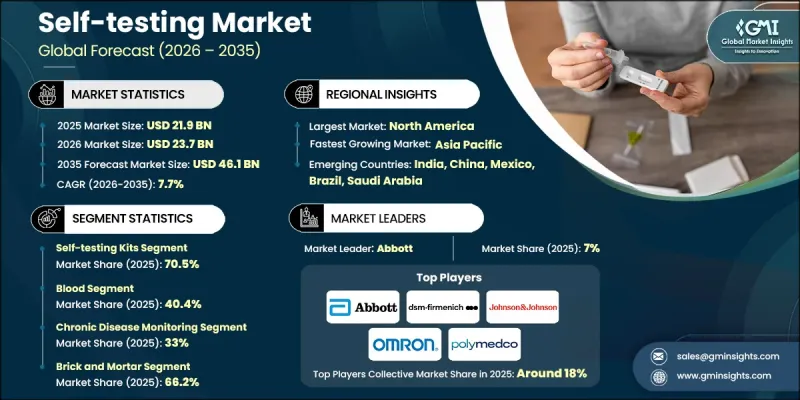
Growth within the self-testing market is largely driven by the rising incidence of chronic health conditions, greater awareness regarding preventive healthcare practices, and the increasing accessibility of convenient at-home diagnostic solutions. Self-testing refers to diagnostic tools that enable individuals to evaluate health conditions independently without the need to visit a medical facility, either by performing the test themselves or by collecting a specimen for laboratory analysis from home. Market expansion is closely connected to the increasing burden of long-term and infectious health conditions, combined with a broader societal shift toward proactive health management. Consumers are becoming more engaged in monitoring important health indicators and taking a preventative approach to personal wellness. At the same time, digital health technologies and public health initiatives have helped improve awareness regarding the value and convenience of self-administered diagnostic tools. Growing demand for fast, reliable, and discreet testing solutions outside conventional healthcare facilities is further supporting market development, particularly as patients seek greater control over their healthcare decisions and monitoring practices.
| Market Scope | |
|---|---|
| Start Year | 2025 |
| Forecast Year | 2026-2035 |
| Start Value | $21.9 Billion |
| Forecast Value | $46.1 Billion |
| CAGR | 7.7% |
The self-testing kits segment held a 70.5% share in 2025. This segment continues to maintain a strong position due to its convenience, broad availability, and increasing consumer preference for quick at-home diagnostic solutions. Self-testing kits support early health detection and regular monitoring, which has significantly increased their acceptance among individuals seeking more control over personal health management. Ongoing product development and technological advancements are expanding the range of health conditions that can be assessed using these kits. In addition, stronger distribution networks across pharmacies, digital marketplaces, and healthcare retail outlets have improved accessibility for consumers. Supportive regulatory environments in multiple countries have also facilitated faster product approvals, allowing new self-testing solutions to enter the market more efficiently.
The blood segment accounted for 40.4% share in 2025 and is projected to reach USD 19 billion during 2026-2035. This segment maintains its leading position due to the reliability of blood-based diagnostics for detecting and monitoring key health indicators. Blood samples provide accurate biomarker measurements, making them highly valuable for routine health monitoring and disease management. Advancements in minimally invasive sampling technologies have improved user comfort and acceptance, enabling individuals to collect samples conveniently at home while maintaining diagnostic reliability. Increasing cases of chronic health conditions that require consistent monitoring continue to strengthen demand for blood-based self-testing solutions. Furthermore, ongoing innovation in rapid testing technologies is expected to further reinforce the importance of this segment throughout the forecast timeline.
U.S. Self-testing Market generated USD 7.7 billion in 2025. The country's leadership is supported by a well-developed healthcare ecosystem and strong consumer awareness regarding preventive health practices. Widespread acceptance of at-home diagnostic tools has strengthened the market, particularly as individuals increasingly adopt convenient testing solutions for ongoing health monitoring. Regulatory frameworks that support product approvals and encourage innovation have also contributed to consistent advancements in diagnostic technologies. Additionally, the expansion of telehealth services and digital healthcare platforms has strengthened the role of self-testing within decentralized healthcare delivery models. Broader insurance coverage for certain diagnostic tests and extensive distribution through pharmacies and online retail channels have further enhanced accessibility, allowing the United States to maintain a dominant share of the global self-testing market.
Major companies operating in the Global Self-testing Market include Abbott, Roche, Johnson & Johnson, Omron Healthcare, Clearblue, Everlywell, ACON, PTS Diagnostics, Polymedco, FORA, YorkTest, myLAB Box, First Response, DSM-Firmenich, Patris Health, and Wisp TBD. Companies participating in the Self-Testing Market are strengthening their competitive position through innovation, digital integration, and strategic partnerships. Many firms are investing heavily in research and development to design advanced testing kits that deliver faster results, improved accuracy, and simplified user experiences. Companies are also expanding product portfolios to address a wider range of health monitoring needs. Partnerships with digital health platforms and telemedicine providers allow organizations to integrate self-testing with remote healthcare services, creating more comprehensive care solutions. In addition, manufacturers are strengthening global distribution networks by collaborating with pharmacies, online retailers, and healthcare providers.
Table of Contents
Chapter 1 Research Methodology
- 1.1 Research approach
- 1.2 Quality commitments
- 1.2.1 GMI AI policy & data integrity commitment
- 1.2.1.1 Source consistency protocol
- 1.2.1 GMI AI policy & data integrity commitment
- 1.3 Research trail & confidence scoring
- 1.3.1 Research trail components
- 1.3.2 Scoring components
- 1.4 Data collection
- 1.4.1 Partial list of primary sources
- 1.5 Data mining sources
- 1.5.1 Paid sources
- 1.5.1.1 Sources, by region
- 1.5.1 Paid sources
- 1.6 Base estimates and calculations
- 1.6.1 Base year calculation for any one approach
- 1.7 Forecast model
- 1.7.1 Quantified market impact analysis
- 1.7.1.1 Mathematical impact of growth parameters on forecast
- 1.7.1 Quantified market impact analysis
- 1.8 Research transparency addendum
- 1.8.1 Source attribution framework
- 1.8.2 Quality assurance metrics
- 1.8.3 Our commitment to trust
Chapter 2 Executive Summary
- 2.1 Industry 3600 synopsis
- 2.2 Key market trends
- 2.2.1 Regional trends
- 2.2.2 Product type trends
- 2.2.3 Sample type trends
- 2.2.4 Application trends
- 2.2.5 Distribution channel trends
- 2.3 CXO perspectives: Strategic imperatives
Chapter 3 Industry Insights
- 3.1 Industry ecosystem analysis
- 3.2 Industry impact forces
- 3.2.1 Growth drivers
- 3.2.1.1 Development of technologically advanced self-test kits
- 3.2.1.2 Growing adoption and easy availability of self-testing kits
- 3.2.1.3 Rising awareness of preventive healthcare
- 3.2.1.4 Increasing prevalence of chronic diseases
- 3.2.2 Industry pitfalls and challenges
- 3.2.2.1 Lack of accuracy and reliability
- 3.2.2.2 Affordability and complexity issues associated with tests
- 3.2.3 Market opportunities
- 3.2.3.1 Rising demand for convenient, privacy-focused diagnostics
- 3.2.3.2 Increased regulatory support and streamlined approval pathways
- 3.2.1 Growth drivers
- 3.3 Growth potential analysis
- 3.4 Regulatory landscape
- 3.4.1 North America
- 3.4.2 Europe
- 3.4.3 Asia Pacific
- 3.5 Technology landscape
- 3.5.1 Current technological trends
- 3.5.2 Emerging technologies
- 3.6 Future market trends
- 3.7 Pipeline analysis
- 3.8 Patent analysis
- 3.9 Pricing analysis, 2025
- 3.10 Customer insights
- 3.11 Porter's analysis
- 3.12 PESTEL analysis
- 3.13 Gap analysis
Chapter 4 Competitive Landscape, 2025
- 4.1 Introduction
- 4.2 Company matrix analysis
- 4.3 Company market share analysis
- 4.3.1 Global
- 4.3.2 North America
- 4.3.3 Europe
- 4.3.4 Asia Pacific
- 4.3.5 LAMEA
- 4.4 Competitive positioning matrix
- 4.5 Competitive analysis of major market players
- 4.6 Key developments
- 4.6.1 Mergers & acquisitions
- 4.6.2 Partnerships & collaborations
- 4.6.3 New product type launches
- 4.6.4 Expansion plans
Chapter 5 Market Estimates and Forecast, By Product Type, 2022 - 2035 ($ Mn)
- 5.1 Key trends
- 5.2 Self-testing kits
- 5.3 Self-collection test kits
Chapter 6 Market Estimates and Forecast, By Sample Type, 2022 - 2035 ($ Mn)
- 6.1 Key trends
- 6.2 Blood
- 6.3 Urine
- 6.4 Saliva
- 6.5 Stool
- 6.6 Other sample types
Chapter 7 Market Estimates and Forecast, By Application, 2022 - 2035 ($ Mn)
- 7.1 Key trends
- 7.2 Chronic disease monitoring
- 7.2.1 Blood glucose testing
- 7.2.2 Blood pressure monitoring
- 7.2.3 Cholesterol & triglycerides
- 7.2.4 Other chronic disease monitoring
- 7.3 Reproductive & hormonal health
- 7.3.1 Pregnancy test
- 7.3.2 Ovulation/Fertility tests
- 7.3.3 Other reproductive & hormonal health tests
- 7.4 Infectious disease testing
- 7.4.1 UTI testing
- 7.4.2 STD/STI tests
- 7.4.3 Other infectious disease tests
- 7.5 Preventive & wellness testing
- 7.6 Serious disease early detection
- 7.7 Behavioral/Forensic
- 7.8 Other applications
Chapter 8 Market Estimates and Forecast, By Distribution Channel, 2022 - 2035 ($ Mn)
- 8.1 Key trends
- 8.2 Brick and mortar
- 8.3 E-commerce
Chapter 9 Market Estimates and Forecast, By Region, 2022 - 2035 ($ Mn)
- 9.1 Key trends
- 9.2 North America
- 9.2.1 U.S.
- 9.2.2 Canada
- 9.3 Europe
- 9.3.1 Germany
- 9.3.2 UK
- 9.3.3 France
- 9.3.4 Spain
- 9.3.5 Italy
- 9.3.6 Netherlands
- 9.4 Asia Pacific
- 9.4.1 China
- 9.4.2 Japan
- 9.4.3 India
- 9.4.4 Australia
- 9.4.5 South Korea
- 9.5 Latin America
- 9.5.1 Brazil
- 9.5.2 Mexico
- 9.5.3 Argentina
- 9.6 Middle East and Africa
- 9.6.1 South Africa
- 9.6.2 Saudi Arabia
- 9.6.3 UAE
Chapter 10 Company Profiles
- 10.1 Abbott
- 10.2 ACON
- 10.3 Clearblue
- 10.4 dsm-firmenich
- 10.5 everlywell
- 10.6 FIRST RESPONSE
- 10.7 FORA
- 10.8 Johnson & Johnson
- 10.9 myLAB Box
- 10.10 Omron Healthcare
- 10.11 Patris Health
- 10.12 polymedco
- 10.13 pts Diagnostics
- 10.14 Roche
- 10.15 wisp TBD
- 10.16 yorktest

