PUBLISHER: Global Market Insights Inc. | PRODUCT CODE: 1998757

PUBLISHER: Global Market Insights Inc. | PRODUCT CODE: 1998757
Interceptor Missiles Market Opportunity, Growth Drivers, Industry Trend Analysis, and Forecast 2026 - 2035
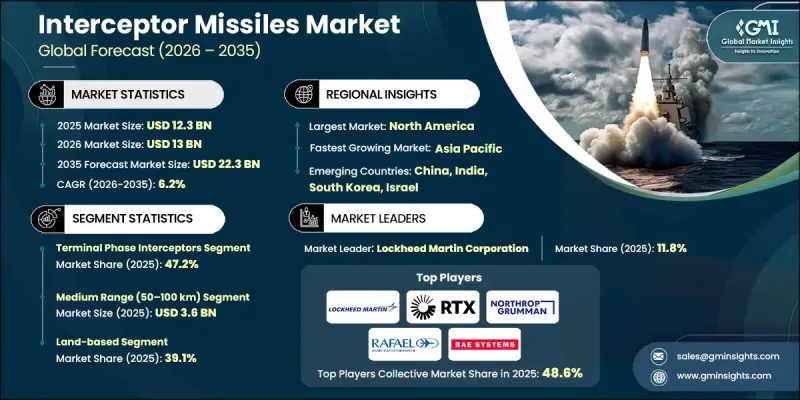
The Global Interceptor Missiles Market was valued at USD 12.3 billion in 2025 and is estimated to grow at a CAGR of 6.2% to reach USD 22.3 billion by 2035.
Market expansion is driven by increasing global defense budgets, rising threats from ballistic and hypersonic missiles, and continuous advancements in missile interception technologies. Governments are prioritizing modernization of air and missile defense systems to counter emerging threats, including medium- and long-range ballistic missiles, cruise missiles, and hypersonic glide vehicles. The adoption of multi-layered missile defense architectures, which combine terminal, midcourse, and boost-phase interceptors, is reshaping defense strategies worldwide. Integration of AI-driven guidance, radar, and infrared sensing, and predictive algorithms allows real-time threat tracking, enhancing interception success rates. Expansion of foreign military sales and allied defense programs further strengthens market demand, while space- and airborne-based early warning systems are increasingly being integrated to improve detection, coordination, and operational efficiency. Rising geopolitical tensions, coupled with strategic investments in homeland and allied security, are expected to maintain strong industry growth throughout the forecast period.
| Market Scope | |
|---|---|
| Start Year | 2025 |
| Forecast Year | 2026-2035 |
| Start Value | $12.3 Billion |
| Forecast Value | $22.3 Billion |
| CAGR | 6.2% |
The terminal phase interceptors segment held a 47.2% share in 2025, reflecting their critical role in neutralizing short- and medium-range ballistic missile threats. Terminal interceptors are valued for rapid response capabilities, proven reliability, and operational flexibility in layered defense networks. Their deployment is widespread across national and allied programs due to high success rates in real-world exercises. Continuous development in propulsion systems, guidance accuracy, and warhead efficiency enhances their operational effectiveness, making them central to modern missile defense strategies. Governments are increasingly relying on terminal interceptors to complement midcourse and boost-phase systems, ensuring a multi-layered approach to air and missile defense that mitigates risk across multiple threat vectors.
The Medium-range interceptors (50-100 km) accounted for USD 3.6 billion in 2025, owing to their ability to balance cost, coverage, and operational flexibility. These systems are widely adopted for regional missile defense programs, providing both homeland and allied protection against evolving missile threats. Their integration into multi-tiered defense networks allows seamless coordination with terminal and midcourse interceptors, optimizing response times and threat neutralization. Increasing investment in AI-assisted targeting, networked sensor fusion, and automated command centers is further enhancing medium-range interceptor efficiency. These systems are becoming the preferred choice for countries seeking cost-effective yet technologically advanced solutions to protect critical infrastructure, military assets, and urban centers.
North America Interceptor Missiles Market held 41.7% share in 2025, driven by strategic investments in multi-layered air and missile defense programs. Rising geopolitical tensions and the need to protect both homeland and allied interests are prompting significant defense budget allocations. Advanced R&D initiatives focus on AI-guided targeting, multi-sensor fusion, and enhanced situational awareness to maintain technological superiority. Integration of space- and network-based early warning systems enables rapid response, improved coordination, and accurate threat assessment. The expansion of foreign military sales and cooperative defense programs supports regional dominance and creates opportunities for system upgrades, training programs, and strategic partnerships. Strong defense industrial bases and technological leadership ensure that North America remains a global hub for interceptor missile innovation.
Prominent players in the Global Interceptor Missiles Market include Lockheed Martin Corporation, RTX Corporation, Northrop Grumman Corporation, Boeing Defense Space & Security, BAE Systems plc, Thales Group, MBDA, Rafael Advanced Defense Systems Ltd., Israel Aerospace Industries, Aselsan A.S., Saab AB, Mitsubishi Heavy Industries, Hanwha Aerospace, Anduril Industries, BlueHalo, and Dynetics. Companies in the Global Interceptor Missiles Market are strengthening their positions through continuous innovation in propulsion systems, guidance technologies, and sensor integration. Firms are expanding their presence in emerging markets via strategic alliances, joint ventures, and foreign military sales. Investments in AI-assisted targeting, predictive algorithms, and networked command-and-control systems are enhancing operational efficiency and effectiveness. Companies are also focusing on modular and upgradeable systems to extend product lifecycles and meet evolving threat scenarios. Marketing collaborations with governments, military exercises, and training programs help build trust and demonstrate technological superiority. By prioritizing R&D, global footprint expansion, and strategic partnerships, companies are ensuring sustained competitiveness and long-term market leadership.
Table of Contents
Chapter 1 Methodology and Scope
- 1.1 Market scope and definition
- 1.2 Research design
- 1.2.1 Research approach
- 1.2.2 Data collection methods
- 1.3 Data mining sources
- 1.3.1 Global
- 1.3.2 Regional/Country
- 1.4 Base estimates and calculations
- 1.4.1 Base year calculation
- 1.4.2 Key trends for market estimation
- 1.5 Primary research and validation
- 1.5.1 Primary sources
- 1.6 Forecast model
- 1.7 Research assumptions and limitations
Chapter 2 Executive Summary
- 2.1 Industry 360° synopsis, 2022 - 2035
- 2.2 Key market trends
- 2.2.1 Intercept phase trends
- 2.2.2 Threat type trends
- 2.2.3 Launch platform trends
- 2.2.4 Range trends
- 2.2.5 Guidance system trends
- 2.2.6 Region trends
- 2.3 TAM Analysis, 2026-2035
- 2.4 CXO perspectives: Strategic imperatives
Chapter 3 Industry Insights
- 3.1 Industry ecosystem analysis
- 3.1.1 Supplier Landscape
- 3.1.2 Profit Margin
- 3.1.3 Cost structure
- 3.1.4 Value addition at each stage
- 3.1.5 Factor affecting the value chain
- 3.1.6 Disruptions
- 3.2 Industry impact forces
- 3.2.1 Growth drivers
- 3.2.1.1 Increasing global defense spending on missile defense systems
- 3.2.1.2 Rising ballistic and hypersonic missile threats
- 3.2.1.3 Advancements in interceptor missile technologies and guidance systems
- 3.2.1.4 Growing adoption of multi-layered missile defense architectures
- 3.2.1.5 Expansion of foreign military sales and allied defense programs
- 3.2.2 Industry pitfalls and challenges
- 3.2.2.1 High development and procurement costs of interceptor missile systems
- 3.2.2.2 Strict regulatory and export control restrictions on missile technologies
- 3.2.3 Market opportunities
- 3.2.3.1 Integration of interceptor missiles with space-based and early warning systems
- 3.2.3.2 Modernization and replacement of legacy air and missile defense systems
- 3.2.1 Growth drivers
- 3.3 Growth potential analysis
- 3.4 Regulatory landscape
- 3.4.1 North America
- 3.4.2 Europe
- 3.4.3 Asia Pacific
- 3.4.4 Latin America
- 3.4.5 Middle East & Africa
- 3.5 Porter's analysis
- 3.6 PESTEL analysis
- 3.7 Technology and Innovation landscape
- 3.7.1 Current technological trends
- 3.7.2 Emerging technologies
- 3.8 Emerging business models
- 3.9 Compliance requirements
- 3.10 Patent and IP analysis
- 3.11 Pricing analysis (Driven by Primary Research)
- 3.11.1 Historical price trend analysis
- 3.11.2 Pricing strategy by player type
- 3.12 Trade Data Analysis (Based on Paid Databases)
- 3.12.1 Import/export volume & value trends
- 3.12.2 Key trade corridors & tariff impact
- 3.13 Impact of AI & generative AI on the market (Driven by Primary Research)
- 3.13.1 AI-driven disruption of existing business models
- 3.13.2 GenAI use cases & adoption roadmap by segment
- 3.13.3 Risks, limitations & regulatory considerations
- 3.14 Capacity & production landscape (Driven by Primary Research)
- 3.14.1 Production capacity by region & key producer
- 3.14.2 Capacity utilization rates & expansion pipelines
- 3.15 Defense budget analysis
- 3.16 Global defense spending trends
- 3.17 Regional defense budget allocation
- 3.17.1 North America
- 3.17.2 Europe
- 3.17.3 Asia Pacific
- 3.17.4 Middle East and Africa
- 3.17.5 Latin America
- 3.18 Key defense modernization programs
- 3.19 Budget forecast (2025-2034)
- 3.19.1 Impact on industry growth
- 3.19.2 Defense budgets by country
- 3.19.3 Defense budget allocation by segment
- 3.19.3.1 Personnel
- 3.19.3.2 Operations and maintenance
- 3.19.3.3 Procurement
- 3.19.3.4 Research, development, test and evaluation
- 3.19.3.5 Infrastructure and construction
- 3.19.3.6 Technology and innovation
- 3.20 Supply chain resilience
- 3.21 Geopolitical analysis
- 3.22 Workforce analysis
- 3.23 Digital transformation
- 3.24 Mergers, acquisitions, and strategic partnerships landscape
- 3.25 Risk assessment and management
- 3.26 Major contract awards (2021-2024)
Chapter 4 Competitive Landscape, 2025
- 4.1 Introduction
- 4.2 Company market share analysis
- 4.2.1 By region
- 4.2.1.1 North America
- 4.2.1.2 Europe
- 4.2.1.3 Asia Pacific
- 4.2.1.4 Latin America
- 4.2.1.5 Middle East & Africa
- 4.2.2 Market concentration analysis
- 4.2.1 By region
- 4.3 Competitive benchmarking of key players
- 4.3.1 Financial performance comparison
- 4.3.1.1 Revenue
- 4.3.1.2 Profit margin
- 4.3.1.3 R&D
- 4.3.2 Product portfolio comparison
- 4.3.2.1 Product range breadth
- 4.3.2.2 Technology
- 4.3.2.3 Innovation
- 4.3.3 Geographic presence comparison
- 4.3.3.1 Global footprint analysis
- 4.3.3.2 Service network coverage
- 4.3.3.3 Market penetration by region
- 4.3.4 Competitive positioning matrix
- 4.3.4.1 Leaders
- 4.3.4.2 Challengers
- 4.3.4.3 Followers
- 4.3.4.4 Niche players
- 4.3.1 Financial performance comparison
- 4.4 Key developments
- 4.4.1 Mergers and acquisitions
- 4.4.2 Partnerships and collaborations
- 4.4.3 Technological advancements
- 4.4.4 Expansion and investment strategies
- 4.4.5 Digital transformation initiatives
- 4.5 Emerging/ startup competitors landscape
Chapter 5 Market Estimates and Forecast, By Intercept Phase, 2022 - 2035 (USD Billion)
- 5.1 Key trends
- 5.2 Terminal phase interceptors
- 5.3 Midcourse phase interceptors
- 5.4 Boost phase interceptors
Chapter 6 Market Estimates and Forecast, By Threat Type, 2022 - 2035 (USD Billion)
- 6.1 Key trends
- 6.2 Ballistic missile interceptors
- 6.3 Cruise missile interceptors
- 6.4 Hypersonic threat interceptors
- 6.5 Aircraft / aerial threat interceptors
Chapter 7 Market Estimates and Forecast, By Launch Platform, 2022 - 2035 (USD Billion)
- 7.1 Key trends
- 7.2 Land-based
- 7.3 Naval / ship-based
- 7.4 Airborne
- 7.5 Space-based
Chapter 8 Market Estimates and Forecast, By Range, 2022 - 2035 (USD Billion)
- 8.1 Key trends
- 8.2 Short range (<50 km)
- 8.3 Medium range (50-100 km)
- 8.4 Long range (100-1,000 km)
- 8.5 Extended range (>1,000 km)
Chapter 9 Market Estimates and Forecast, By Guidance System, 2022 - 2035 (USD Billion)
- 9.1 Key trends
- 9.2 Radar-guided systems
- 9.3 Infrared / heat-seeking systems
- 9.4 Command-guided systems
- 9.5 Gps-guided systems
- 9.6 Multi-sensor / hybrid guidance systems
Chapter 10 Market Estimates and Forecast, By Region, 2022 - 2035 (USD Billion)
- 10.1 Key trends
- 10.2 North America
- 10.2.1 U.S.
- 10.2.2 Canada
- 10.3 Europe
- 10.3.1 Germany
- 10.3.2 UK
- 10.3.3 France
- 10.3.4 Spain
- 10.3.5 Italy
- 10.3.6 Netherlands
- 10.4 Asia Pacific
- 10.4.1 China
- 10.4.2 India
- 10.4.3 Japan
- 10.4.4 Australia
- 10.4.5 South Korea
- 10.5 Latin America
- 10.5.1 Brazil
- 10.5.2 Mexico
- 10.5.3 Argentina
- 10.6 Middle East and Africa
- 10.6.1 South Africa
- 10.6.2 Saudi Arabia
- 10.6.3 UAE
Chapter 11 Company Profiles
- 11.1 Global Key Players
- 11.1.1 RTX Corporation
- 11.1.2 Lockheed Martin Corporation
- 11.1.3 Northrop Grumman Corporation
- 11.1.4 Boeing Defense, Space & Security
- 11.1.5 BAE Systems plc
- 11.1.6 MBDA
- 11.1.7 Thales Group
- 11.2 Regional Players
- 11.2.1 Rafael Advanced Defense Systems Ltd.
- 11.2.2 Israel Aerospace Industries
- 11.2.3 Aselsan A.
- 11.2.4 Saab AB
- 11.2.5 Mitsubishi Heavy Industries
- 11.2.6 Hanwha Aerospace
- 11.3 Niche Players
- 11.3.1 Anduril Industries
- 11.3.2 BlueHalo
- 11.3.3 Dynetics
- 11.3.4 Bharat Dynamics Limited

