PUBLISHER: Global Market Insights Inc. | PRODUCT CODE: 1998765

PUBLISHER: Global Market Insights Inc. | PRODUCT CODE: 1998765
Automotive Parallel Hybrid Power System Market Opportunity, Growth Drivers, Industry Trend Analysis, and Forecast 2026 - 2035
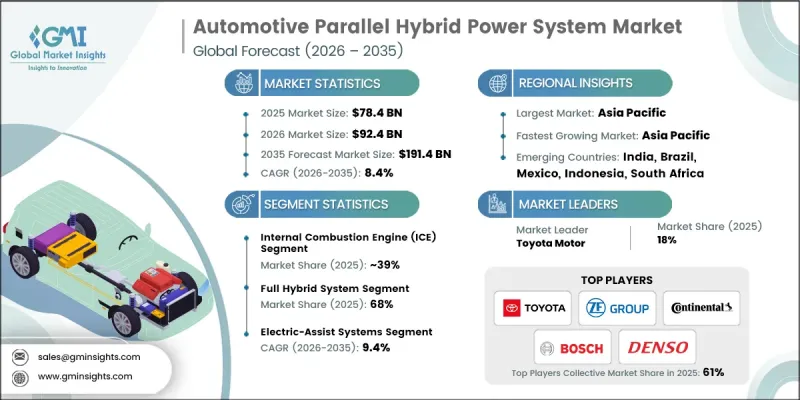
The Global Automotive Parallel Hybrid Power System Market was valued at USD 78.4 billion in 2025 and is estimated to grow at a CAGR of 8.4% to reach USD 191.4 billion by 2035.
Rising regulatory pressure on fleet average greenhouse gas emissions and vehicle fuel economy is compelling automakers to adopt parallel hybrid systems as a cost-effective strategy to reduce emissions without fully transitioning to battery electric vehicles. Parallel hybrids offer a practical solution to improve fuel efficiency in urban and stop-and-go driving conditions, particularly for passenger cars, taxis, and last-mile delivery vehicles. These systems combine regenerative braking, electric motor assistance, and optimized internal combustion engines (ICE) to reduce fuel consumption and provide long-term operational cost savings. Growing urbanization, fluctuating oil prices, and increasing demand for sustainable mobility further strengthen the adoption of parallel hybrid vehicles. OEMs and fleet operators are investing in hybrid solutions that balance environmental compliance with performance, durability, and cost efficiency.
| Market Scope | |
|---|---|
| Start Year | 2025 |
| Forecast Year | 2026-2035 |
| Start Value | $78.4 Billion |
| Forecast Value | $191.4 Billion |
| CAGR | 8.4% |
The internal combustion engines segment held 39% share in 2025 and is projected to grow at a CAGR of 7.1% through 2035. ICE units in parallel hybrid vehicles are becoming smaller, more efficient, and integrated with turbochargers, lightweight materials, and advanced thermal management. Regenerative braking and sophisticated control software are enhancing torque assistance, fuel efficiency, and emission reductions, while providing smooth transitions between electric and combustion modes. These technological improvements ensure consistent performance under varied driving conditions and improve overall powertrain efficiency.
The full hybrid systems segment held a 68% share in 2025 and is expected to grow at a CAGR of 8% through 2035. Full hybrid solutions are favored by consumers seeking fuel-efficient SUVs and passenger cars, particularly as governments continue to offer financial incentives for hybrid adoption. OEMs are investing in better integration of battery systems with ICE components, optimizing energy recovery, and enhancing electric assist performance. These developments increase fuel economy, support emission reduction targets, and make full hybrid systems one of the fastest-growing market segments.
U.S. Automotive Parallel Hybrid Power System Market reached USD 17.8 billion in 2025. Increased adoption of mild and full hybrid sedans and SUVs is driven by urban commuters, federal incentives, and rising consumer awareness of environmental impacts. Fleet operators are incorporating hybrid vehicles to reduce operational costs and meet emission regulations. Manufacturers are enhancing regenerative braking, electric assist systems, and hybrid powertrain efficiency while improving the driving experience, which is driving widespread acceptance of hybrid solutions across private and commercial fleets.
Major players operating in the Global Automotive Parallel Hybrid Power System Market include Aisin, BorgWarner, Continental, Denso, Hyundai Mobis, Magna International, Robert Bosch, Toyota Motor, Valeo, and ZF Friedrichshafen. Companies in the Global Automotive Parallel Hybrid Power System Market are pursuing strategies such as expanding R&D for high-efficiency hybrid components, integrating lightweight materials and advanced electronics, and developing modular full and mild hybrid platforms. They are forming strategic partnerships with OEMs to accelerate vehicle adoption and comply with emission standards. Firms are also investing in software solutions for optimized energy management, regenerative braking, and torque assistance. Targeted regional expansion, local manufacturing, and aftermarket support enhance market penetration. Additionally, offering cost-effective, fuel-efficient hybrid solutions tailored for urban fleets and passenger vehicles strengthens brand presence, drives consumer preference, and ensures long-term competitive advantage in a rapidly evolving automotive landscape.
Table of Contents
Chapter 1 Methodology
- 1.1 Research approach
- 1.2 Quality commitments
- 1.3 GMI AI policy & data integrity commitment
- 1.4 Research trail & confidence scoring
- 1.4.1 Research trail components
- 1.4.2 Scoring components
- 1.5 Data collection
- 1.5.1 Partial list of primary sources
- 1.6 Data mining sources
- 1.6.1 Paid sources
- 1.7 Base estimates and calculations
- 1.7.1 Base year calculation
- 1.8 Forecast model
- 1.9 Research transparency addendum
Chapter 2 Executive Summary
- 2.1 Industry 360° synopsis
- 2.2 Key market trends
- 2.2.1 Regional
- 2.2.2 Component
- 2.2.3 Propulsion
- 2.2.4 Vehicle
- 2.2.5 Technology
- 2.2.6 Application
- 2.3 TAM analysis, 2026-2035
- 2.4 CXO perspectives: Strategic imperatives
Chapter 3 Industry Insights
- 3.1 Industry ecosystem analysis
- 3.1.1 Supplier landscape
- 3.1.2 Profit margin
- 3.1.3 Cost structure
- 3.1.4 Value addition at each stage
- 3.1.5 Factor affecting the value chain
- 3.1.6 Disruptions
- 3.2 Industry impact forces
- 3.2.1 Growth drivers
- 3.2.1.1 Stringent emission regulations
- 3.2.1.2 Rising fuel prices
- 3.2.1.3 Growing urbanization and traffic congestion
- 3.2.1.4 Increasing demand for fuel-efficient vehicles
- 3.2.2 Industry pitfalls and challenges
- 3.2.2.1 High system cost
- 3.2.2.2 Limited consumer awareness
- 3.2.3 Market opportunities
- 3.2.3.1 Expansion in emerging markets
- 3.2.3.2 Commercial vehicle hybridization
- 3.2.3.3 Technological advancements in electric motors
- 3.2.3.4 Fleet electrification initiatives
- 3.2.1 Growth drivers
- 3.3 Growth potential analysis
- 3.4 Regulatory landscape
- 3.4.1 North America
- 3.4.1.1 U.S. Department of Energy
- 3.4.1.2 SAE International / American National Standards Institute (ANSI)
- 3.4.2 Europe
- 3.4.2.1 European Commission
- 3.4.2.2 CharIN / Eurovent Certita Certification
- 3.4.3 Asia Pacific
- 3.4.3.1 BCA - Building and Construction Authority (Singapore)
- 3.4.3.2 JIS - Japanese Industrial Standards
- 3.4.4 Latin America
- 3.4.4.1 Associacao Brasileira de Normas Tecnicas
- 3.4.4.2 Comision Nacional de Energia
- 3.4.5 Middle East & Africa
- 3.4.5.1 UAE Ministry of Energy and Infrastructure
- 3.4.5.2 Saudi Standards, Metrology and Quality Organization
- 3.4.1 North America
- 3.5 Porter's analysis
- 3.6 PESTEL analysis
- 3.7 Technology and innovation landscape
- 3.7.1 Current technological trends
- 3.7.2 Emerging technologies
- 3.8 Pricing Analysis (Driven by Primary Research)
- 3.8.1 Historical Price Trend Analysis
- 3.8.2 Pricing Strategy by Player Type (Premium / Value / Cost-plus)
- 3.9 Cost breakdown analysis
- 3.10 Patent analysis (Driven by Primary Research)
- 3.11 Capacity & Production Landscape (Driven by Primary Research)
- 3.11.1 Installed Capacity by Region & Key Producer
- 3.11.2 Capacity Utilization Rates & Expansion Pipelines
- 3.12 Sustainability and environmental aspects
- 3.12.1 Sustainable practices
- 3.12.2 Waste reduction strategies
- 3.12.3 Energy efficiency in production
- 3.12.4 Eco-friendly initiatives
- 3.12.5 Carbon footprint considerations
- 3.13 Trade Data Analysis (Driven by Paid Database)
- 3.13.1 Import/Export Volume & Value Trends
- 3.13.2 Key Trade Corridors & Tariff Impact
- 3.14 Impact of AI & Generative AI on the Market
- 3.14.1 AI-Driven Disruption of Existing Business Models
- 3.14.2 GenAI Use Cases & Adoption Roadmap by Segment
- 3.14.3 Risks, limitations & regulatory considerations
- 3.15 Forecast assumptions & scenario analysis (Driven by Primary Research)
- 3.15.1 Base Case - key macro & industry variables driving CAGR
- 3.15.2 Optimistic Scenarios - Favorable macro and industry tailwinds
- 3.15.3 Pessimistic Scenario - Macroeconomic slowdown or industry headwinds
Chapter 4 Competitive Landscape, 2025
- 4.1 Introduction
- 4.2 Company market share analysis
- 4.2.1 North America
- 4.2.2 Europe
- 4.2.3 Asia Pacific
- 4.2.4 LATAM
- 4.2.5 MEA
- 4.3 Competitive analysis of major market players
- 4.4 Competitive positioning matrix
- 4.5 Key developments
- 4.5.1 Mergers & acquisitions
- 4.5.2 Partnerships & collaborations
- 4.5.3 New product launches
- 4.5.4 Expansion plans and funding
Chapter 5 Market Estimates & Forecast, By Component, 2022 - 2035 ($Mn, Mn Units)
- 5.1 Key trends
- 5.2 Electric Motor
- 5.2.1 DC/DC Converter
- 5.2.2 DC/AC Converter (Inverter)
- 5.3 Internal combustion engine (ICE)
- 5.3.1 Gasoline Engine
- 5.3.2 Diesel Engine
- 5.4 Battery & energy storage systems
- 5.4.1 Lithium-ion Batteries
- 5.4.2 Solid-State Batteries
- 5.4.3 Lithium-Sulphur Batteries
- 5.5 Power electronics
- 5.5.1 Inverters
- 5.5.2 Controllers
- 5.5.3 Battery Management Systems (BMS)
- 5.6 Transmission system
- 5.6.1 Dedicated Hybrid Transmissions
- 5.6.2 Dual-Clutch Transmissions (DCT)
- 5.6.3 Continuously Variable Transmissions (CVT)
Chapter 6 Market Estimates & Forecast, By Propulsion, 2022 - 2035 ($Mn, Mn Units)
- 6.1 Key trends
- 6.2 Full Hybrid System
- 6.2.1 High-Voltage Systems (200V-400V)
- 6.2.2 800V High-Performance Systems
- 6.3 Mild Hybrid System
- 6.3.1 48V Mild Hybrid
- 6.3.2 12V Micro Hybrid
Chapter 7 Market Estimates & Forecast, By Vehicle, 2022 - 2035 ($Mn, Mn Units)
- 7.1 Key trends
- 7.2 Passenger cars
- 7.2.1 SUV
- 7.2.2 Sedan
- 7.2.3 Hatchback
- 7.3 Commercial vehicle
- 7.3.1 LCV
- 7.3.2 MCV
- 7.3.3 HCV
Chapter 8 Market Estimates & Forecast, By Technology, 2022 - 2035 ($Mn, Mn Units)
- 8.1 Key trends
- 8.2 Regenerative braking systems
- 8.3 Start-stop system
- 8.4 Electric-assist systems
Chapter 9 Market Estimates & Forecast, By Application, 2022 - 2035 ($Mn, Mn Units)
- 9.1 Key trends
- 9.2 Urban transportation
- 9.3 Intercity travel
- 9.4 Off-highway applications
Chapter 10 Market Estimates & Forecast, By Region, 2022 - 2035 ($Mn, Mn Units)
- 10.1 Key trends
- 10.2 North America
- 10.2.1 US
- 10.2.2 Canada
- 10.3 Europe
- 10.3.1 Germany
- 10.3.2 UK
- 10.3.3 France
- 10.3.4 Italy
- 10.3.5 Spain
- 10.3.6 Nordics
- 10.3.7 Russia
- 10.3.8 Poland
- 10.3.9 Romania
- 10.4 Asia Pacific
- 10.4.1 China
- 10.4.2 India
- 10.4.3 Japan
- 10.4.4 South Korea
- 10.4.5 ANZ
- 10.4.6 Vietnam
- 10.4.7 Indonesia
- 10.5 Latin America
- 10.5.1 Brazil
- 10.5.2 Mexico
- 10.5.3 Argentina
- 10.6 MEA
- 10.6.1 South Africa
- 10.6.2 Saudi Arabia
- 10.6.3 UAE
Chapter 11 Company Profiles
- 11.1 Global companies
- 11.1.1 Aisin
- 11.1.2 BorgWarner
- 11.1.3 Continental
- 11.1.4 Denso
- 11.1.5 Hyundai Mobis
- 11.1.6 Magna International
- 11.1.7 Robert Bosch
- 11.1.8 Toyota Motor
- 11.1.9 Valeo
- 11.1.10 ZF Friedrichshafen
- 11.2 Regional players
- 11.2.1 Hitachi Astemo
- 11.2.2 Infineon
- 11.2.3 LG Chem
- 11.2.4 Mitsubishi Electric
- 11.2.5 Panasonic
- 11.2.6 Schaeffler
- 11.2.7 Siemens
- 11.3 Emerging players
- 11.3.1 Mahle
- 11.3.2 Nidec
- 11.3.3 YASA

