PUBLISHER: Global Market Insights Inc. | PRODUCT CODE: 1998773

PUBLISHER: Global Market Insights Inc. | PRODUCT CODE: 1998773
India Condom Market Opportunity, Growth Drivers, Industry Trend Analysis, and Forecast 2026 - 2035
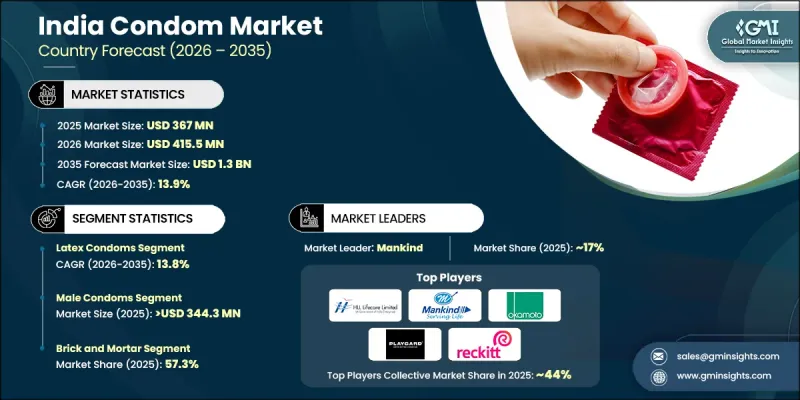
India Condom Market was valued at USD 367 million in 2025 and is estimated to grow at a CAGR of 13.9% to reach USD 1.3 billion by 2035.
Growth in the India condom industry is supported by several evolving social and healthcare trends. Increasing public awareness around reproductive health and contraception is encouraging wider adoption of protective products. Greater affordability and improved availability across urban and rural regions are also helping expand market reach. At the same time, shifting social attitudes toward sexual health and personal well-being are influencing consumer behavior. Growing emphasis on gender equality in contraceptive responsibility is further strengthening demand. Public health institutions and various social initiatives continue to focus on improving knowledge about safe sexual practices and reproductive health. Educational initiatives, broader healthcare access, and expanding retail distribution networks are contributing to improved accessibility. As conversations around sexual wellness become more open and socially accepted, the India condom market is expected to maintain strong momentum in the coming years.
| Market Scope | |
|---|---|
| Start Year | 2025 |
| Forecast Year | 2026-2035 |
| Start Value | $367 Million |
| Forecast Value | $1.3 Billion |
| CAGR | 13.9% |
A condom is defined as a protective barrier device used during sexual activity to lower the risk of sexually transmitted infections and prevent unintended pregnancies. These products are commonly manufactured using flexible protective materials designed to create a physical barrier during intercourse. Condoms are designed for use by both men and women and serve as an important component of reproductive health protection. Awareness campaigns conducted by public health organizations and advocacy groups have played an important role in increasing public understanding of safe sex practices and contraception. Large-scale awareness initiatives have significantly improved accessibility to contraceptive products across different population groups. Programs focused on improving reproductive health literacy have helped reduce stigma associated with purchasing and using condoms, particularly in rural and semi-urban communities.
The latex condoms segment is expected to grow at a CAGR of 13.8% to reach USD 1.2 billion by 2035. Latex is widely recognized for its elasticity, durability, and protective effectiveness, which makes it a preferred material for manufacturing condoms. The material provides reliable protection against unintended pregnancies and sexually transmitted infections when used properly. Latex condoms are offered in numerous variations that cater to changing consumer preferences and comfort expectations. Manufacturers regularly introduce new product designs and textures to enhance user experience, which continues to stimulate consumer interest and drive product sales. In addition, latex is derived from natural rubber and is biodegradable, which aligns with the increasing consumer interest in environmentally responsible products. This environmental advantage further supports the rising demand for latex-based condoms within the India condom industry.
The male condom segment reached USD 344.3 million in 2025. Male condoms are widely recognized as an effective barrier contraceptive method that helps reduce the risk of both unintended pregnancies and sexually transmitted infections when used consistently and correctly. Public health awareness programs that focus on safe sexual practices continue to promote the use of male condoms as a reliable preventive solution. In addition, male condoms remain one of the most affordable contraceptive products available, which helps ensure accessibility for a wide range of consumers across different income groups. The extensive availability of these products through pharmacies, retail stores, automated vending channels, and digital commerce platforms further supports consumer convenience and market penetration. Their continued role in national health awareness campaigns aimed at promoting responsible sexual behavior and reproductive health also contributes significantly to sustained product demand.
Key companies operating in the India Condom Market include CORAL, CUPID, Godrej Consumer Products, HLL Lifecare Limited, Mankind, Okamoto, PLAYGARD, Reckitt, Redcliffe Hygiene, SIRONA, SKYN, and TTK Healthcare. Companies active in the India Condom Market are implementing a variety of strategic initiatives to strengthen their competitive position and expand consumer reach. Many manufacturers are investing in product innovation by introducing new materials, improved designs, and enhanced comfort features to differentiate their offerings. Branding and targeted marketing campaigns aimed at younger demographics are also helping companies increase product visibility and consumer engagement. Expanding distribution channels through retail stores, pharmacies, online platforms, and automated dispensing machines allows companies to improve product accessibility across both urban and rural markets. In addition, partnerships with healthcare organizations and awareness initiatives focused on reproductive health education help reinforce brand credibility.
Table of Contents
Chapter 1 Methodology and Scope
- 1.1 Research approach
- 1.2 Quality commitments
- 1.2.1 GMI AI policy & data integrity commitment
- 1.2.1.1 Source consistency protocol
- 1.2.1 GMI AI policy & data integrity commitment
- 1.3 Research trail & confidence scoring
- 1.3.1 Research trail components
- 1.3.2 Scoring components
- 1.4 Data collection
- 1.4.1 Partial list of primary sources
- 1.5 Data mining sources
- 1.5.1 Paid sources
- 1.5.1.1 Sources, by country
- 1.5.1 Paid sources
- 1.6 Forecast calculations
- 1.6.1 Forecast calculation for any one approach
- 1.7 Forecast model
- 1.7.1 Quantified market impact analysis
- 1.7.1.1 Mathematical impact of growth parameters on forecast
- 1.7.1 Quantified market impact analysis
- 1.8 Research transparency addendum
- 1.8.1 Source attribution framework
- 1.8.2 Quality assurance metrics
- 1.8.3 Our commitment to trust
Chapter 2 Executive Summary
- 2.1 Industry 3600 synopsis
- 2.2 Key market trends
- 2.2.1 Country trends
- 2.2.2 Material trends
- 2.2.3 Category trends
- 2.2.4 Distribution channel trends
- 2.3 CXO perspectives: Strategic imperatives
Chapter 3 Industry Insights
- 3.1 Industry ecosystem analysis
- 3.2 Industry impact forces
- 3.2.1 Growth drivers
- 3.2.1.1 Increase in awareness levels and emphasis on safe sex practices
- 3.2.1.2 Significant rise in online condom purchases
- 3.2.1.3 Rising awareness about sexually transmitted infections (STIs)
- 3.2.1.4 Increased product availability and affordability
- 3.2.2 Industry pitfalls and challenges
- 3.2.2.1 Social stigma and side effects associated with materials used in condoms
- 3.2.3 Market opportunities
- 3.2.3.1 Rapid expansion of e-commerce and quick-commerce platforms is accelerating discreet, convenient condom purchases.
- 3.2.1 Growth drivers
- 3.3 Growth potential analysis
- 3.4 Regulatory landscape
- 3.5 Pricing analysis, 2025 (Driven by primary research)
- 3.6 Consumer preference analysis (Driven by primary research)
- 3.7 Brand analysis
- 3.8 No. of units of condoms sold in India, 2022-2035
- 3.9 Technology landscape
- 3.9.1 Current technological trends
- 3.9.2 Emerging technologies
- 3.10 Gap analysis
- 3.11 Impact of AI and generative AI on the market
- 3.12 Porter's analysis
- 3.13 PESTEL analysis
- 3.14 Future market trends
Chapter 4 Competitive Landscape, 2025
- 4.1 Introduction
- 4.2 Introduction
- 4.3 Company matrix analysis
- 4.4 Company market share analysis
- 4.5 Competitive positioning matrix
- 4.6 Competitive analysis of major market players
- 4.7 Key developments
- 4.7.1 Mergers & acquisitions
- 4.7.2 Partnerships & collaborations
- 4.7.3 New product type launches
- 4.7.4 Expansion plans
Chapter 5 Market Estimates and Forecast, By Material, 2022 - 2035 ($ Mn)
- 5.1 Key trends
- 5.2 Latex condoms
- 5.3 Synthetic condoms
- 5.3.1 Polyurethane
- 5.3.2 Polyisoprene
- 5.3.3 Nitrile
Chapter 6 Market Estimates and Forecast, By Category, 2022 - 2035 ($ Mn)
- 6.1 Key trends
- 6.2 Male condom
- 6.3 Female condom
Chapter 7 Market Estimates and Forecast, By Distribution Channel, 2022 - 2035 ($ Mn)
- 7.1 Key trends
- 7.2 Brick and mortar
- 7.2.1 Pharmacies
- 7.2.2 Convenience stores
- 7.2.3 Supermarkets and hypermarkets
- 7.3 E-commerce
- 7.4 Other distribution channels
Chapter 8 Company Profiles
- 8.1 CORAL
- 8.2 CUPID
- 8.3 godrej Consumer Products
- 8.4 HLL Lifecare Limited
- 8.5 Mankind
- 8.6 okamoto
- 8.7 PLAYGARD
- 8.8 reckitt
- 8.9 Redcliffe Hygiene
- 8.10 SIRONA
- 8.11 SKYN
- 8.12 TTK Healthcare

